Sustainability & Energy
De-Icing Solutions for California Facilities: What Works
January 28, 2026
If you manage a building with a tenant cafeteria, a shared break room, or even just a handful of micro-kitchens on each floor, you already know where your diversion numbers actually get made or lost: the organics stream. Cardboard and mixed paper are easy. Employees have been trained on blue bins since elementary school. Food scraps, coffee grounds, compostable serviceware, and the greasy napkin that gets tossed on top of all of it: that's the stream that determines whether your facility clears California's 75% diversion mandate or quietly falls short every quarter.
SB 1383, the state's mandatory organics recycling law, has been enforceable since 2022, but enforcement in Santa Clara and San Mateo counties has tightened considerably over the past eighteen months. Local jurisdictions are now conducting waste-generator inspections, and haulers are contractually required to report contamination rates back to the jurisdiction: not just to you. A facility that was quietly non-compliant in 2023 is now a facility with a paper trail.
This post is a deep dive into the operational side of organics diversion: what actually breaks in commercial kitchens and break rooms, what equipment and signage genuinely change behavior, and what MAFM does differently when we take over waste programs for tenants who've been failing their audits.
Every hauler that services a Silicon Valley office park or life sciences campus runs contamination audits on the organics stream, typically by hand-sorting a sample load at the transfer station. The threshold most jurisdictions and haulers use to flag a load as "contaminated" is around 10-25% by volume, depending on the county and the specific franchise agreement. Once a load crosses that line, the hauler can reject it, charge a contamination fee, or, worse for your compliance record, redirect it to landfill and report the tonnage as such.
The most common contaminants we find in Silicon Valley break room and cafeteria organics bins are not exotic. They're plastic-lined coffee cups that look compostable but aren't (certified compostable cups require BPI certification, and most vendor-supplied cups don't have it), single-use plastic cutlery mixed in with food scraps, and "compostable" bags that are actually just green-tinted conventional plastic. A single vendor switch in the cafeteria's disposable packaging, done without notifying facilities, can push contamination rates from 8% to 30% in one billing cycle.
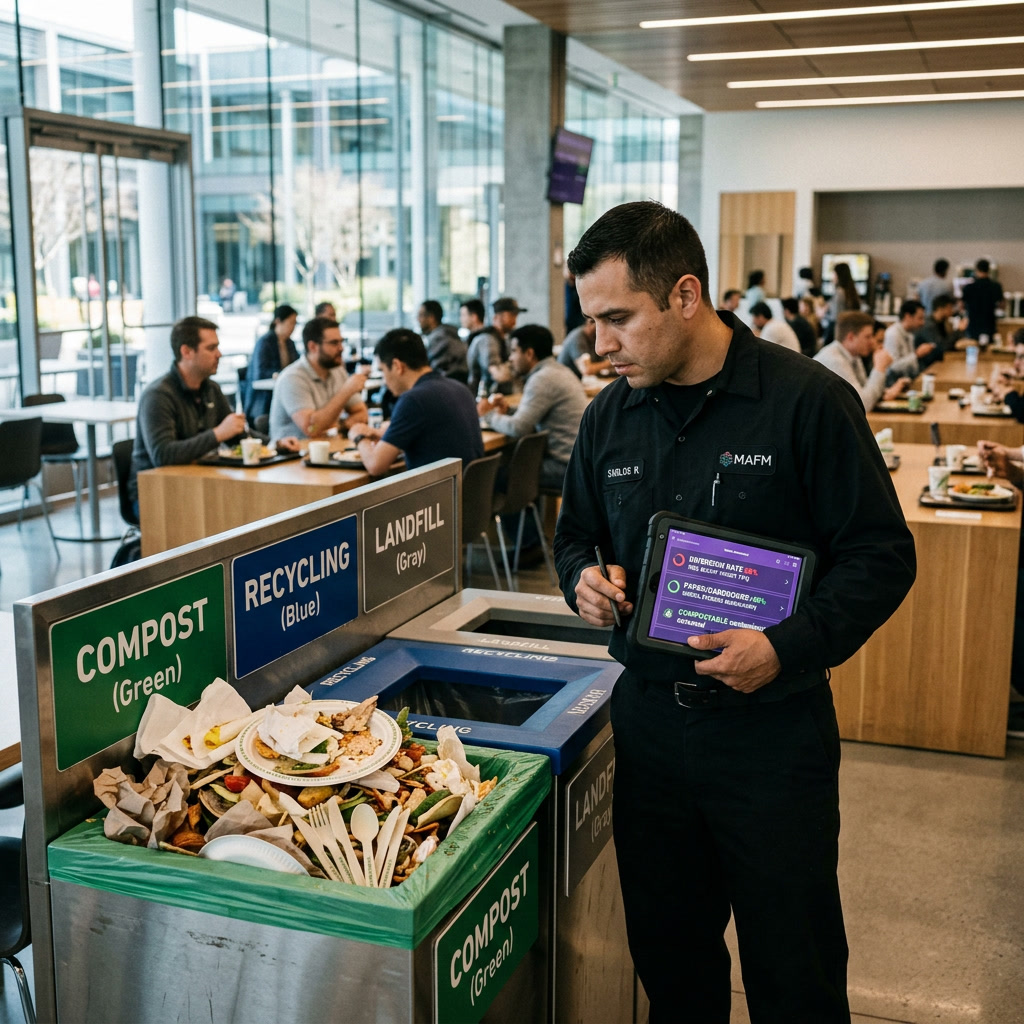
The second-biggest contributor is bin confusion at the point of disposal. In a typical multi-tenant floor with a three-stream setup (landfill, recycling, organics), employees make the sorting decision in under two seconds while carrying a tray. If the organics bin doesn't have a lid cutout shaped specifically for food scraps, or if it sits next to a landfill bin with an identical lid, contamination climbs regardless of signage. We've measured this directly: floors where we swapped to color-coded, differently-shaped lid openings saw contamination drop by roughly a third within 60 days, with no other change to the program.
The physical station matters more than most facility teams budget for it. A functional three-stream station needs matched-height bins so nothing looks like an afterthought, distinct lid geometries (a round hole for landfill, a slot for recycling, a wide flap for organics), and consistent color coding across every floor and every kitchen: gray/black for landfill, blue for recycling, green for organics, matching CalRecycle's statewide color standard. If your building has a mix of legacy bins from three different office moves over the past decade, that inconsistency alone is likely costing you diversion points.
Signage needs to be photographic, not text-based, and it needs to be specific to what actually gets served in that building. A generic "compost here" graphic with a stock photo of a banana peel does nothing for an employee holding a half-eaten poke bowl in a compostable container with a plastic fork stuck in it. We build signage using photos of the actual packaging used by the building's specific cafeteria vendor or the most common delivery services tenants order from: DoorDash containers, the coffee vendor's cup, the specific bakery box from the ground-floor tenant. It's more work upfront, and it's the difference between signage employees glance at once and signage that changes behavior for two years.
Back-of-house matters just as much as the public-facing stations. Kitchen staff and janitorial crews need a designated organics collection point that's separate from general trash, ideally with a smaller-capacity, frequently-emptied bin near the prep and dish areas, because organics left sitting for a full shift attracts pests and creates the odor complaints that get an entire program shut down by a frustrated property manager. We typically recommend organics pickup from back-of-house at least twice daily in any facility running a hot cafeteria line.
Most facility managers inherit their hauler contract rather than negotiate it, and that's where compliance risk quietly accumulates. Under SB 1383, your jurisdiction requires documentation showing your organics collection service level is adequate for your generation volume: meaning if your cafeteria serves 400 people a day but your organics bin is a single 64-gallon cart picked up twice a week, you are, on paper, non-compliant regardless of how well tenants sort. Service level adequacy is one of the first things a jurisdictional inspector checks, and it's a documentation gap we find constantly when we audit a new client's existing program.
You also need to confirm your hauler is actually routing your organics load to a permitted composting or anaerobic digestion facility, not to a mixed materials recovery facility that pulls organics out downstream (or doesn't). Ask your hauler for the specific facility name and permit number your organics loads are delivered to, and get it in writing as part of your annual documentation. Santa Clara County's Recycling and Waste Reduction division and San Mateo County's RethinkWaste program both require this documentation be available on request, and "our hauler handles that" is not an acceptable answer during an inspection.
Contamination fee structures also deserve a second look. Many hauler contracts charge escalating contamination fees per load rather than a flat rate, and facilities that don't track which loads got flagged often don't realize they're paying $150-$400 per contaminated pickup until the annual waste spend review. We've had clients discover retroactively that a single tenant's catering vendor was responsible for the majority of a building's contamination fees over an entire year, simply because no one was checking load-level hauler reports against move-in/move-out and event calendars.
California's 75% diversion mandate isn't self-enforcing at the building level: it gets verified through waste characterization studies, jurisdictional inspections, and hauler-reported contamination data, and the facilities that pass consistently are the ones that can produce records on demand. That means maintaining monthly tonnage reports by stream, contamination incident logs from your hauler, signage and bin photos with install dates, and a training record showing when janitorial and kitchen staff last received organics sorting instruction.
Training needs to happen at onboarding for janitorial staff and cafeteria vendor employees, not as an annual refresher buried in a compliance binder. New hires in food service roles turn over frequently in Silicon Valley's contracted cafeteria model, and a crew that wasn't trained on the building's specific bin setup will default to whatever habits they learned at their last job site. We build a five-minute walk-through into every new staff member's first shift: here's the organics bin, here's what goes in it, here's what doesn't, here's who to call if a vendor's packaging changes.
The most effective single practice we've implemented across Silicon Valley cafeteria accounts is a quarterly visual audit: someone physically opens the organics bin before pickup, photographs the contents, and flags contamination sources by tenant or vendor before the hauler ever sees the load. Catching a packaging problem internally costs you a conversation with a vendor. Catching it via a hauler contamination fee or a jurisdictional inspection costs you money and puts your facility on a watch list.
The 75% diversion mandate gets discussed at the policy level in tons and percentages, but at the building level it's decided by bin lid shapes, signage photos, hauler documentation, and whether a new coffee vendor's cups are actually BPI-certified. Organics is the stream where Silicon Valley facilities lose the most ground, precisely because it's the stream most dependent on human behavior at the point of disposal rather than on equipment alone.
Facilities that treat organics diversion as a one-time bin installation rather than an ongoing operational program are the ones showing up in contamination reports a year later, wondering why their diversion rate dropped despite "having a composting program." The fix isn't complicated, but it does require someone checking the details regularly: which is exactly the gap a dedicated facilities management partner is built to close.
If your building's organics diversion numbers have been sliding or you've never actually seen your hauler's contamination reports, MAFM can run a full waste stream audit and rebuild your three-stream program from the bin up: contact us to schedule a facility walkthrough.
Link to earlier posts in this week's Recycling and Waste Diversion series covering the overall 75% diversion mandate landscape and California's compliance requirements, as well as any prior MAFM content on tenant communication strategies for sustainability programs.
CalRecycle's SB 1383 regulations page (calrecycle.ca.gov) and Santa Clara County's Recycling and Waste Reduction program guidance for commercial generators.
MAFM offers comprehensive facility management solutions tailored to your business needs.
Get in Touch