Business Development
How Facility Management Quality Became a Leasing Amenity in Silicon Valley
July 20, 2026
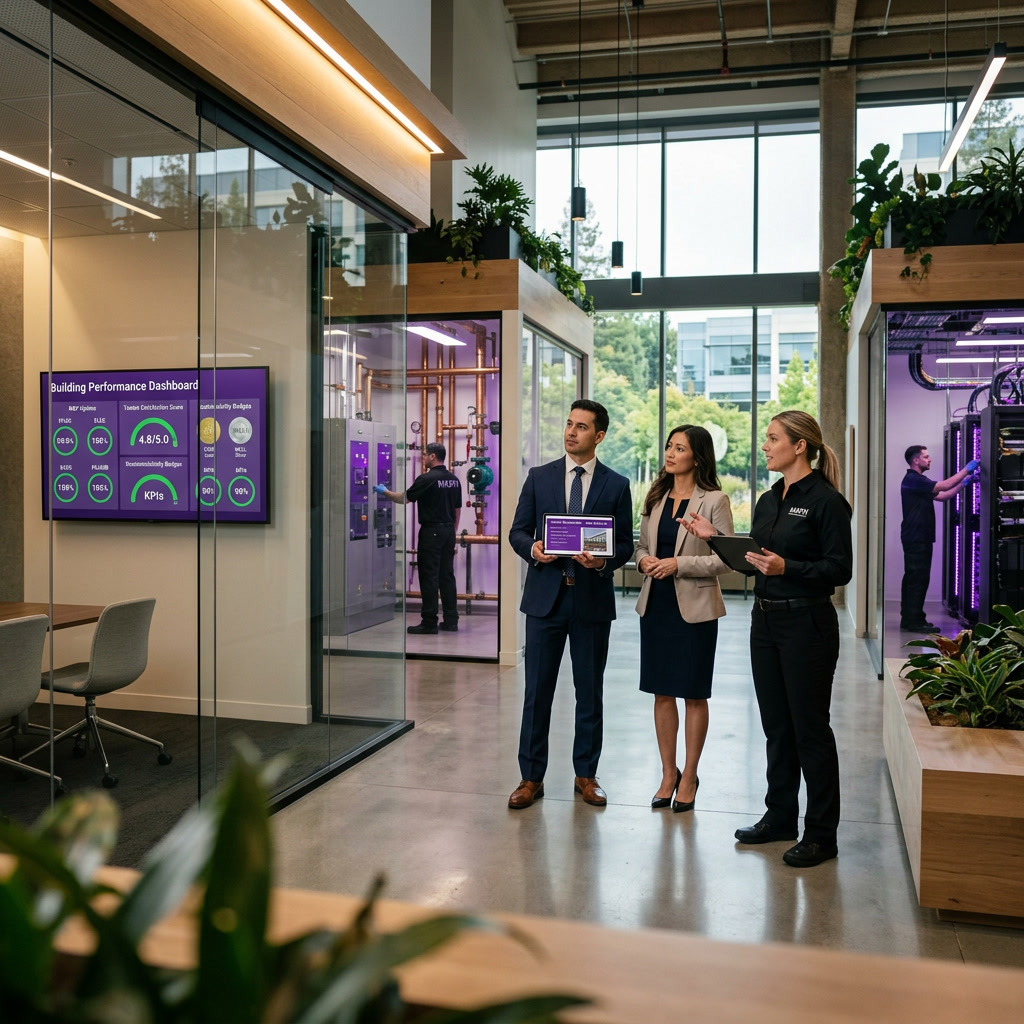
This week we've made the case, piece by piece, that facilities management is no longer a back-office cost center you mention in passing during a leasing pitch. It's a marketing asset. Earlier this week we walked through how mechanical, electrical, and plumbing performance data becomes leasing collateral, how tenant experience amenities separate Class A buildings from Class A-adjacent ones, how sustainability certifications translate into rent premiums, and how facility staff professionalism shows up in tenant satisfaction scores that brokers now ask about before they ask about parking ratios.
The problem we hear most from property owners and facility directors in Santa Clara, San Mateo, and Alameda counties isn't disagreement with the premise, it's not knowing where to start. Should you chase LEED recertification first? Retrain the janitorial contractor? Rebuild the tour deck? The answer depends on your building, your submarket, and your renewal calendar, but the sequencing matters more than most teams assume. Do the wrong thing first and you spend budget on a certification plaque nobody notices, while your HVAC still short-cycles during the exact hour a prospective tenant's CFO walks the floor.
This post is the synthesis: a practical roadmap that takes everything covered this week and puts it into a 90-day sequence you can actually execute, whether you self-manage a single building on El Camino Real or oversee a portfolio spread across three cities.
Before you market anything, you need an honest inventory, and this is where most property teams skip a step. Pull your last 18 months of work orders and sort them by category: emergency repairs, preventive maintenance completions, tenant complaints, and vendor response times. If more than 15% of your ticket volume is emergency/reactive rather than scheduled, that's a data point a competing property won't have to disclose, and it's exactly the kind of thing that surfaces in a tenant reference call during lease negotiations.
Next, walk the building with fresh eyes, ideally alongside your broker or leasing team, and score it the way a prospective tenant's ops director would: lobby condition, restroom finishes, elevator wait times during peak, loading dock organization, EV charging availability, air quality reporting (a question we're getting weekly now post-2023 wildfire seasons). Document this with photos and timestamps. This becomes your baseline.
Finally, benchmark your utility and maintenance costs against BOMA's Experience Exchange Report data for comparable Silicon Valley office or industrial product. If your energy use intensity is 20% above the median for your building type, that's not just an operating expense problem, it's a marketing liability once tenants start asking for Scope 2 emissions data as part of their own ESG reporting, which is increasingly common among biotech and semiconductor tenants renewing 20,000+ square foot leases.
With the audit done, prioritize fixes by tour visibility and cost, not by what's easiest for your vendors. A broken lobby directory or a stained ceiling tile in the elevator lobby costs almost nothing to fix and kills momentum in the first 90 seconds of a tour. Handle these in week four, full stop.
Then move to systems that affect comfort during a tour but aren't visible, rooftop unit performance, VAV box calibration, restroom exhaust fans. If your building has had recurring hot-cold complaints on specific floors, get those zones recalibrated before you schedule broker previews for that space. We've seen deals stall not because of rent but because a prospective tenant's facilities lead noticed a thermostat reading 4 degrees off from the room's actual temperature and asked what else wasn't being monitored.
This is also the window to address the staffing visibility issue we covered earlier this week. If your janitorial or engineering staff aren't in uniform, aren't wearing badges, or aren't briefed on how to interact with tour groups, fix that now. A facilities team that looks organized and responsive during a walk-through is doing marketing work whether anyone labels it that way or not.
Once the physical building matches the standard you're marketing, build the paper trail that supports it. This means assembling a facilities performance packet for leasing: preventive maintenance completion rates, average work order response time, energy performance (Energy Star score if you have one, or a clear trend line if you don't), water usage, and any certifications in progress, LEED, WELL, ENERGY STAR, or Fitwel.
Pair this with a simple one-page "building operations summary" your leasing team can hand to brokers alongside the standard marketing flyer. Most flyers lead with square footage and parking ratio. Almost none mention that the building runs on a CMMS with 94% on-time PM completion, or that indoor air quality is monitored continuously and reported quarterly. In a submarket where tenants are comparing three similar buildings on rent and TI allowance, this packet becomes the tiebreaker, particularly for tenants in life sciences, semiconductor, or any regulated industry where their own compliance teams will ask these questions eventually anyway.
If you're pursuing a certification, and this is worth saying plainly, don't wait for the plaque to start marketing the effort. Buildings actively pursuing LEED or Energy Star recognition can talk about that trajectory in leasing conversations now, as long as you're transparent about timeline. Tenants signing five- to ten-year leases care more about the direction you're heading than the certificate on the wall today.
The last phase is often skipped entirely: making sure everyone who touches a prospective tenant (leasing agents, property managers, facility engineers, even the security desk) can speak to the same facts consistently. Run a 30-minute briefing with your leasing team covering the operations summary, the top three building differentiators, and how to answer the questions tenants are actually asking now (EV charging capacity, backup power for critical loads, air filtration MERV rating, sustainability roadmap).
Then close the loop with your broker relationships. Send an updated tour script and building fact sheet directly to the brokers who represent tenants in your target size range. Brokers show buildings that make their job easier, where the story is clear, the building matches the story, and the facility team doesn't create surprises mid-tour. This is also the point to schedule a quarterly cadence: every three months, update the operations packet with fresh metrics, so the story stays current instead of going stale six months after you built it.
Finally, measure it. Track tour-to-LOI conversion rate before and after this initiative, and track tenant retention at renewal for buildings where you've implemented the full packet versus ones where you haven't. Facilities-driven marketing is one of the few FM investments where you can directly connect the spend to a leasing outcome, and having that data makes the case for renewing the budget next year.
None of this requires a new department or a six-figure consulting engagement. It requires treating your facilities operation as evidence, evidence that a prospective tenant's ops team can verify, that a broker can repeat confidently, and that a CFO can defend when comparing your building against two others in the same three-mile radius. The buildings winning renewals and premium rents across Silicon Valley right now aren't necessarily the newest ones. They're the ones where facilities management and leasing strategy stopped operating in separate silos.
Start the 90-day sequence with the audit. Everything else on this list depends on knowing, specifically and honestly, what condition your building is actually in before you decide what story you're ready to tell.
If you want an outside team to run this audit objectively, and build the operations packet your leasing team can start using next quarter, MAFM's facility assessment services are built for exactly this handoff between operations and leasing. Contact us to scope a 90-day facilities marketing audit for your property.
Reference earlier posts in this week's Property Marketing & Competitive Positioning series, the MEP performance data/leasing collateral post, the tenant experience amenities post, the sustainability certification/rent premium post, and the facility staff professionalism post, as the source material this roadmap consolidates.
BOMA International's Experience Exchange Report (benchmarking data); ENERGY STAR Portfolio Manager (building performance scoring and certification pathway).
July 20, 2026
July 21, 2026
July 22, 2026
MAFM offers comprehensive facility management solutions tailored to your business needs.
Get in Touch