Technology & Operations
AI Facility Management: What It Can Do for Response Times
January 21, 2026
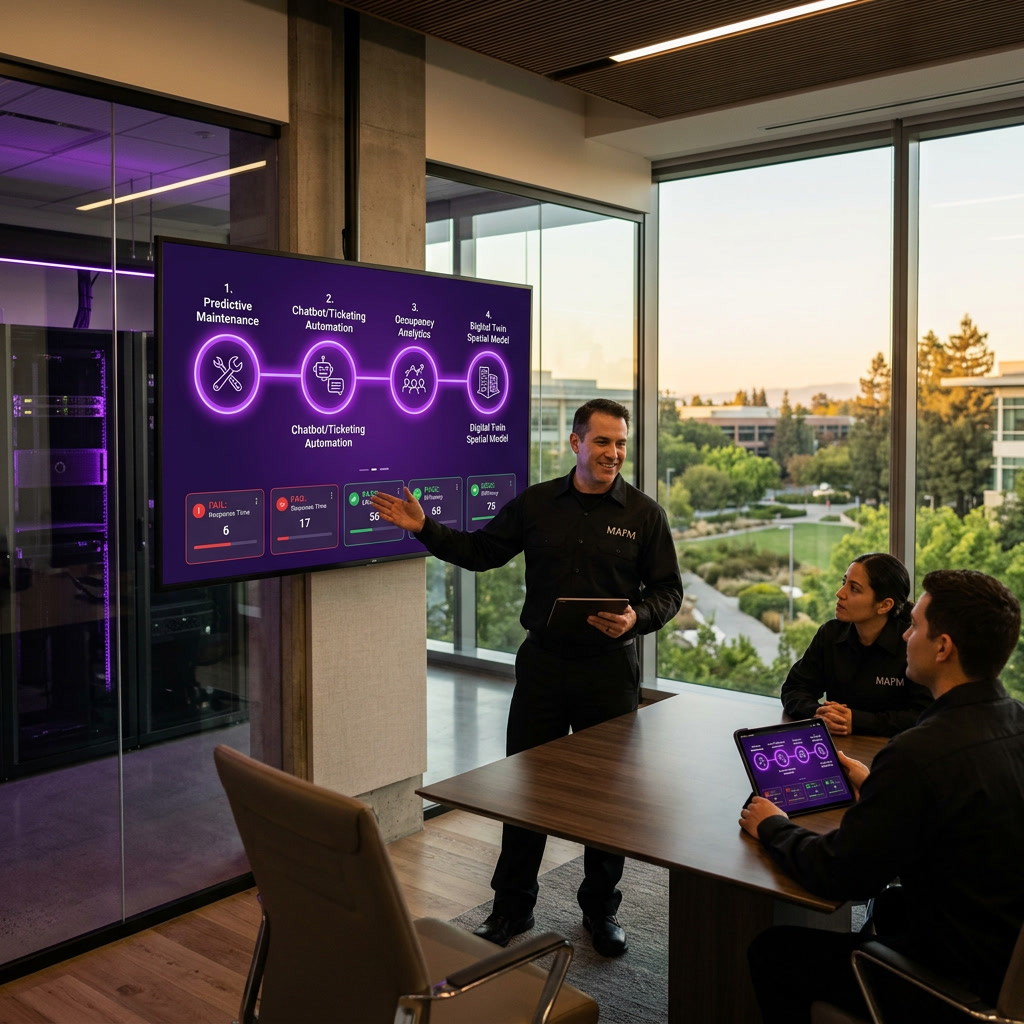
A facility AI adoption roadmap should start with the capability your building's data can already support, not the one with the best vendor demo. For most buildings that means starting with tenant service and work order tools, moving to predictive maintenance and occupancy analytics once building automation and maintenance records are usable, and leaving a digital twin for last.
The order matters because each tool depends on data the one before it produces. Teams that skip the data work end up with a dashboard nobody trusts. The sections below give a readiness check, a sequence, a way to build the budget case and the pitfalls to plan for.
Check three things first: whether your building automation system (BAS) can share data, how complete your maintenance records are, and who the tool will touch. Each one decides which capability is realistic now and which has to wait.
Write down what you find for each system. That list becomes the basis for the sequence below.
Start with the one that depends least on building systems, which is usually tenant service and work order automation. It can run on its own request channel and ticketing data, so it does not wait on BAS integration.
A sensible order for most buildings:
This sequence is a default, not a rule. If your BAS is already open and your CMMS is clean, predictive maintenance may be the right first move.
Fault detection and diagnostics (FDD) is the closest real-world evidence for building analytics, and it shows both the payoff and the conditions. The Department of Energy's Smart Energy Analytics Campaign reported, in a 2019 Lawrence Berkeley National Laboratory analysis of 96 commercial organizations, a median energy saving of 4% for energy information systems and 9% for FDD software after two years, with a one to two year simple payback.
Read that with its caveat. DOE notes the savings cannot be attributed only to the analytics, because they are measured at the whole building level and other projects may have been running at the same time.
The more useful lesson is in how one participant ran it. The University of Iowa's recognized FDD program (2017 to 2018) tested the approach in a one-building pilot before rolling out to 20 buildings. It moved BAS point tagging and rule setup into the vendor's scope after the pilot showed that work was time consuming. It also integrated FDD output with its work order system and met daily to prioritize what the software flagged. The campaign write-up calls that integration key to its success.
Those are habits any facility team can copy at any scale: pilot small, push the tedious data work to the vendor, and make sure alerts become work orders with an owner.
Tie each pilot to one measurable outcome you can name before you start, and measure the same thing afterward. A general "smart building" pitch is hard to defend; a specific before and after is not.
Our guide to smart building technology for mid-size properties covers the cost side in more detail.
The main risks are privacy, vendor lock-in, unreviewed alerts and treating a tool as a decision maker. Plan for each before purchase.
Privacy. If a tool collects personal information, such as camera-based occupancy counting, California's privacy rules can apply. The California Privacy Protection Agency says a business must give a notice at collection at or before the point it collects personal information, that notice can be given through prominent signage for cameras, and that employees are covered by the CCPA. Ask counsel which rules apply to your tenants and staff, and prefer sensors that count people without identifying them.
Governance. NIST's AI Risk Management Framework organizes the work into govern, map, measure and manage. Several of its actions translate directly to a facility team: keep an inventory of AI systems, document who is responsible for each, consider "viable non-AI alternative" approaches, and have a way to deactivate a system whose performance does not match its intended use.
Lock-in. Evaluate a vendor on how openly it connects to the rest of your stack, not only on its standalone features. Ask what data you can export and in what format.
Adoption. A maintenance alert nobody reviews delivers nothing. Budget training time and name who reads each output, which is exactly what Iowa's daily review meeting did.
Judgment. These tools inform the people who run the building. They do not replace them.
Only after live, trusted data feeds exist from your BAS, work order system and occupancy sensors. NIST describes a digital twin as a computer model of a physical system, such as a machine or building, and says its use depends on forecasting: simulation, monitoring, optimization and decision support all rely on models that predict future states. NIST's own program focuses on manufacturing, so treat claims about benefits in other settings with caution.
A twin built on stale or partial data becomes a decorative 3D model. Build it last, and start with one system, such as a single floor or chiller plant, before attempting a whole building.
What is the first AI project a facility team should try?
Usually tenant request triage and work order routing, because it needs the least integration with building systems. If your BAS is open and your maintenance records are clean, a predictive maintenance pilot on one asset class can come first instead.
How much can building analytics save?
DOE's Smart Energy Analytics Campaign reported a median energy saving of 9% for FDD software and 4% for energy information systems after two years, in a 2019 analysis of 96 organizations. Savings were measured at the whole building level, so they cannot be credited to the software alone, and your results will vary.
Do cameras for occupancy analytics need a privacy notice in California?
Possibly. The California Privacy Protection Agency says a notice at collection is required when personal information is collected and that signage can serve for cameras, and employees are covered. Confirm the details for your setup with counsel.
Do we need a CMMS before using AI tools?
Not for tenant service tools, but predictive maintenance and digital twins depend on a reliable asset list and repair history. If your records are thin, fix them first.
A roadmap works when someone owns the sequence, the vendors and the baseline data. MAFM is a San Jose facilities management company that can coordinate your technology vendors, set up the work order and walkthrough routines that feed these tools, and keep the schedule honest. Talk to us about facility management.
MAFM offers comprehensive facility management solutions tailored to your business needs.
Get in Touch