Sustainability / Compliance
Scope 1, 2, and 3 Emissions Reporting: What Silicon Valley Building Owners and Facility Managers Must Know Now
May 20, 2026
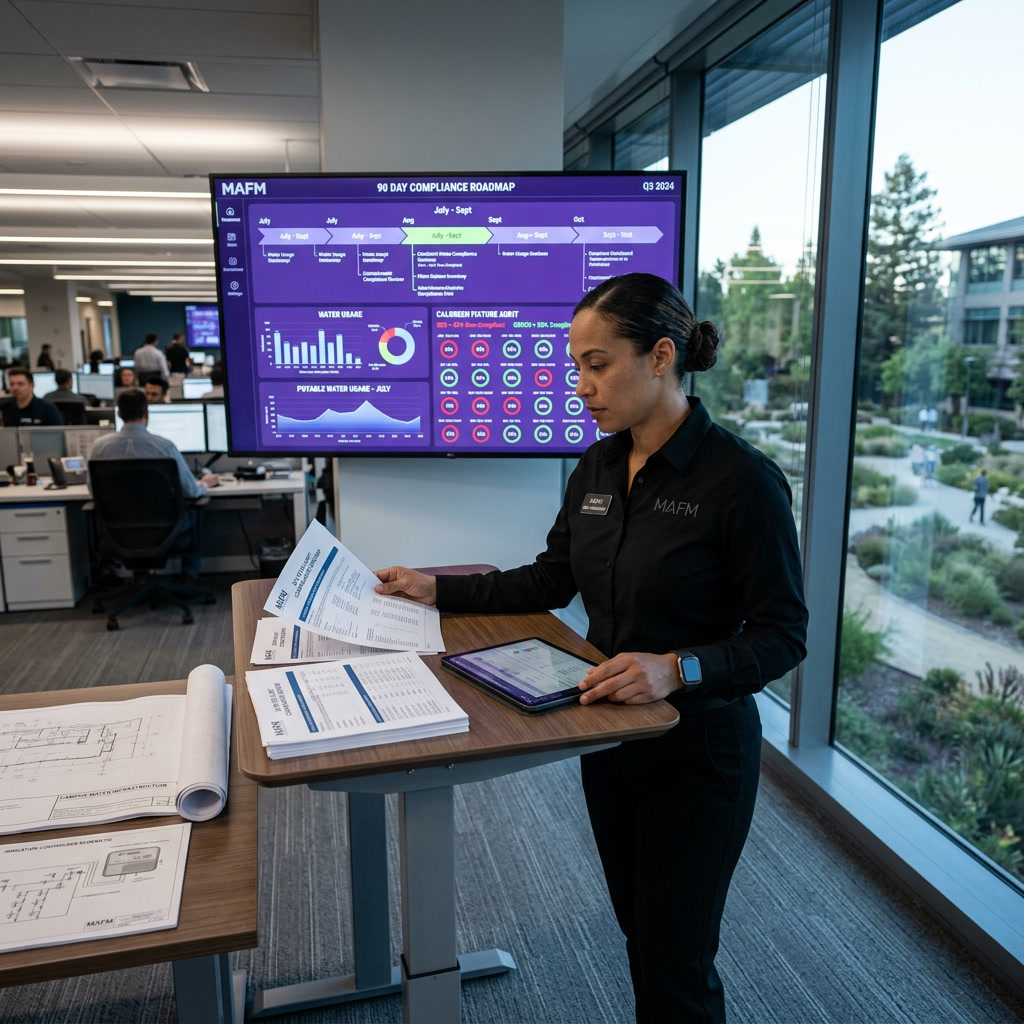
Over the past four posts, we've walked through the mechanics of a CalGreen-aligned water audit — from reading your Santa Clara Valley Water Board tier data against Section 5.303 fixture thresholds, to spotting irrigation overwatering on smart controllers that were never actually reprogrammed after the last landscaper turnover, to calculating the real payback period on retrofitting a 40,000-square-foot office park's restroom fixtures. If you've been following along and pulled your own utility bills, submeter logs, or CalGreen checklist, you likely have a stack of findings sitting on your desk right now. That stack is only useful if it turns into a schedule.
This is the synthesis post. Rather than introducing new audit techniques, we're going to organize everything covered this week into a single 90-day action sequence that a facility manager can actually execute — one that accounts for vendor lead times, tenant notification requirements, capital approval cycles, and the reality that most Silicon Valley commercial properties can't take restrooms or landscape zones offline all at once. Think of this as the project plan that follows the diagnosis.
We'll also flag where drought-year urgency should override your normal replacement-cycle patience, because 2026 water allocation pressure from the Santa Clara Valley Water District means facilities that defer these fixes are increasingly exposed to both higher tiered rates and CalGreen enforcement during permit-triggered inspections.
Before any purchase order goes out, finish the baseline work from earlier this week: your fixture inventory against CalGreen Section 5.303 flow rate maximums (1.28 gallons per flush for toilets, 0.5 gpm for restroom faucets in most non-residential retrofits), your twelve-month water bill trend by tier, and your irrigation controller audit results. If you skipped the submetering step, install temporary data loggers on your two or three highest-consumption lines now — domestic water, cooling tower makeup, and irrigation mainline — because you need at least two weeks of logged data to validate any vendor's proposed savings numbers.
With that baseline in hand, rank findings into three tiers, not by dollar cost but by exposure. Tier one is anything already out of compliance with a current CalGreen threshold — pre-1994 toilets still running 3.5 gallons per flush, faucets without aerators, or irrigation systems lacking the weather-based controllers required for landscape areas over 500 square feet. Tier two is equipment technically compliant but underperforming, like WaterSense-labeled fixtures installed correctly but paired with pressure-reducing valves that were never calibrated after a recent water main upgrade. Tier three is optimization — greywater reuse feasibility, cooling tower conductivity controller upgrades, or drought-tolerant landscape conversions that pay back over three to five years rather than one.
This risk-based sorting matters because your first capital request should target tier one exclusively. Facility directors who lump all three tiers into one large proposal tend to get the whole package delayed while finance debates the tier-three payback math, when the tier-one items should have moved in week three regardless of budget cycle timing.
Restroom fixture replacement is the fastest-payback item from this week's audits, typically returning capital in 14 to 22 months on a mid-size office building, but it's also the most disruptive to tenants if sequenced poorly. The practical approach we recommend to our multi-tenant clients across the Peninsula and South Bay is floor-by-floor rotation rather than building-wide shutdown: complete one floor's restrooms in a single overnight-to-weekend window, verify function Monday morning before crews move to the next floor, and notify tenants 5-7 business days ahead with exact restroom closure windows posted at elevator lobbies.
Order lead times matter more than most facility managers expect going into this. WaterSense-certified 1.28 gpf toilets and 0.5 gpm faucet aerators are generally in stock from major distributors, but ADA-compliant flush valve kits and the specific mounting hardware needed for older Kohler or American Standard installations from 1990s-era buildouts can run 3-4 week backorders, especially when every Silicon Valley property is retrofitting simultaneously ahead of drought-year rate increases. Place your fixture order in week three even if your capital approval is still finalizing labor contracts, because a facility sitting on approved capital with fixtures stuck on backorder loses the whole sequencing advantage.
For properties with cooling towers — a category we haven't discussed as heavily this week but that shows up in almost every mid-rise office and lab building's water bill — this is also the window to schedule your conductivity controller calibration. A cooling tower running at 3 cycles of concentration instead of an achievable 6 cycles can waste 20,000 to 40,000 gallons monthly on a modest 200-ton system, and recalibration is typically a half-day service call, not a capital project.
If your audit turned up irrigation controllers running on factory default schedules — which our field teams find in roughly one of every three properties we assess, usually after a landscape vendor change where nobody reprogrammed the new controller — this is the cheapest fix in your entire roadmap. Reprogramming a weather-based controller to actual site conditions costs nothing but labor time and typically cuts landscape water use 15-30% immediately, with results visible on the very next billing cycle.
Beyond reprogramming, weeks six through eight should cover physical irrigation repairs: broken or misaligned sprinkler heads causing runoff onto pavement (a CalGreen and often municipal code violation independent of water waste), drip line conversions for shrub and groundcover beds currently on overhead spray, and check valve installation on any zones on sloped terrain where water continues draining from pipes after cycles end. These are typically $150-$400 per zone repairs rather than major capital items, which means they can often move forward on operating budget without the approval delay tier-one fixture work requires.
For properties considering the larger landscape conversion projects flagged as tier-three optimization — replacing turf with drought-tolerant plantings — this window is also when to apply for Santa Clara Valley Water District's landscape rebate program if you haven't already, since rebate funds are allocated on a first-come basis each fiscal year and applications typically require pre-conversion photos and a landscape plan before work begins, not after.
The step facility managers most often skip is documentation, and it's the one that matters most when a CalGreen inspection or tenant improvement permit triggers a records request. For every fixture replaced, retain the manufacturer's WaterSense certification or flow rate spec sheet, the installation date, and photos of the installed nameplate — not just the invoice. Build this into a single compliance binder or shared drive folder organized by building system (restroom fixtures, irrigation, cooling tower, submeters) rather than by date, since that's how inspectors and future buyers' due diligence teams will want to review it.
Run your post-retrofit water bill comparison against the same twelve-month baseline you built in week one, adjusted for occupancy changes, and calculate actual gallons-per-occupant or gallons-per-square-foot reduction rather than relying on manufacturer-claimed savings percentages. This verified number is what supports any future CalGreen compliance narrative, LEED or Green Building certification renewal, or tenant sustainability reporting request — and Silicon Valley tenants, particularly tech companies with their own ESG disclosure requirements, increasingly ask property managers for exactly this kind of verified water performance data during lease renewals.
Finally, calendar your next audit for 10-11 months out rather than waiting for the next drought emergency declaration to force reactive action. Water rates and CalGreen thresholds both tend to tighten rather than loosen, and a property with an annual audit rhythm consistently gets ahead of tier changes that catch reactive owners off guard with rate shock.
A water audit that ends in a findings report accomplishes almost nothing. The value is entirely in the 90 days that follow — the sequencing decisions, the vendor lead-time management, and the documentation discipline that turns "we identified inefficiencies" into "we reduced consumption by 22% and can prove it." If this week's posts gave you the diagnostic tools, this roadmap is meant to give you the execution discipline, because in a drought year with tightening CalGreen enforcement, the properties that move on their findings within a quarter are the ones that avoid both the rate penalties and the compliance scramble.
If your team needs hands-on support sequencing fixture retrofits, calibrating irrigation controllers, or building a CalGreen-ready compliance file, MAFM's sustainability services team can manage the full 90-day process for your property — contact us to schedule a walkthrough before your next fiscal year budget cycle closes.
Reference earlier in the week's posts on reading CalGreen Section 5.303 fixture thresholds, diagnosing irrigation controller overwatering, and calculating restroom retrofit payback periods — link each as "earlier this week" callouts within Sections 1 and 2.
California Green Building Standards Code (CalGreen) Title 24, Part 11 official text via the California Building Standards Commission; Santa Clara Valley Water District's current water use restrictions and landscape rebate program page.
May 20, 2026
September 24, 2026
MAFM offers comprehensive facility management solutions tailored to your business needs.
Get in Touch