Budgets & Contracts
Reduce Facility Operating Costs in Silicon Valley, 2026
January 12, 2026
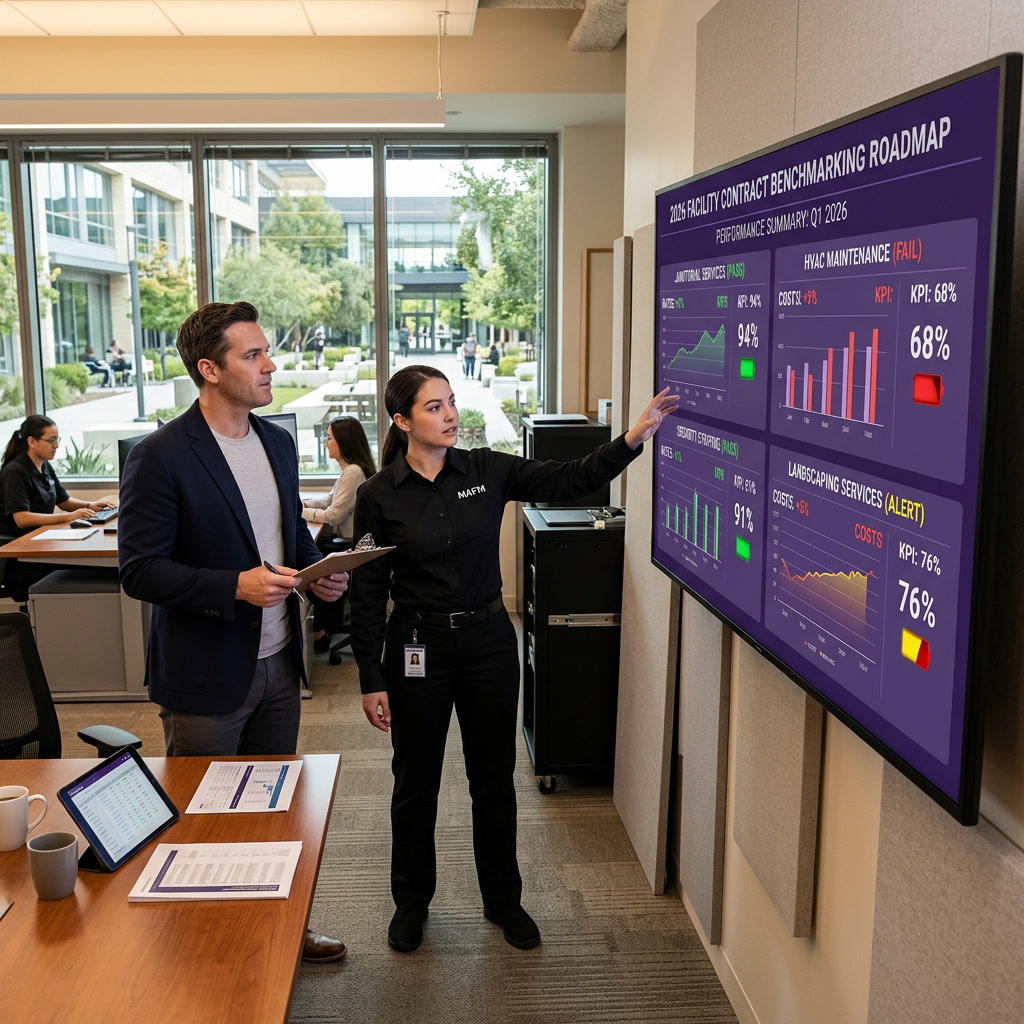
If you've been following along this week, you've seen us dig into the specific dollar figures behind janitorial rates, HVAC maintenance agreements, security staffing costs, and landscaping contracts across the Silicon Valley market in 2026. That's a lot of data to absorb in five days, and if you're like most facility directors we talk to, you probably read at least one of those posts thinking "okay, but what do I actually do with this on Monday?"
That's the point of this final post in the series. We're not introducing new pricing data today: we're pulling together the threads from earlier this week into a decision framework you can actually use. Benchmarking data is only useful if it changes what you do in your next vendor conversation, your next budget presentation to ownership, or your next RFP cycle. A spreadsheet full of market rates that sits in a shared drive doesn't save anyone money.
We've built facility budgets for properties from 40,000-square-foot flex/R&D buildings in Sunnyvale to 500,000-square-foot corporate campuses in San Jose, and the pattern is consistent: the properties overpaying by 15-20% aren't overpaying because their vendors are dishonest. They're overpaying because nobody has re-benchmarked the contract since it was signed, sometimes three or four years ago, against a labor market and materials market that has moved substantially. Here's how to close that gap.
Earlier this week we walked through janitorial rates (running $0.11-$0.16 per square foot per month for standard Class A office in Santa Clara and San Mateo counties as of Q3 2026), HVAC preventive maintenance agreements (typically $0.18-$0.28 per square foot annually depending on rooftop unit count and refrigerant type: R-410A systems now cost noticeably more to service given EPA phase-down schedules), security officer staffing (loaded hourly rates of $34-$42 for unarmed guards in this labor market, driven by California's minimum wage trajectory and the tight competition for reliable guard labor near tech campuses), and landscaping/grounds contracts (which vary wildly by irrigation complexity but generally run $0.03-$0.07 per square foot monthly for combined maintenance).
If you skipped any of those posts, go back and pull the specific range for your service line before you do anything else. The number you need isn't the market average: it's where your current contract falls within that range, and why.
The "why" matters more than the number itself. A contract priced at the high end of the janitorial range might be completely justified if your building runs a 24/7 tenant schedule with nightly deep-clean requirements, or if your cleaning crew is also handling COVID-era enhanced disinfection protocols your peers dropped years ago. A contract priced at the low end of the HVAC range might mean your vendor is skipping quarterly coil cleaning or deferring belt replacement: which shows up eighteen months later as a compressor failure, not as savings.
Once you know where you sit against market, the renegotiation itself follows a predictable sequence, and skipping steps is where most facility managers lose leverage. Start by requesting a service-level itemization from your current vendor before you mention benchmarking data at all, ask them to break down exactly what's included in the current scope: frequency of service, staffing hours, consumables, equipment allowances. Vendors who've been coasting on an unexamined contract often can't produce this cleanly, and that gap itself becomes a negotiating point.
Second, bring your benchmark data as context, not accusation. Facility managers who walk in saying "you're overcharging me" get defensive vendors. Facility managers who say "here's what comparable Class A buildings in the 94089 and 95054 zip codes are paying for equivalent scope, and I'd like to understand where our contract differs" get productive conversations and usually a revised proposal within two weeks.
Third, decide in advance which of three outcomes you're actually seeking: a straight rate reduction, an expanded scope at the current rate, or a term extension in exchange for rate stability. Vendors in this labor market have real cost pressures too, California's minimum wage increases and healthcare mandates are squeezing janitorial and security subcontractors specifically, so a vendor who can't drop price may genuinely be able to add quarterly window cleaning or an extra security patrol at no additional cost instead. Know which of those you'd accept before you're in the room.
Fourth, get everything in writing as a contract amendment, not a verbal agreement or an email thread. We've seen too many "handshake" rate adjustments disappear the next time account management changes at the vendor's office.
Sometimes the benchmarking data tells you the current vendor relationship isn't salvageable at market rate, and you need to run a formal RFP. This is a heavier lift, but it's the right move when your current contract is more than 20% above benchmark with no defensible scope difference, when service quality has already been declining independent of price, or when your vendor's ownership or management has changed in the last year (a common source of quiet service degradation in the janitorial and security sectors specifically, where regional consolidation has been active in 2025 and 2026).
A tight RFP for Silicon Valley facility services should specify square footage and building type precisely, include your actual incident/complaint history from the past 12 months as context for bidders, require itemized pricing by service line rather than a single lump sum, and set a realistic transition timeline: 45 to 60 days minimum for janitorial and security transitions, longer for HVAC service agreements where technician familiarity with your specific rooftop units and BMS integration has real value that a new vendor has to rebuild.
One mistake we see constantly: running an RFP purely on price and awarding to the lowest bidder without weighting past performance references or staffing stability. The facility teams that get burned worst are the ones who save 8% on a janitorial contract and then spend the next year dealing with turnover-driven quality issues because the new vendor won the bid by underpricing labor. Weight your RFP scoring toward references and staffing plans, not just the bottom-line number.
The single biggest structural fix we recommend after a week like this one: don't treat benchmarking as a one-time project you do when a budget feels off. Build it into your annual facility management calendar as a recurring task, the same way you schedule fire life-safety inspections or annual roof assessments.
Practically, that means pulling updated market rate data every Q3, timed so you have current numbers heading into Q4 budget season and January contract renewal windows: which is exactly why we ran this series this week. It also means keeping a simple internal log of every service contract's rate history, escalation clauses, and last renegotiation date, so you're never caught not knowing that a contract has gone four years without a market check. For portfolios managing multiple properties, standardizing this benchmarking calendar across all sites also gives you internal comparison data, not just external market data: sometimes your best negotiating leverage is showing a vendor what you're paying at a sister property three miles away for the same scope of work.
Market rate benchmarking isn't a one-time exercise: it's a discipline, and the Silicon Valley facility services market moves fast enough that a contract that was fairly priced in 2023 can be meaningfully out of line by 2026. The four service categories we covered this week (janitorial, HVAC, security, and landscaping) represent the bulk of most commercial facility operating budgets, and even modest corrections across all four can free up real budget for the capital improvements and tenant experience investments that actually move the needle on retention.
If this week's series left you with more questions about your specific contracts than answers, that's normal: every building's scope and history is different, and generic market ranges only get you so far.
MAFM offers a complimentary contract benchmarking review for Silicon Valley properties: send us your current janitorial, HVAC, security, or landscaping contracts and we'll tell you plainly whether you're at, above, or below market, with no obligation attached.
Reference earlier posts in this week's series covering janitorial contract rate benchmarks, HVAC preventive maintenance pricing, security staffing cost analysis, and landscaping/grounds contract benchmarking for Silicon Valley properties.
California Department of Industrial Relations minimum wage and prevailing wage schedules (dir.ca.gov); IFMA (International Facility Management Association) Operations & Maintenance Benchmarking Report.
MAFM offers comprehensive facility management solutions tailored to your business needs.
Get in Touch