Budgets & Contracts
Reduce Facility Operating Costs in Silicon Valley, 2026
January 12, 2026
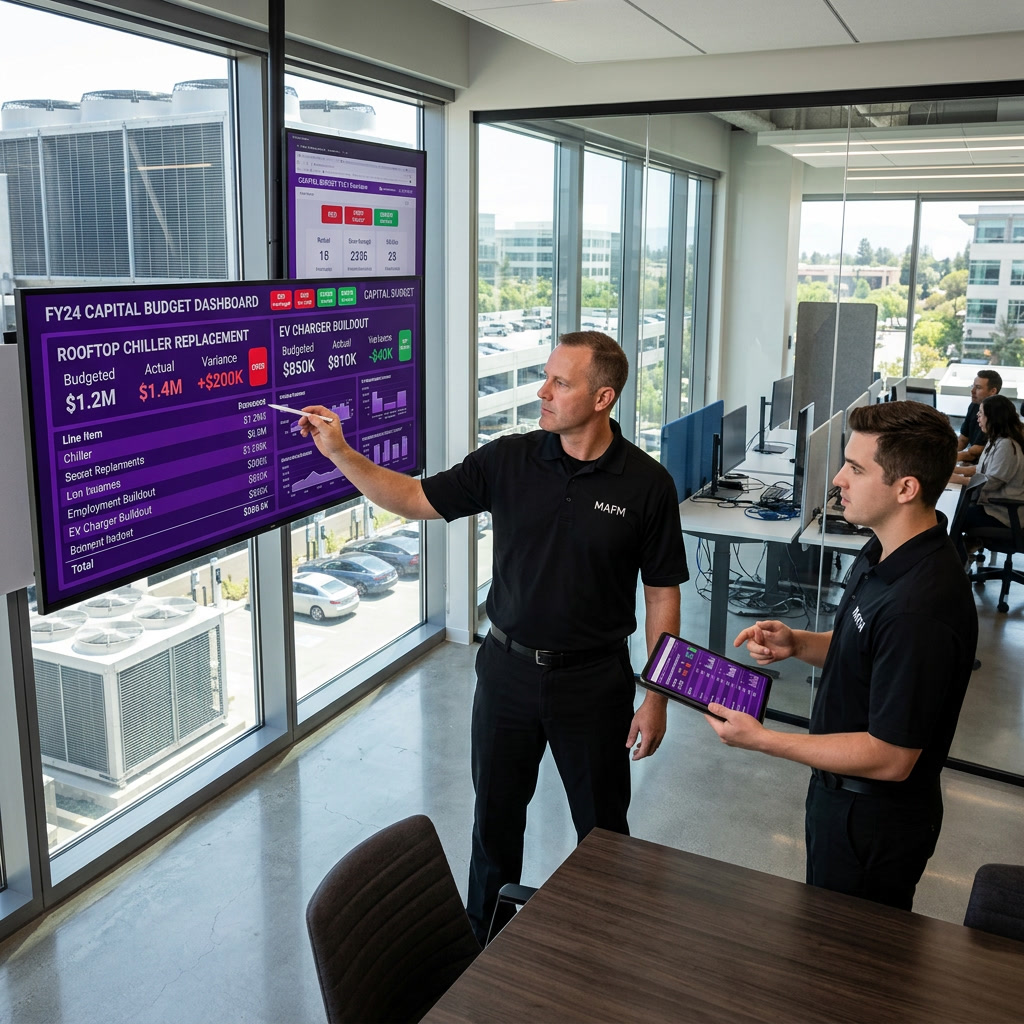
Somewhere between January's capital plan and August's actual invoices, something always breaks the model. Maybe it's the rooftop chiller replacement that was quoted at $180,000 in Q4 planning and came back at $260,000 after lead times pushed the order into a tariff window. Maybe it's the parking structure EV charger buildout that the property owner promised tenants in the lease renewal, except the utility interconnection study added four months and $45,000 nobody budgeted for. In Silicon Valley, where commercial buildings sit on some of the most expensive real estate in the country and tenants expect campus-grade amenities, capital plans drift fast and they drift expensively.
This is the piece of mid-year reconciliation that gets the least attention because it's the hardest one to have a clean conversation about. Operating budget variances can usually be explained with a line item and a memo. Capital budget variances mean telling a property owner or a CFO that the multi-year plan they approved needs to be re-sequenced, and that something they were counting on this year might slip to next year, or that something planned for 2027 needs to move up because a piece of equipment just failed inspection.
This post is about building a defensible, repeatable process for that conversation: how to diagnose why capex plans drift in this market specifically, how to decide what gets reprioritized when the numbers don't hold, and how to document the pivot so it survives an audit, a new CFO, or a change in ownership.
Three forces hit Silicon Valley capital budgets harder than almost anywhere else in the country, and understanding which one is driving your variance changes how you respond.
The first is permitting timeline volatility. A rooftop unit swap in San Jose, Santa Clara, or Sunnyvale that would take six weeks in a lower-regulation market can take four to five months once you factor in structural review for equipment weight changes, updated Title 24 energy compliance documentation, and, increasingly, electrification requirements tied to local reach codes. If your capital plan assumed a Q2 install and the permit didn't clear until Q3, you're not over budget on the equipment: you're over budget on carrying costs, temporary cooling rental, and often a second mobilization fee for the contractor.
The second is skilled labor pricing. Controls technicians, licensed refrigeration mechanics, and electricians certified for high-voltage switchgear work are in short supply across the Bay Area, and demand from data center and life sciences buildouts pulls that labor away from standard commercial work. A generator transfer switch replacement quoted in November at prevailing 2025 rates can come back 15-20% higher by the time the crew is actually available, independent of any material cost change.
The third, and the one owners underestimate most, is scope creep driven by tenant expectations. When you plan a lobby refresh or an HVAC upgrade, tenants increasingly ask for it to include air quality monitoring, occupancy sensors tied to the building automation system, or EV infrastructure that wasn't in the original scope. Each addition is reasonable in isolation. Stacked together, they turn a $300,000 project into a $420,000 project, and that gap has to come from somewhere in the plan.
Once you know why a capital item is over or under its budgeted number, the mid-year question becomes: what do we do about the rest of the plan? We use a simple three-branch framework with facility teams, and it works because it forces a decision instead of a discussion.
Branch one: does the asset have a documented safety, code, or life-safety exposure? Fire pump controllers, elevator components tied to CPSC or state elevator code updates, and electrical gear with any arc-flash hazard findings go to the front of the line regardless of what the January plan said. If your Q1 assessment flagged a switchgear issue and it's still open in August, that's not a line item to defer: that's a liability conversation with the owner, full stop.
Branch two: does deferring the item increase total cost of ownership faster than inflation would otherwise justify? This is where reserve studies earn their keep. A packaged rooftop unit at 16 years old with a compressor already replaced once is a candidate for planned replacement. Pushing it another year to fund something else usually means one more emergency service call, a higher probability of a mid-summer failure during peak tenant occupancy, and a replacement quote that's even higher next year. Run the numbers before you defer: sometimes the "savings" from delay evaporate within six months.
Branch three: is the asset a discretionary enhancement rather than an infrastructure necessity? EV charger expansion, common area finishes, and amenity-driven upgrades belong here. These are the first candidates for a phase shift when the budget is tight, and they're also the easiest to communicate to ownership because nobody argues that a lobby renovation is more urgent than a chiller keeping server rooms and lab space at temperature.
The teams that handle mid-year capital reallocation well aren't the ones with the biggest contingency reserve. They're the ones who can run this triage in a single meeting because the framework already exists before the variance shows up.
Once you know what's moving and what's staying, the harder question is where the money actually comes from. Three sources tend to cover most gaps, and each comes with a different set of trade-offs worth spelling out to ownership rather than assuming they understand.
The first is the capital contingency line, typically 8-12% of the total annual capital budget on well-run commercial properties. If your plan doesn't have one, that's a conversation for next year's budget cycle, not this one: but if it exists, this is exactly what it's for. The mistake we see most often is treating the contingency line as untouchable "just in case" money that never actually gets released, which defeats its purpose and leaves teams scrambling for approval mid-crisis.
The second is re-sequencing within the multi-year capital plan itself. If your reserve study runs a five-to-ten-year horizon, a project planned for year three can often absorb a modest acceleration or delay without breaking the overall funding model, especially if you're financing larger items through a reserve fund rather than paying cash each year. This is where having an actual reserve study, updated within the last three years, matters: a stale study built on 2021 replacement costs is going to understate everything by 20-30% in today's material and labor market, and any reallocation math built on it will be wrong before you start.
The third source, and the one that requires the most upfront trust, is a direct ask to ownership for supplemental capital outside the approved plan. This works when you bring a clear before-and-after picture: original budget, actual cost drivers, and the specific consequence of not funding the gap, a failed unit during a heat event, a code violation notice, a tenant retention risk. Owners and asset managers in this market are used to capital variance; what they're not used to, and what damages trust, is a facility team that surfaces the number without the underlying diagnosis.
A reallocated capital plan is only as good as the paper trail behind it. This matters for three audiences: the property owner reviewing performance at year-end, any lender or insurer reviewing reserve adequacy, and a future facility team or new ownership group inheriting the building.
Every reallocation decision should generate a short memo, not a full report, just enough to establish the record: original budgeted amount and timeline, actual cost and cause of variance, the decision made using the repair/replace/defer framework, and the funding source used to close the gap. Keep these memos in the same file as your reserve study updates. When an owner asks in November why the EV charger project slipped, you want to hand them a one-page answer, not reconstruct it from memory.
It's also worth updating your reserve study assumptions in real time rather than waiting for the next scheduled refresh. If a chiller replacement came in 40% over the study's assumed cost, that same gap likely applies to the other three chillers on the property scheduled for replacement in the next few years. Flagging that now, even informally, prevents next year's plan from repeating the same underestimate and gives ownership an early signal on future capital needs rather than a surprise.
Finally, tie the documentation back to tenant communication where relevant. If a capital project tenants were told about gets re-sequenced, facility teams that get ahead of that conversation (even briefly, even informally) protect the relationship far more than teams that let tenants discover the delay on their own.
Capital budgets in Silicon Valley aren't going to stop drifting. Permitting timelines, skilled labor pricing, and rising tenant expectations for building performance are structural features of this market, not temporary conditions. What separates facility teams that handle this well from teams that scramble every August isn't a bigger contingency fund: it's a repeatable framework for triage, a funding hierarchy that's been thought through before the variance appears, and a documentation habit that turns every hard decision into an asset for next year's planning instead of a mystery someone has to reconstruct later.
Earlier this week we looked at operating budget variance and vendor cost overruns; capital planning is the third leg of the mid-year reconciliation stool, and arguably the one with the longest memory: a poorly documented reallocation this August can still be causing confusion in a reserve study three years from now.
If your capital plan needs a mid-year health check, MAFM's facility finance team can run a full variance and reserve study review for your Silicon Valley property: reach out to schedule a walkthrough before your Q4 planning cycle begins.
Reference earlier posts in this week's Budget vs. Reality series on operating expense variance analysis and vendor contract cost overruns; link forward to Friday's synthesis post tying together the week's mid-year reconciliation strategies.
IREM's guidance on reserve study standards and capital reserve funding (irem.org); BOMA International's benchmarking data on commercial building operating and capital expenditures (boma.org).
MAFM offers comprehensive facility management solutions tailored to your business needs.
Get in Touch