Budgets & Contracts
Reduce Facility Operating Costs in Silicon Valley, 2026
January 12, 2026
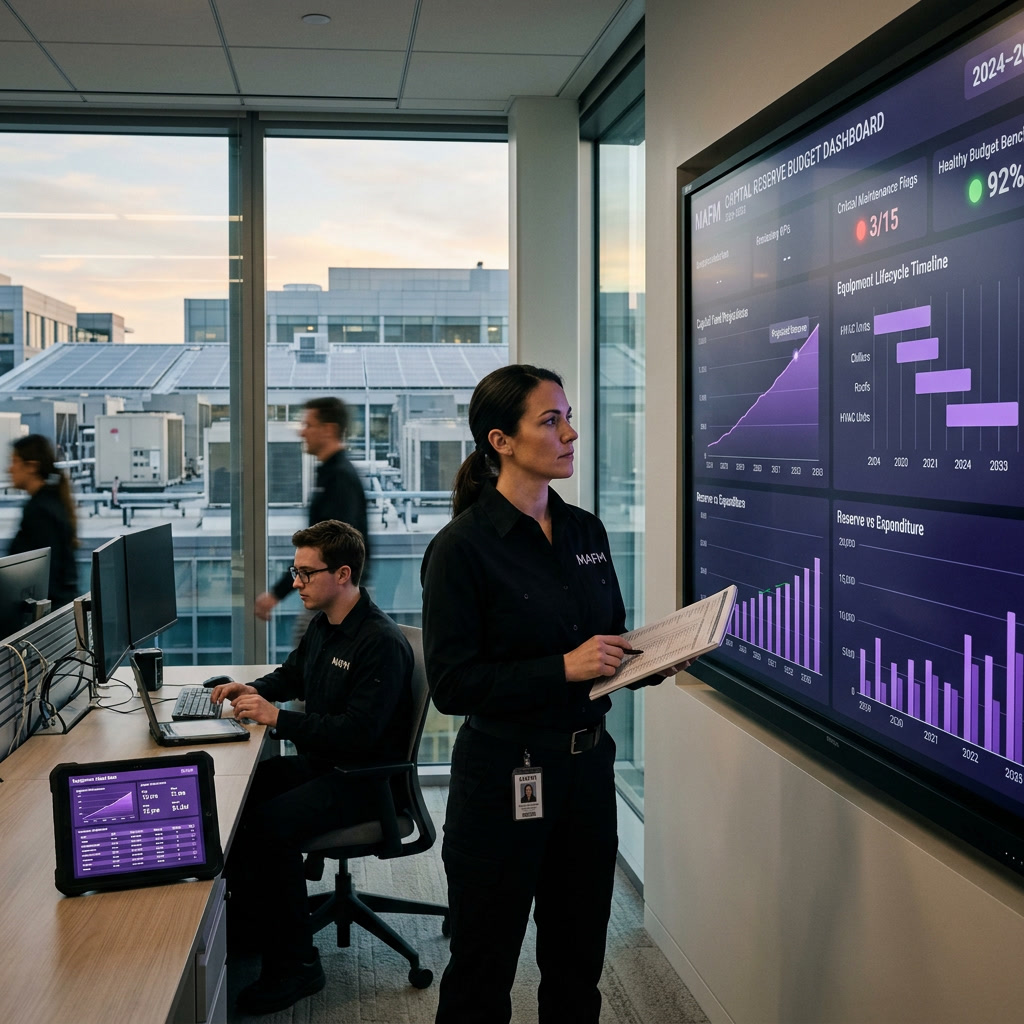
Every August, we get the same call: a property manager staring at a five-figure quote for an emergency chiller replacement, asking why nobody flagged this coming. The honest answer is usually that somebody did flag it: three years ago, in a reserve study nobody updated since the building changed hands. In Silicon Valley, where a single rooftop package unit swap on a 40,000-square-foot office building can run $180,000 to $240,000 installed, "we'll deal with it when it breaks" is not a budget strategy. It's a guarantee of overpaying and underplanning.
This is post three in our Q3 planning series, and it tackles the piece of annual budgeting that gets skipped most often: capital reserve forecasting for major building systems. Operating budgets get scrutinized line by line every quarter. Capital reserves (the money set aside for roofs, HVAC plants, elevators, parking structures, and life-safety systems) often get a placeholder number that hasn't been recalculated since the building was acquired. That gap is where six-figure surprises live.
If your Q3 planning process doesn't include a system-by-system age and condition assessment tied to real replacement cost data, you're not planning: you're guessing with better formatting. Here's how to fix that before your annual budget goes to ownership or the board.
Silicon Valley commercial real estate has a churn problem that works against long-term capital planning. Buildings change hands, tenants turn over lab and R&D space every 3-5 years, and facility management contracts get rebid. Each transition is a chance for institutional knowledge about equipment age and condition to evaporate. We've walked into properties where the current property manager didn't know the rooftop units were original to a 2008 construction: meaning they were already past their 15-to-20-year expected service life and nobody had budgeted a dime for replacement.
The second failure mode is inflation blindness. A reserve study done in 2021 that estimated $150,000 for a boiler replacement is now looking at $210,000 or more once you account for equipment cost increases, tariff-driven material surcharges, and Bay Area labor rates that have climbed 18-22% for mechanical trades since then. If your reserve fund contributions were calculated against 2021 numbers and never adjusted, you're underfunded by design, not by accident.
The third issue is specific to this region: many Silicon Valley properties carry a mix of standard office HVAC alongside supplemental systems for server rooms, lab exhaust, or process cooling installed by a tenant years ago and never formally handed back to building ownership for maintenance responsibility. These orphaned systems rarely appear in reserve studies at all, and they fail at the worst possible moment: usually during a heat event when everything else in the building is also under load.
Not every building system needs equal attention in a capital reserve refresh. Based on the properties we manage across the Peninsula and South Bay, four categories consistently account for the bulk of unplanned capital spend.
Rooftop and central plant HVAC tops the list. Package units typically run 15-20 years before major component failure becomes likely; chillers and boilers can run longer but come with higher single-event replacement costs, often $150,000-$400,000 depending on tonnage and building size. If your equipment schedule doesn't list install year, current runtime hours (where metered), and last major component replacement, you don't have enough information to forecast this line item: you have a guess.
Roofing is second, and it's underestimated because failure is gradual rather than catastrophic: until it isn't. A membrane roof with visible ponding, seam separation, or blistering has maybe 3-5 years of life left, and full replacement on a mid-size commercial building can run $8-$15 per square foot depending on system type. Waiting for a leak to force the issue means paying for water damage remediation on top of the roof itself.
Vertical transportation, elevators and escalators, is third. Modernization projects (not just maintenance) run $80,000-$150,000 per elevator cab and typically get triggered by code updates or parts obsolescence on older hydraulic or traction systems, not by convenience. Parking structure restoration is fourth, particularly for properties built before current waterproofing standards; post-tension cable and structural concrete repair projects can hit $200,000-$500,000 depending on square footage and damage extent, and they're almost always more expensive the longer they're deferred because rebar corrosion accelerates once it starts.
Start with an equipment inventory that has four columns, not two. Most reserve studies list equipment type and estimated remaining life. That's not enough. You need install date (or best documented estimate), manufacturer expected service life, current condition based on the last physical inspection, and replacement cost indexed to current-year pricing: not the price from whenever the last study was done.
Next, assign each major system a risk tier based on remaining life. Anything with less than 3 years of expected remaining service life goes into your near-term capital plan and gets a firm budget line for the coming fiscal year. Systems in the 3-7 year range go into a rolling five-year forecast that you revisit annually: this is the category most properties neglect, and it's exactly where you avoid surprises by starting vendor conversations and getting updated quotes 18-24 months ahead of actual need. Anything beyond 7 years gets tracked but doesn't need detailed costing yet.
Then run the inflation adjustment. Don't assume flat costs year over year. For mechanical equipment and skilled trade labor in this market, budgeting a 4-6% annual escalation on multi-year forecasts is more realistic than using a flat number, and for anything involving copper, steel, or specialized components subject to tariff exposure, build in a wider contingency band, 10-15%, rather than a single point estimate. Property owners are far more receptive to a reserve contribution increase when it's presented as "here's the math and here's why," rather than a lump revision that looks arbitrary.
Finally, cross-reference your forecast against actual reserve fund balance and contribution rate. This is the step that turns a maintenance exercise into a real budget conversation. If your five-year forecast shows $1.2 million in capital need and your current reserve is accumulating $140,000 a year, you have a funding gap that needs to be addressed in this year's budget cycle: not discovered when the first big-ticket item comes due.
Facility directors often have the right data but present it in a way that doesn't land with ownership or finance teams focused on NOI and cap rates. The fix is framing capital reserve underfunding as a risk to asset value, not just a maintenance concern. A building with a documented, funded capital plan is more attractive in a sale or refinance than one where a buyer's engineering due diligence turns up an aging chiller plant with no replacement reserve behind it: that gap gets priced into the deal, usually at a worse rate than if you'd planned for it yourself.
Bring three numbers to every capital reserve conversation: the near-term (12-month) required spend, the five-year rolling forecast, and the current funding gap between reserve balance and forecasted need. Avoid presenting a single giant number for "capital improvements": it invites skepticism and gets deferred. Broken into system-specific line items with condition photos and vendor quotes attached, the same total is far more likely to get approved because it's clearly grounded in physical reality rather than a budgeting placeholder.
It also helps to tie capital items to tenant experience and lease renewal risk where applicable. An HVAC system nearing end of life isn't just a capital risk: it's a comfort complaint risk, and in a market where tenants have leverage, comfort complaints during lease renewal conversations cost you more than the equipment itself.
Q3 is exactly the right window to do this work, because it gives you a full quarter to gather updated vendor quotes, walk your systems with a qualified engineer, and build a defensible forecast before annual budgets lock in for next year. Skipping this step doesn't save time: it just moves the cost of figuring it out to the moment a system fails, when you have the least leverage on pricing and the least patience from tenants and ownership alike.
Treat your capital reserve forecast as a living document, not a one-time study. Revisit it annually, update replacement costs to current pricing, and adjust contribution rates before the gap between what you've saved and what you'll need becomes the headline of next year's budget meeting.
MAFM's facility engineering team can walk your property's major systems, build a system-by-system capital reserve forecast with current market pricing, and help you present a funding plan ownership will actually approve: schedule a capital assessment before your budget cycle closes.
Reference Monday's post introducing the Q3 planning and annual budget series, and Tuesday's post on operating budget line-item review; tease Thursday's post on vendor contract renegotiation timing and Friday's roadmap synthesis tying the week's budget planning steps together.
Building Owners and Managers Association (BOMA) Experience Exchange Report benchmarking data; International Facility Management Association (IFMA) guidance on capital reserve and lifecycle cost planning.
MAFM offers comprehensive facility management solutions tailored to your business needs.
Get in Touch