Health & Safety
The Ultimate Guide to Preventing Slip-and-Fall Incidents in Bay Area Buildings
January 24, 2026
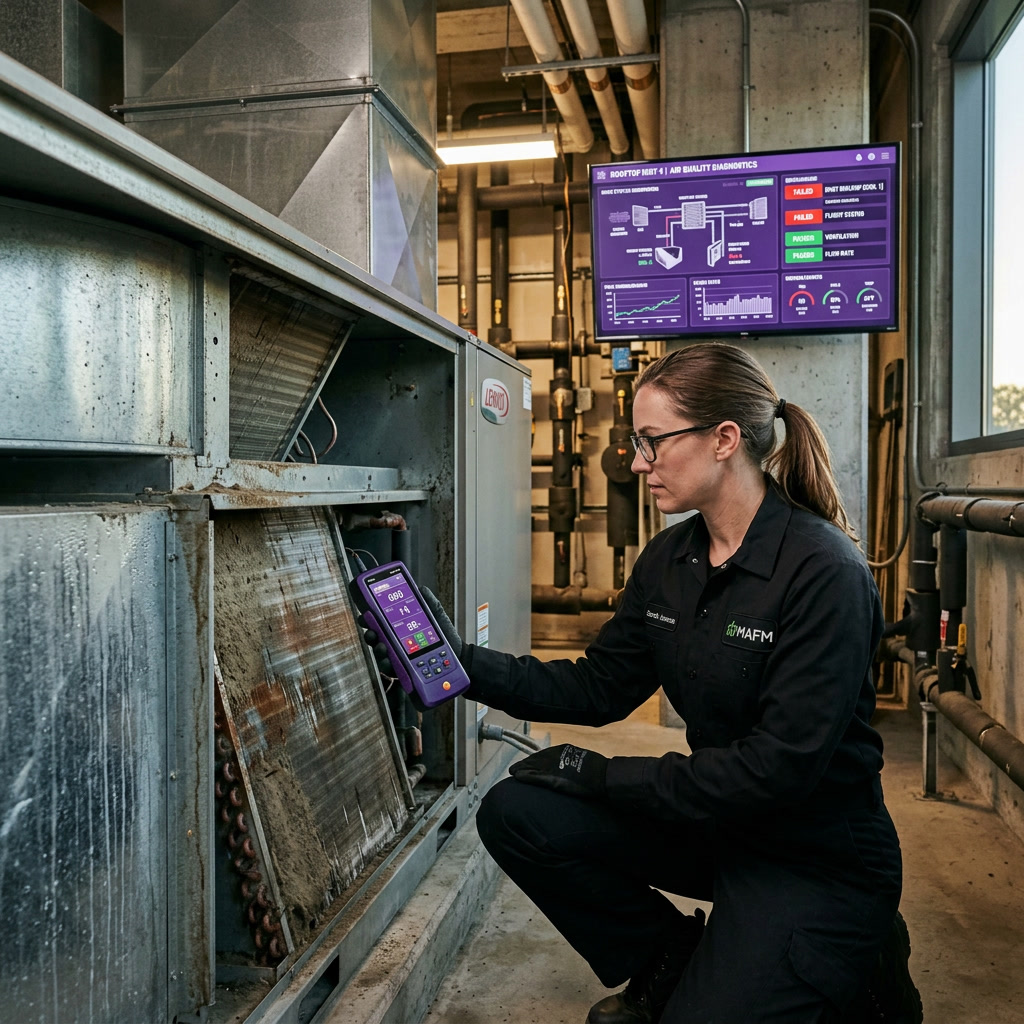
Earlier this week we covered why September is the right window to audit indoor air quality before Bay Area buildings switch from cooling-dominant to heating-dominant operation. Today we go deeper into a specific and underappreciated risk: what happens inside HVAC equipment that has sat idle, partially idle, or run in economizer-only mode all summer. Heating coils, unit heaters, dormant boiler loops, and unused zones of VAV systems can become reservoirs for moisture, mold growth, and off-gassed volatile organic compounds: and none of it shows up until the first cold snap forces air handlers to push that air into occupied space.
In our portfolio of Silicon Valley office campuses, lab buildings, and mixed-use properties, we've pulled particle counters and VOC meters on buildings where nothing looked wrong on a walkthrough and found ppm concentrations that triggered immediate remediation before a single employee complained. The failure mode is predictable: California's dry summers mean many buildings run minimal heating for four to five months, condensate pans and heating-loop piping sit stagnant, and dust accumulates on coils that haven't cycled since April. When facilities teams skip pre-season testing and just flip equipment on in October, they're often the first ones to find out something's wrong: via a tenant odor complaint or a sick-building call to EHS.
This post lays out the actual testing protocol we run before heating season startup: what to measure, what equipment to use, how to read the results, and how to build this into a turnover schedule that doesn't blow your fall maintenance budget.
Most Silicon Valley office and R&D buildings run economizer-heavy cooling from May through September, meaning heating coils, hot water reheat valves, and standalone unit heaters can go four to six months without a real operating cycle. Static air in those zones, combined with condensate that never fully drains from summer humidity swings, creates ideal conditions for microbial growth on coil fins and in drain pans: especially in buildings near the Bay where marine layer humidity keeps outdoor air moister than people assume.
VOC accumulation is the second issue, and it's less obvious. Sealants, gasket materials, and insulation inside heating equipment off-gas continuously, but when that equipment isn't running, those compounds concentrate in stagnant ductwork rather than diluting into the building's normal air exchange. We've measured total VOC readings in idle heating plenums at 2-3x the levels found in actively circulating supply air in the same building, measured the same week.
Then there's the dust load. HVAC coils that haven't cycled collect particulate from six months of intermittent economizer operation, and when heating finally kicks on, that dust gets thermally baked and redistributed through the duct system: a phenomenon facility engineers sometimes call "furnace smell," but which is really a particulate and VOC event, not just an odor nuisance. For lab buildings and cleanrooms adjacent to office space, this matters even more because particulate spikes can affect adjacent controlled environments.
A proper pre-heating-season IAQ test covers four parameters, and skipping any one of them leaves a gap. We run these in sequence across representative zones: typically one test point per 10,000-15,000 square feet, plus every mechanical room and any zone with prior complaint history.
First, particulate matter (PM2.5 and PM10) using a handheld optical particle counter: we use TSI AeroTrak or equivalent units that log continuously rather than spot-check, since dust redistribution during equipment startup is often a 20-30 minute spike rather than a steady-state condition. Second, total VOC concentration using a photoionization detector (PID), such as a Testo 400 or RAE Systems ppbRAE, run both with equipment off (baseline) and 15 minutes after startup (event reading): the delta between those two numbers tells you whether the equipment itself is the source. Third, relative humidity and dew point at coil surfaces and in drain pans, checked with a hygrometer probe, because anything holding above 60% RH for extended periods is a mold risk regardless of visible growth. Fourth, a borescope inspection of duct interiors and coil faces in any zone flagged by the above readings, since instrumentation tells you something's wrong but a camera tells you what and where.
The equipment cost for a mid-size portfolio (say, four buildings totaling 400,000 square feet) runs $8,000-$14,000 to own outright, which is why most facility teams, including several of our clients, rent or contract this out rather than staffing it in-house. A third-party IAQ testing pass across a single 100,000 square foot office building typically runs $2,500-$4,500 depending on zone count and whether mold sampling (via swab or air-o-cell cassette sent to a lab) is included.
Raw numbers are useless without thresholds, and this is where a lot of internal testing programs fall apart: someone collects data, nobody knows what number should trigger action. We set our thresholds against ASHRAE 62.1 ventilation guidance and EPA indoor air quality reference levels, translated into building-specific action limits.
For total VOCs, we treat readings above 500 ppb as requiring investigation, and above 1,000 ppb as requiring the zone to stay in bypass or exhaust-purge mode until source identification is complete: this is a real, published-guideline threshold, not an arbitrary number, and it holds up if a tenant or their attorney ever asks how you made the call. For PM2.5, we use the EPA's 35 µg/m³ 24-hour standard as an occupied-space ceiling, but during an equipment-startup event we expect and tolerate short transient spikes as long as they clear within 30-45 minutes of increased ventilation: anything that doesn't clear points to a duct contamination problem, not just a startup dust event. For humidity, sustained coil-surface readings above 60% RH combined with any visible discoloration on a borescope pass triggers a mold swab sample sent to a certified lab (we use environmental labs accredited under the AIHA Environmental Microbiology Proficiency Analytical Testing program) rather than guessing based on appearance alone.
The critical operational decision is what to do between "test flagged an issue" and "lab results confirmed it," because lab turnaround for mold speciation typically runs 5-10 business days. Our standard practice is to hold that zone on 100% outside air ventilation (bypassing recirculation) until results come back, which costs more in energy but avoids circulating a contaminant through occupied space for over a week while waiting on paperwork.
The mistake we see most often isn't lack of awareness: it's timing. Facility teams schedule heating system startup and IAQ testing as the same event, which means if testing finds a problem, you've already got tenants complaining about cold offices while remediation is underway. The fix is sequencing: run full IAQ testing 10-14 days before planned heating changeover, not the same week.
That window gives enough time to get mold lab results back, schedule coil cleaning or duct remediation if needed, and still hit your target heating-season start date without disruption. For a typical Silicon Valley office portfolio, we recommend scheduling this testing pass in early-to-mid September specifically because it's early enough to beat the first genuine cold week (which in the Bay Area usually arrives late September to mid-October) but late enough that summer economizer operation has fully stabilized, giving you a realistic picture of dormant-system conditions rather than transitional readings.
Staffing-wise, this doesn't require adding headcount if you're already running quarterly PM programs: it's a matter of adding a defined IAQ testing line item to the existing fall HVAC changeover work order, with a hard trigger date tied to weather forecasting rather than the calendar. Buildings with BMS platforms that log outside air temperature trends can automate that trigger; buildings without it should set a standing reminder keyed to the first forecasted week with lows under 55°F.
Testing dormant HVAC systems before heating season isn't a compliance checkbox: it's the difference between a controlled, documented startup and a scramble triggered by tenant complaints in week one of cold weather. The instrumentation is affordable, the thresholds are published and defensible, and the sequencing is simple once it's built into your fall schedule rather than bolted onto changeover day.
The buildings that skip this step aren't saving money: they're deferring the cost to October, when it shows up as emergency remediation, tenant relations calls, and lost trust in the facilities team's ability to manage the building proactively.
MAFM's IAQ testing team runs full pre-heating-season protocols (particulate, VOC, humidity, and borescope inspection) across your entire portfolio with lab-backed documentation. Contact us to schedule your fall testing window before the first cold week hits.
Reference Monday's post introducing the Indoor Air Quality Fall Audit series and its testing timeline, and Tuesday's post on ventilation rate and CO2 baseline testing under ASHRAE 62.1; link forward to later posts in the series on compliance documentation and sensor deployment.
ASHRAE Standard 62.1 (Ventilation for Acceptable Indoor Air Quality); EPA Indoor Air Quality guidance on particulate matter and VOC reference levels.
MAFM offers comprehensive facility management solutions tailored to your business needs.
Get in Touch