
Budgets & Contracts
How Silicon Valley Facility Managers Can Slash 2026 Operating Costs by 23%
January 12, 2026
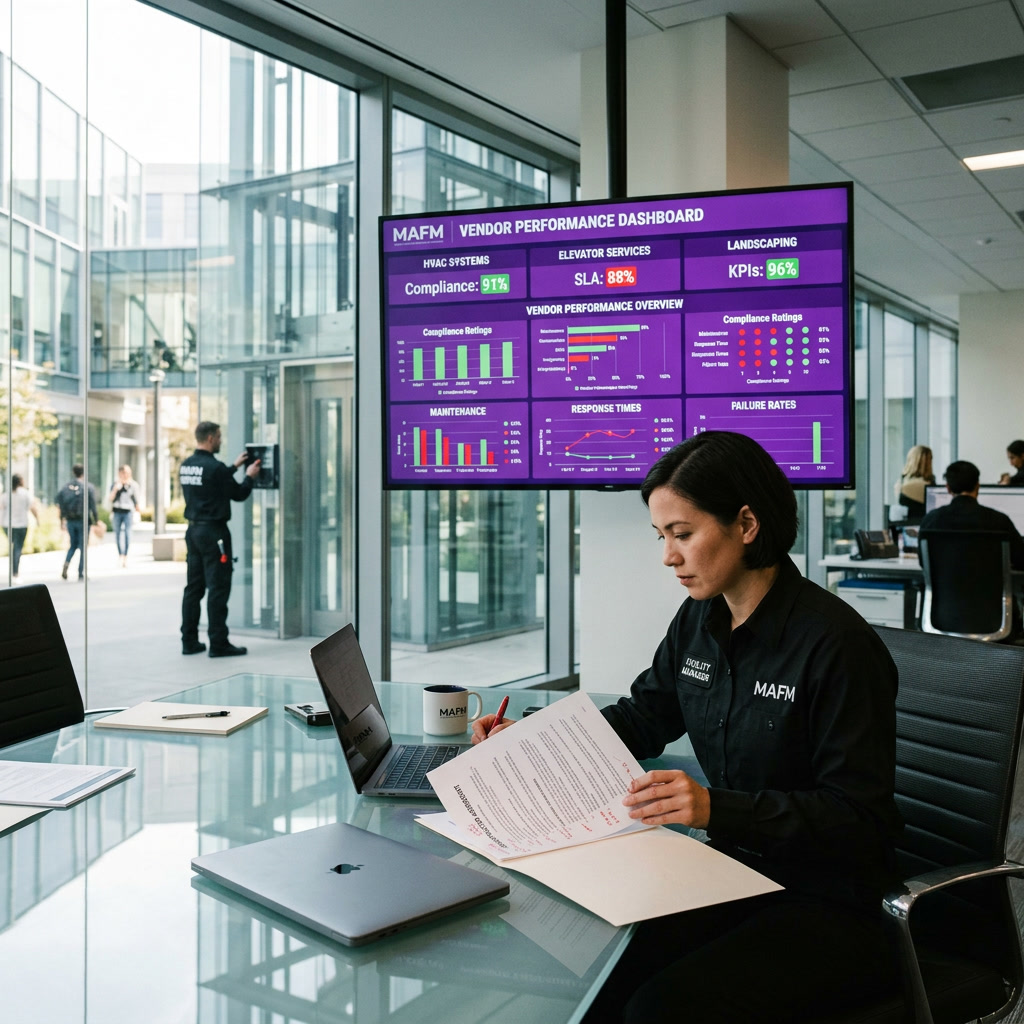
Every facility manager who has managed a portfolio for more than a year has a story about a subcontractor who looked great on paper and performed terribly in the field. The HVAC vendor whose "quarterly preventive maintenance" turned out to be a fifteen-minute filter swap. The elevator contractor who missed three consecutive callback windows during a heat wave, leaving a 200,000-square-foot office tower with one working car. The landscaping crew that showed up with two guys instead of the contracted four, and nobody caught it for six months because the invoice never changed.
In almost every one of these stories, the root cause traces back to the contract itself: not a lack of oversight, but a document that never gave the facility manager the tools to enforce oversight in the first place. A subcontractor agreement that just says "perform maintenance per manufacturer specifications" or "respond to service calls in a timely manner" is not a contract, it's a wish. It gives you nothing to point to when performance slips, and it gives the vendor's account manager plenty of room to explain away a problem instead of fixing it.
This post is about the specific clauses and structures that convert a vague vendor relationship into an enforceable one: the language that lets you hold a specialty trade accountable on the day of a failure, not three renewal cycles later. This matters more in Silicon Valley than almost anywhere else, because the buildings here carry a mix of legacy mechanical systems, cutting-edge cleanroom and lab infrastructure, and tenant expectations shaped by tech-company facilities teams who are used to a very high bar. A soft contract with your fire suppression vendor or your data hall precision cooling contractor isn't a paperwork gap: it's an operational risk.
Most facility teams start subcontractor scopes of work with a maintenance calendar: quarterly, semi-annual, annual. That's necessary, but it's the wrong starting point. Before you write down when work happens, you need to write down what "done correctly" looks like, in terms specific enough that a third party could audit it without asking you a clarifying question.
For an HVAC preventive maintenance contract, that means listing the actual tasks per visit (belt tension checks, refrigerant pressure readings recorded against baseline, condenser coil cleaning frequency, economizer damper cycling tests) rather than "PM per manufacturer guidelines." Manufacturer guidelines are long documents, and vague references to them let a technician decide, in the moment, how much of the checklist actually gets done. If you've ever pulled a PM report and found the same four data points filled in every quarter with no variation, you've seen this failure mode firsthand.
The same logic applies to janitorial and landscaping contracts, where quality is more subjective but still measurable. Instead of "maintain grounds in a neat and orderly condition," specify irrigation check frequency, turf height tolerances, and a defined response window for storm debris removal. Instead of "clean restrooms as needed," specify checkpoints per shift with initialed logs. The goal isn't to micromanage the vendor's labor: it's to remove the ambiguity that lets underperformance hide behind soft language. Once the standard is written in measurable terms, the schedule becomes a compliance document instead of a suggestion.
A service level agreement that only specifies response time is half a contract. Response time matters for elevator entrapments and life-safety systems, but for most specialty trades, the more important number is resolution time, and the two get conflated constantly. A vendor can "respond" within the contracted 30 minutes by having someone answer the phone, while the actual technician doesn't arrive on-site for four hours. Your SLA needs separate, defined clocks for acknowledgment, on-site arrival, and resolution: each with its own threshold, and each tied to the priority tier of the issue.
Priority tiers themselves need real definitions, not adjectives. "Emergency," "urgent," and "routine" mean different things to different vendors unless the contract spells out examples: a chiller failure during a summer weekday is emergency-tier; a dripping faucet in a break room is routine-tier. Silicon Valley properties with lab space, server rooms, or 24/7 operations should also build in escalation contacts by name and phone number, not just a dispatch queue, because a general contact number is where accountability goes to die during an actual emergency at 2 a.m.
The clause that most contracts skip entirely is what happens when SLAs are missed. Credits, fee reductions, or right-to-cure provisions only work if they're pre-negotiated and specific: "a 5% service fee credit for each missed resolution window in a calendar month" is enforceable; "vendor will make reasonable efforts to correct performance issues" is not. We've found that vendors who balk at specific SLA penalties during contract negotiation are almost always the ones who intend to under-resource your account later. That resistance is useful information before you sign, not after.
A certificate of insurance collected once at contract signing is a snapshot, and snapshots go stale. Insurance can lapse mid-contract, workers' comp coverage can change when a subcontractor shifts labor pools, and a specialty license (for elevator mechanics, fire alarm technicians, refrigerant handlers under EPA Section 608) can expire without anyone on your side noticing until an inspector asks for it during an audit.
Build automatic re-verification into the contract itself: a clause requiring the vendor to submit updated certificates of insurance and license renewals to your team within a set number of days of expiration, with a defined consequence, typically suspension of work authorization, for lapses that go unaddressed. This isn't paranoia; it's standard risk transfer practice, and it protects your organization's own liability position if a subcontractor's technician is injured on your property while working under an expired workers' comp policy.
For California facilities specifically, this section should also reference Cal/OSHA-specific certifications where applicable: confined space entry training for tank and vault work, fall protection certification for roof-mounted equipment techs, and hazardous materials handling documentation for anyone servicing refrigeration or lab exhaust systems. Contracts that reference these requirements by name, rather than generically requiring "compliance with applicable law," give your team a concrete document to request and a concrete gap to flag when it's missing.
The clauses above only work if someone is actually checking them against real performance on a schedule, and that schedule needs to be written into the contract, not left as an informal practice. A quarterly performance scorecard (covering SLA compliance rate, PM checklist completion accuracy, callback frequency for the same issue, and documentation timeliness) turns subjective frustration ("this vendor feels unreliable") into an objective record you can act on.
Tie that scorecard to consequences with specific thresholds. A vendor who falls below, say, 85% SLA compliance for two consecutive quarters should trigger a formal corrective action meeting, documented in writing, with a defined improvement period. If performance doesn't recover within that window, your termination-for-cause clause needs to actually be usable: meaning it references the scorecard data directly as grounds for termination, rather than requiring you to prove "material breach" from scratch in a dispute.
This is also where transition provisions matter and get overlooked. A contract that lets you terminate for cause but doesn't require the outgoing vendor to hand over equipment logs, warranty documentation, and as-built records leaves you starting the next vendor relationship blind. Require a defined transition period, typically 30 to 60 days, with documented handover of all maintenance history and open work orders as a contractual obligation, not a professional courtesy you're hoping for.
The difference between a subcontractor relationship that runs itself and one that consumes your week in fire drills almost always comes down to what got written down at signing. Vague scopes produce vague performance. Specific, measurable standards (tied to real SLA tiers, verified compliance documentation, and scorecards with actual consequences) give you the leverage to manage trades proactively instead of reactively renegotiating after every failure.
None of this requires an adversarial relationship with your vendors. The best subcontractors we work with prefer tight contracts, because clear standards protect good performers from being lumped in with the ones who cut corners, and they remove the guesswork from what "good" looks like on both sides of the table.
If your current subcontractor agreements are more aspirational than enforceable, MAFM can audit your existing contracts, rebuild your SLA structure, and manage the vendor relationships on your behalf so quality issues get caught before they become tenant complaints.
Link back to earlier posts in this week's subcontractor management series covering how to vet and select specialty trade vendors, and how to build inspection and audit routines that verify contract compliance in the field.
Reference the American Institute of Architects (AIA) standard contract documents for facility services agreements, and Cal/OSHA's guidance on specialty trade certification requirements for confined space and refrigerant handling work.
January 12, 2026
January 14, 2026
January 16, 2026
MAFM offers comprehensive facility management solutions tailored to your business needs.
Get in Touch