Budgets & Contracts
Reduce Facility Operating Costs in Silicon Valley, 2026
January 12, 2026
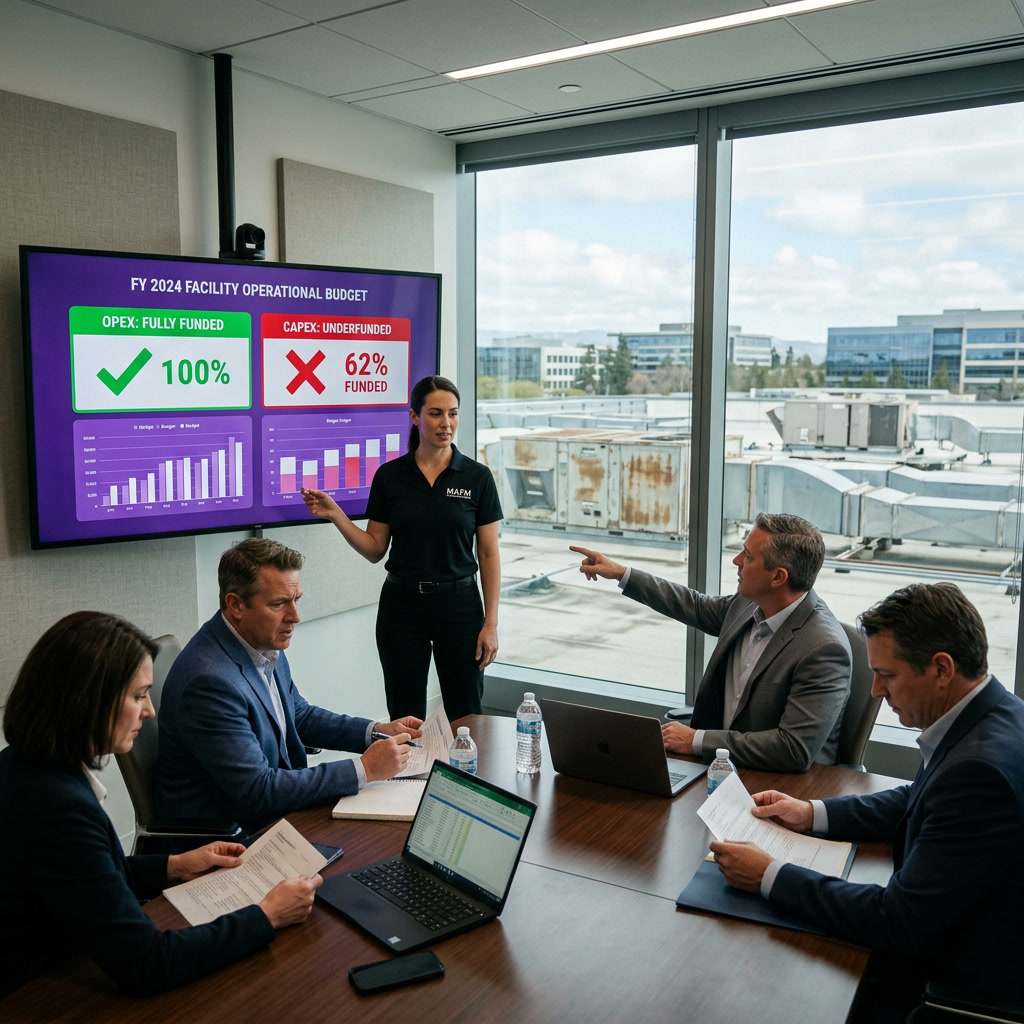
Every August, we sit across the table from facility directors who have a beautifully organized operating budget and almost nothing credible for capital expenditures. Utilities, janitorial contracts, landscaping, pest control: all tracked to the dollar. Then someone asks "what's the replacement cost on the three 40-ton rooftop units installed in 2011?" and the room goes quiet. That gap is where budgets blow up in Q2 of the following year.
This is the fourth post in our Q3 planning series, and it's the one that tends to get skipped because it requires math that most FM software doesn't do automatically: mapping equipment age against useful life, then translating that into a multi-year capital forecast instead of a single-year guess. In Silicon Valley specifically, this matters more than most markets. Buildings converted from single-tenant R&D to multi-tenant office, campuses with mixed lab and office loads, and 1980s-vintage business parks now running data-center-adjacent power draws all have equipment operating well outside its original design assumptions.
If your annual budget submission for 2027 is due to ownership or your board in the next 60-90 days, this is the section that gets scrutinized hardest and defended worst. Here's how to build a capex forecast that survives that scrutiny.
Most capital forecasts fail because they're built on memory instead of records. If you can't produce a list of every major system (rooftop units, chillers, boilers, elevators, roof membrane sections, parking structure waterproofing, generators, fire pumps) with install date, manufacturer, tonnage or capacity, and last major service date, you don't have a capital plan. You have a guess with a dollar sign on it.
We recommend a walking asset audit, not a desk exercise. On a recent 280,000 square foot campus in Santa Clara, our team found that the building's own O&M binder listed four packaged units as installed in 2009. Nameplate data showed two of the four were actually replaced in 2015 after a compressor failure, and nobody had updated the capital tracking sheet. That six-year discrepancy is the difference between budgeting a replacement for next year versus five years out: roughly $180,000 in premature spend or, worse, a unit that fails in August with a six-week lead time on a new compressor and tenants in a 400-person building with no cooling.
Build the inventory in a spreadsheet or a CMMS with four columns that matter for budgeting: install year, ASHRAE or manufacturer-stated useful life, current condition score (we use a simple 1-5 scale from field techs, not just visual inspection), and replacement cost in today's dollars. That last column needs to be sourced from actual vendor quotes updated within the last 12 months, not a number carried forward from 2022 pricing, which is now off by 20-30% on most mechanical equipment due to tariff-related steel and copper cost increases.
The single biggest mistake we see in budget submissions is presenting capital needs as a flat annual number ("$400,000 for capital projects in 2027") with no schedule behind it. Ownership groups and CFOs who manage multiple properties want to see the five-year curve, because that's what lets them smooth spending, time it against lease rollover, and avoid three roofs coming due in the same fiscal year.
Take a typical 150,000 square foot Silicon Valley office asset built in the mid-1990s and renovated once around 2008. A realistic five-year schedule looks something like this: Year 1, replace two of six rooftop HVAC units reaching 18-20 years of service, roughly $140,000 combined. Year 2, re-roof one of three roof sections showing granule loss and ponding in the reserve study, approximately $220,000. Year 3, elevator modernization on the two passenger cabs installed in 2001: cab interiors, controllers, and door operators, around $280,000 for two units. Year 4, replace the remaining rooftop units and upgrade the building automation system tying them together, roughly $310,000. Year 5, parking structure waterproofing and expansion joint replacement, $190,000.
Laid out this way, ownership sees a $1.14 million five-year capital need instead of being blindsided by a single bad year. It also gives you leverage in the budget conversation: you can propose phasing, financing, or reserve contributions now instead of fighting for emergency capital when a unit actually fails. On multi-tenant properties, this schedule is also what you use to justify CAM capital pass-throughs or negotiate reserve fund contributions with an HOA or ownership group ahead of time, rather than after an assessment.
Manufacturer useful-life tables are a starting point, not a forecast. ASHRAE's equipment life expectancy tables put packaged rooftop units at a median 15 years, but that's a national average built around moderate-duty cycles. In the South Bay, units running near-continuous cooling loads for R&D or data-adjacent tenant spaces, or units on buildings with poor shading and heavy solar gain on west-facing roofs, routinely show compressor and coil failure by year 12-13. We've pulled failed compressors on units that were on paper "good for three more years" according to generic tables.
The adjustment factors that matter most in this market: run-hours (a unit serving a 24/7 server room annex ages faster than one serving a standard 9-to-5 office floor), refrigerant type (older R-22 units are both aging out and facing steep refrigerant cost increases that make repair economically irrational well before mechanical failure), and maintenance history (a unit on a consistent quarterly PM program will outperform its rated life; one that's had deferred filter changes and coil cleaning will underperform it, sometimes by 30-40%).
Build your forecast using a blended life expectancy: take the manufacturer or ASHRAE number, then apply a 10-15% reduction for high-duty-cycle equipment and a 10% extension for equipment with documented, consistent preventive maintenance. This isn't guesswork dressed up as precision: it's the same adjustment insurance actuaries make, and it will hold up better under CFO questioning than a flat industry-average number pulled from a manufacturer brochure.
Not every line in your capital forecast carries the same urgency, and treating them all as equally critical is how good projects get cut alongside genuinely optional ones. We recommend a three-tier classification in the budget document itself: Tier 1 is equipment at or past end of life with documented condition issues, visible corrosion, refrigerant leaks, repeated service calls exceeding a defined threshold (we use three or more emergency calls in 12 months as a trigger). Tier 2 is equipment approaching end of life within the next 24 months where planning now avoids emergency pricing later. Tier 3 is equipment that's aging but stable, where the recommendation is continued monitoring with a defined re-assessment date rather than a locked replacement year.
This tiering does two things in the actual budget approval process. First, it protects Tier 1 items from being cut when ownership needs to trim the overall capital ask: nobody wants to be the one who deferred a failed boiler replacement to save money on paper. Second, it gives you credibility on Tier 3 items, because you're demonstrably not padding the request with speculative replacements. On a recent submission for a Mountain View office park, presenting the request in tiers rather than a flat list got a $60,000 elevator modernization item approved that had been cut two years running: the ownership group could finally see it sat in Tier 1 alongside a chiller replacement, not buried in a list that looked like discretionary spend.
A capital forecast built on a real asset inventory, a five-year schedule, climate-adjusted life expectancy, and tiered urgency isn't just more accurate: it's more fundable. Ownership groups, CFOs, and HOA boards don't reject capital requests because the number is too high. They reject them because the number isn't defensible. The difference between a rejected capex line and an approved one is almost always documentation, not dollars.
If your 2027 budget is due for submission in the next few weeks, now is the window to get this right before the number gets locked in.
MAFM's asset condition audits and capital forecasting service can get a defensible five-year capex schedule in front of your ownership group before your budget deadline: contact us to schedule a walkthrough of your major building systems this month.
Reference earlier posts in this week's Q3 Planning & Annual Budget Preparation series covering operating budget line-item review and vendor contract renewal timing; point ahead to Friday's synthesis post tying the week's budget planning steps into a single Q3 action roadmap.
ASHRAE's "Service Life and Maintenance Cost Database" for equipment life expectancy benchmarks; BOMA International's guidance on capital reserve planning for commercial office properties.
MAFM offers comprehensive facility management solutions tailored to your business needs.
Get in Touch