
Budgets & Contracts
How Silicon Valley Facility Managers Can Slash 2026 Operating Costs by 23%
January 12, 2026
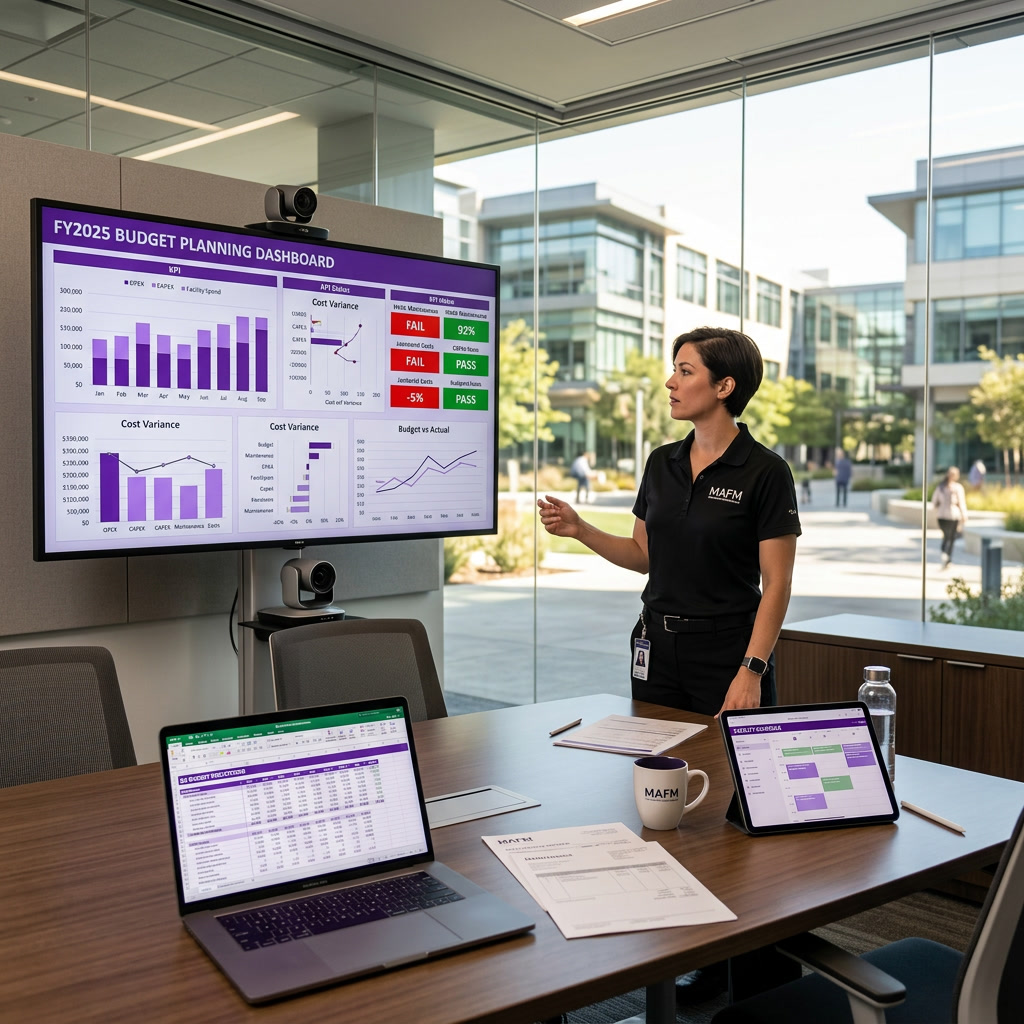
If you manage a commercial property anywhere from Sunnyvale to San Jose, you already know the rhythm: Q4 arrives, finance asks for next year's numbers with two weeks' notice, and you're reconstructing a year of maintenance invoices from memory while trying to justify why the chiller replacement can't wait another cycle. This week on the MAFM blog, we're running a five-part series on Q3 planning and annual budget preparation, built specifically for facility teams operating in Silicon Valley's unique mix of aging Class B office parks, high-density R&D campuses, and life sciences buildings that never stop running.
Today's post covers the foundational question: why Q3, not Q4, is the window where your facilities budget actually gets built, and what separates a budget that survives executive scrutiny from one that gets slashed by 15% before it ever reaches the building.
Over the next four posts this week, we'll dig into capital reserve planning for aging HVAC and roofing systems, staffing and vendor contract renegotiation timing, energy cost forecasting given California's shifting utility rate structures, and how to build contingency into a budget that still gets approved. Today, we start with the framework.
Most finance departments set their formal budget submission deadline in October or early November, which trains facility managers to think of Q4 as "budget season." That's a mistake. By the time Q4 starts, you've lost the two things you need most: time to gather accurate data, and leverage to negotiate with vendors before their own year-end pricing resets.
Q3 is when your current-year spending patterns are mature enough to extrapolate from, you have nine months of actual utility bills, maintenance tickets, and vendor invoices rather than guessing based on a partial year. It's also when HVAC contractors, elevator maintenance providers, and janitorial services in the Valley are still quoting current-year rates before their own Q4 pricing adjustments kick in, which typically run 4-7% higher industry-wide heading into a new contract year. Locking in renewal terms or getting competitive bids in July and August, rather than November, routinely saves five to six figures on a mid-size commercial portfolio.
There's also an internal politics dimension that gets overlooked. CFOs and property owners build their broader capital plans in Q4, which means facilities budgets submitted in October are competing directly against every other department's last-minute ask. A budget built and pre-socialized in Q3 (with informal conversations already had, data already validated) walks into that October review as a known quantity instead of a surprise line item.
A defensible facilities budget isn't one number, it's three distinct categories that need separate justification logic, and conflating them is the single most common reason budgets get cut without pushback from the FM team.
The first bucket is fixed operating costs: janitorial contracts, landscaping, security staffing, pest control, and recurring preventive maintenance agreements. These are predictable and should be budgeted with minimal variance, typically 2-4% inflation year over year unless a contract is up for renewal. If your fixed costs are swinging more than that, it's a signal you're either under-contracted (paying for emergency work that should be preventive) or your vendor pricing hasn't been benchmarked in years.
The second bucket is variable and consumption-driven costs: utilities, water, and waste. In Silicon Valley specifically, this bucket has gotten harder to forecast because PG&E's rate structures have shifted multiple times in recent years, and buildings with EV charging infrastructure or data center-adjacent tenant loads see consumption patterns that don't match historical seasonal curves anymore. This bucket needs its own forecasting method, ideally trailing 12-month consumption data adjusted for known tenant changes, not last year's flat number with a percentage bump.
The third bucket is capital and deferred maintenance: roof replacement, HVAC unit end-of-life, parking structure repairs, life safety system upgrades. This is where budgets get gutted first because capital items feel deferrable, until a rooftop unit installed in 2011 fails in August and you're paying emergency mobilization rates for a crane and a same-week replacement. We'll go deeper on capital reserve modeling later this week, but the Q3 planning takeaway is simple: capital items need a condition assessment behind them, not just an age-based guess, or they won't survive the first round of executive cuts.
One of the most common budget mistakes we see in the Valley is applying generic per-square-foot facilities cost benchmarks to buildings that don't match the benchmark's assumptions. A 1980s office park in Santa Clara with surface parking and standard HVAC has a fundamentally different cost profile than a modern life sciences building in South San Francisco with lab exhaust systems, backup generators, and 24/7 environmental monitoring requirements, yet both frequently get budgeted against the same "commercial office" industry average.
Start your Q3 planning by pulling your building's actual cost-per-square-foot across each of the three buckets from Section 2, then compare that against your own trailing three years, not just an industry number. Year-over-year internal trend is more useful than external benchmarking for catching problems early, a 12% jump in your HVAC service line, even if it's still "within industry average," tells you something is degrading that a flat external comparison will hide.
For tenant-facing buildings, factor in occupancy and usage intensity. A building that went from 60% to 85% occupancy over the past year isn't going to have flat janitorial or consumable costs next year, and budgets that don't adjust for occupancy trajectory consistently underfund cleaning and restroom supply lines by Q2 of the following year. If you're managing multi-tenant space, pull occupancy projections from leasing before you finalize the operating budget, not after.
Also worth noting for 2026 planning specifically: several Bay Area municipalities have been phasing in stricter building energy performance standards tied to the state's broader decarbonization targets, and compliance-related capital costs (electrification retrofits, EV charging mandates tied to permit renewals) are showing up as budget surprises for facility teams that didn't track local ordinance changes through the year. Building this into your Q3 review now avoids a Q1 scramble.
A budget spreadsheet without context gets cut. A budget with a one-page narrative attached to each major line item gets defended. This is the part of Q3 planning that facility teams most often skip because it feels like extra work, but it's the single highest-leverage thing you can do before the October submission window.
For every capital request over a threshold you set (say, $25,000) attach a short justification that includes the current asset's age and condition, the cost of deferring the work (including likely emergency service premiums), and the risk exposure if it fails, whether that's tenant disruption, life safety, or liability. Property owners and CFOs aren't facilities experts, and they can't tell the difference between a discretionary upgrade and a genuine risk mitigation item unless you tell them explicitly. Framing a rooftop unit replacement as "prevents unplanned outage risk for a tenant paying $4M in annual rent" lands very differently than "HVAC replacement, Building B."
This is also the moment to pre-socialize big-ticket items informally, before the formal submission. If you know a parking structure repair or elevator modernization is coming in the FY27 budget, a short conversation with the property owner or asset manager in August (framed around timeline and options, not a formal ask) means the number isn't a surprise when it appears in the October document. Budgets that arrive without any prior conversation get scrutinized harder by default, simply because they're unfamiliar.
Q3 planning isn't about having every number perfect by Labor Day, it's about having the framework, the data, and the conversations in place so that when the formal Q4 budget cycle starts, you're refining a plan rather than building one from scratch under deadline pressure. The facility teams who consistently get their budgets approved with minimal cuts aren't the ones with the biggest numbers or the flashiest slide decks; they're the ones who did this groundwork in July and August while everyone else was still thinking about Q4.
Later this week, we'll get specific: capital reserve modeling for aging mechanical systems, how to time vendor contract renegotiations for maximum leverage, forecasting utility costs against California's shifting rate landscape, and building contingency reserves that survive executive review. If this first post raised questions about where your own building's budget stands, that's exactly the conversation to have now, not in November.
If your Q3 budget planning is stalling on missing cost data or unclear capital priorities, MAFM's facility assessment team can benchmark your building's actual spend against comparable Silicon Valley properties and help build a budget narrative that holds up in executive review, reach out to schedule a planning session before your Q4 deadline hits.
Link forward to this week's upcoming posts on capital reserve planning for HVAC/roofing systems, vendor contract renegotiation timing, utility cost forecasting under California rate changes, and building budget contingency, reference them as "later this week" as each publishes.
IFMA (International Facility Management Association) benchmarking reports on commercial facility operating costs; PG&E's business rate schedule and Bay Area municipal building energy ordinance updates for compliance-related capital planning.
January 12, 2026
January 14, 2026
January 16, 2026
MAFM offers comprehensive facility management solutions tailored to your business needs.
Get in Touch