Safety / Operations
Emergency Preparedness for Silicon Valley Facilities: The Disaster Recovery Framework Every Building Needs
March 11, 2026
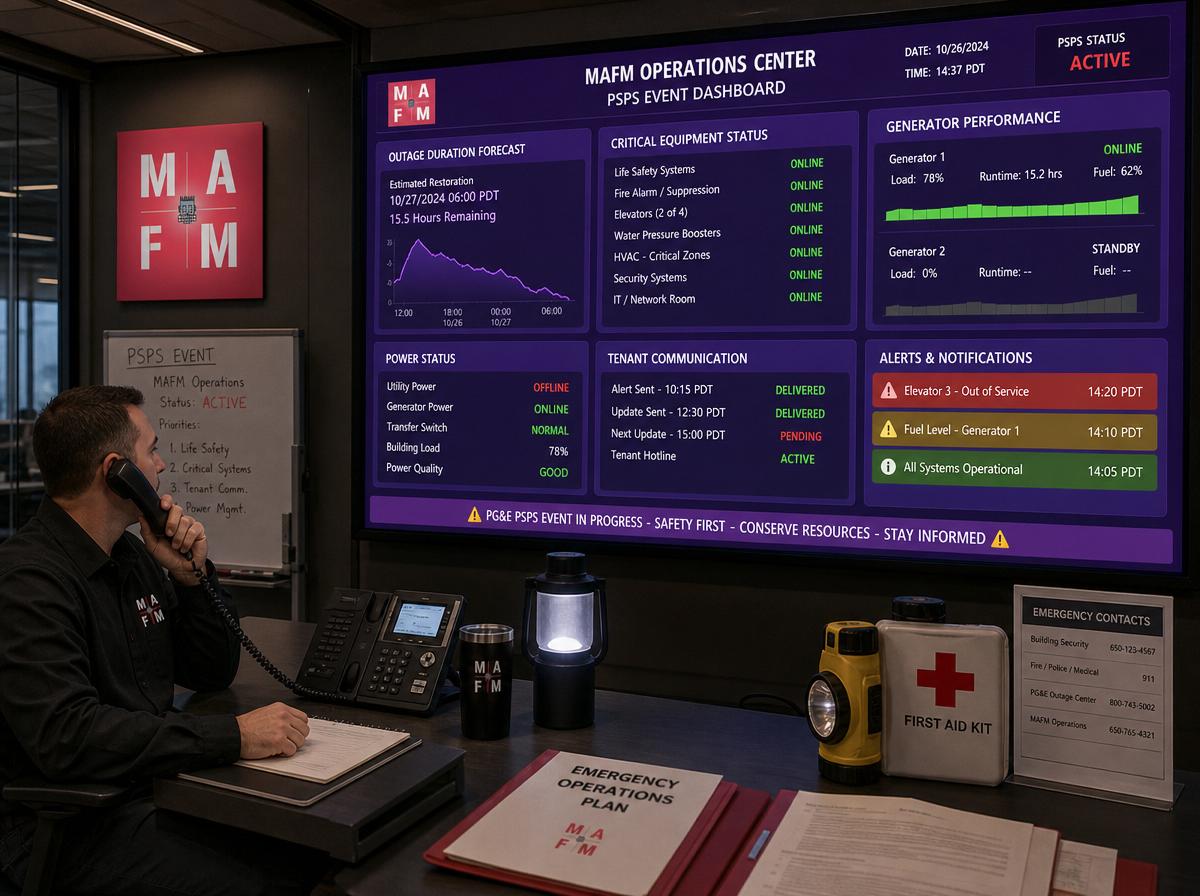
Public Safety Power Shutoff events have become a recurring operational reality for Silicon Valley commercial buildings. PG&E's PSPS program, which proactively deenergizes transmission lines when wind speed, humidity, and fire weather forecasts create extreme wildfire ignition risk, can affect buildings for 24 to 96 hours with notification windows as short as 48 hours before deenergization.
For building operators, a PSPS event is not a minor inconvenience to be managed on the fly. It is an operational disruption that affects every building system simultaneously: HVAC shuts down, lighting fails, elevators stop, fire alarm and access control systems shift to battery backup, refrigeration in break rooms and cafeterias loses power, and the building's operational status becomes uncertain for everyone in it.
The buildings that navigate PSPS events successfully, maintaining tenant safety, protecting building systems, and resuming normal operations quickly after power restoration, are those that built their PSPS management plans before the first event of the season rather than during it.
When PG&E notifies your building of an upcoming PSPS event, the clock starts on preparation activities that protect your building and your tenants during the outage.
Hours 0–4 after notification: Verify emergency generator status and fuel level. Test generator startup and confirm automatic transfer switch function. Calculate expected fuel consumption at anticipated load and verify available fuel duration. Contact your fuel delivery provider to schedule a pre-event delivery if your tank is below 75% capacity.
Notify all tenants with a clear, factual communication: the expected deenergization time, estimated restoration timeline, which building systems will be affected, which systems will continue on emergency power, and specific guidance for tenant operations including refrigeration management, elevator use restrictions, and remote work options.
Hours 4–12: Conduct a building walkthrough verifying that emergency lighting is charged and functional in all required locations, exit signs are illuminated, and all stairwells are safely lit for emergency egress. Test fire alarm monitoring communication to confirm that the monitoring center is aware of the upcoming event and has procedures for the PSPS period.
Review your critical tenant list (tenants with server rooms, refrigerated materials, medical equipment, or other time-sensitive infrastructure) and coordinate their specific needs. A server room tenant who needs cooling continuity requires your attention before power is lost, not after.
Hours 12–48: Position portable lighting equipment, emergency communication devices, and operational supplies where they will be needed. Brief your on-site team on their roles and decision authorities during the event. Establish communication protocols for after-hours contact if the event occurs outside business hours.
Your emergency generator is the operational backbone of the PSPS response, but its performance depends entirely on the preparation that precedes the event.
Load prioritization determines which building systems the generator supports during the event. Life safety systems (fire alarm, emergency lighting, exit signs) are typically already connected to emergency circuits that transfer automatically. Additional loads require deliberate prioritization based on the generator's capacity.
Most commercial building emergency generators are sized for life safety loads only, not for full building operation. A generator sized for 50 kW of life safety loads cannot support 200 kW of HVAC, elevator, and lighting simultaneously. Know your generator's rated capacity, know which loads are connected to emergency circuits, and know what can be added within the available headroom.
For buildings with generators sized only for life safety loads, identify which non-critical loads can be load-shed and which critical loads (server room cooling, medical equipment, refrigeration) might require supplemental portable generator support. Rental generator providers experience extreme demand during regional PSPS events; establish a priority rental agreement before fire season that guarantees availability when needed.
Generator fuel management during extended events requires active monitoring. Track fuel consumption against your tank capacity and the expected event duration. For events projected to exceed your fuel duration, arrange mid-event delivery before your tank drops below 25% to avoid the service interruption risk of running low during peak delivery demand.
Transfer switch testing before fire season confirms that automatic transfer from utility to generator power occurs correctly and within the specified time window, typically 10–15 seconds for life safety systems. A transfer switch that fails during an actual PSPS event leaves your building without emergency power at the moment it is most needed.
The operational impact on tenants during a PSPS event depends heavily on how the building is managed and how well tenants have prepared their own contingency plans.
Elevator management is the first operational question for multi-story buildings. Most commercial elevators will park at the nearest floor and open their doors when power is lost, then remain inoperable. Communicate to tenants before the event that elevators will be non-operational and that stairwells are the emergency egress path. For tenants with mobility limitations, coordinate elevator restoration to battery backup if your system supports it, or develop a specific accommodation plan.
HVAC management during extended outages requires balancing tenant comfort against generator capacity. Full HVAC operation is typically not supportable on a standard life safety generator. Partial HVAC operation, maintaining minimum ventilation in occupied spaces without full temperature control, may be achievable depending on generator capacity. Communicate realistic thermal comfort expectations to tenants before the event so they make appropriate remote work decisions.
Refrigeration management in tenant break rooms and cafeterias requires immediate guidance. A full refrigerator maintains safe food temperatures for approximately 4 hours without power. A full freezer maintains safe temperatures for 24–48 hours. Tenants should remove high-value or perishable items from break room refrigerators before extended PSPS events. For food service operations with significant refrigerated inventory, generator support or dry ice arrangements may be warranted.
Communications infrastructure (WiFi access points, phone systems, and security systems) should be evaluated for emergency power support. Your building's main communication equipment room may be on emergency power; individual floor access points typically are not. Communicate the expected communications impact clearly so tenants can make appropriate arrangements.
Building systems face risks during both the power loss and the power restoration phases of a PSPS event that active management can prevent.
HVAC thermal protection prevents damage to refrigerant systems from extreme temperatures during extended cooling season outages. Chillers and condensing units should be shut down properly through the building automation system before power is lost, rather than experiencing the voltage loss associated with utility deenergization. If possible, pre-program a controlled shutdown sequence that activates automatically when utility voltage drops below threshold.
Power quality protection at power restoration is a frequently overlooked vulnerability. When utility power is restored after a PSPS event, the restoration can include voltage transients and frequency variations that damage sensitive electronic equipment. Ensure that HVAC variable frequency drives, electronic controls, and other sensitive equipment is protected by appropriate surge suppression. Consider delaying the startup of large motor loads for several minutes after restoration to avoid the simultaneous inrush demand that stresses both the utility infrastructure and the building's electrical systems.
Data and security system integrity verification after power restoration confirms that access control databases, surveillance recording, and fire alarm system programming are intact. Some electronic systems lose configuration data during extended power events and require reprogramming before they are fully functional.
Each PSPS event is an operational exercise that reveals gaps in your preparation and creates specific improvement opportunities.
Document every system performance issue, every tenant concern, every operational decision, and every execution gap during the event. Within 24 hours of power restoration, compile these observations into an after-action report that becomes the foundation for pre-season preparation improvements for the following year.
Review your generator performance data against fuel consumption projections. If actual consumption differed significantly from projections, investigate whether load assumptions were incorrect or whether system performance during the event changed the consumption profile.
Survey tenants after each significant PSPS event to assess their experience and identify the specific gaps in building support that created the most operational disruption. Tenant feedback from actual events is more valuable than any tabletop planning exercise for identifying preparation priorities.
PSPS events are recurring operational challenges that test every aspect of building emergency management simultaneously. The buildings that perform well, keeping tenants safe, minimizing operational disruption, and restoring normal operations quickly after restoration, are those that treat PSPS preparation as a professional obligation rather than an inconvenient possibility.
Confirm your generator is ready this week. Establish your tenant notification protocols. Pre-stage your PSPS management checklist. Build your fuel delivery relationship. The first PSPS event of 2026 is a question of when, not whether. Be ready before it arrives.
MAFM manages PSPS events with pre-established protocols that protect tenants and building systems through every stage of the outage. Contact us to assess your building's power outage readiness.
Schedule your consultation: Contact MAFM.PRO
MAFM offers comprehensive facility management solutions tailored to your business needs.
Get in Touch