Safety / Operations
Emergency Preparedness for Silicon Valley Facilities: The Disaster Recovery Framework Every Building Needs
March 11, 2026
June marks the official start of California's extended fire season, a period that now runs from early summer through late fall and that has fundamentally changed how Bay Area commercial building operators approach their seasonal management responsibilities. The catastrophic fire events of the past decade have moved wildfire preparation from an optional operational enhancement to a mandatory risk management function for every commercial property in Northern California.
The preparation window that June provides is short. By July, fire activity accelerates. By August and September, the combination of heat, low humidity, and Diablo winds creates the extreme fire weather conditions that drive the largest and most destructive events. Building operators who begin preparation in June have time to address every aspect of their fire season readiness program thoughtfully. Those who wait until the first red flag warning is issued in August are scrambling through preparation under the worst possible conditions.
Here is the comprehensive preparation guide that positions Silicon Valley commercial buildings for whatever this fire season delivers.
Defensible space management is the most direct fire risk reduction measure available to commercial building operators and the one most closely evaluated by insurers assessing wildfire risk.
Zone 1, extending 30 feet from the building perimeter, requires the most rigorous vegetation management. All dead and dying plant material must be removed. Combustible mulch within five feet of the building should be replaced with non-combustible alternatives, gravel, decomposed granite, or bare earth. Ornamental plantings should be spaced to prevent fire from spreading continuously to the building. Tree branches within 10 feet of the structure or within 6 feet of the ground should be removed.
Zone 2, extending from 30 to 100 feet, requires reduced fuel load management. Maintain spacing between trees and shrubs so that fire cannot crown from one plant to another. Mow grasses to 4 inches or lower. Remove all dead vegetation and debris. Limb trees up from the ground to the lower 1/3 of the tree's height.
Combustible storage elimination around the building exterior is frequently overlooked in commercial settings. Pallets, cardboard, wooden furniture, recycling bins, and landscape debris stored against or near exterior walls create fire pathways that defensible space vegetation management alone cannot address. Conduct a combustible storage audit of every exterior building face and eliminate or relocate all combustibles within 30 feet.
Roof and gutter clearing removes the accumulated organic debris that serves as ignition fuel for wind-driven embers. Commercial buildings with large flat roofs and rooftop equipment develop debris accumulation around equipment bases, in equipment wells, and along parapet walls that poses significant ignition risk during red flag conditions. Schedule a thorough rooftop inspection and cleaning as a June priority.
Ember-resistant upgrades to vents, attic openings, and under-eave gaps prevent the ember intrusion that ignites many fire-adjacent structure losses. Screen openings with 1/8-inch or smaller non-combustible mesh. Seal gaps in soffits, fascias, and roof-to-wall connections that could allow ember entry.
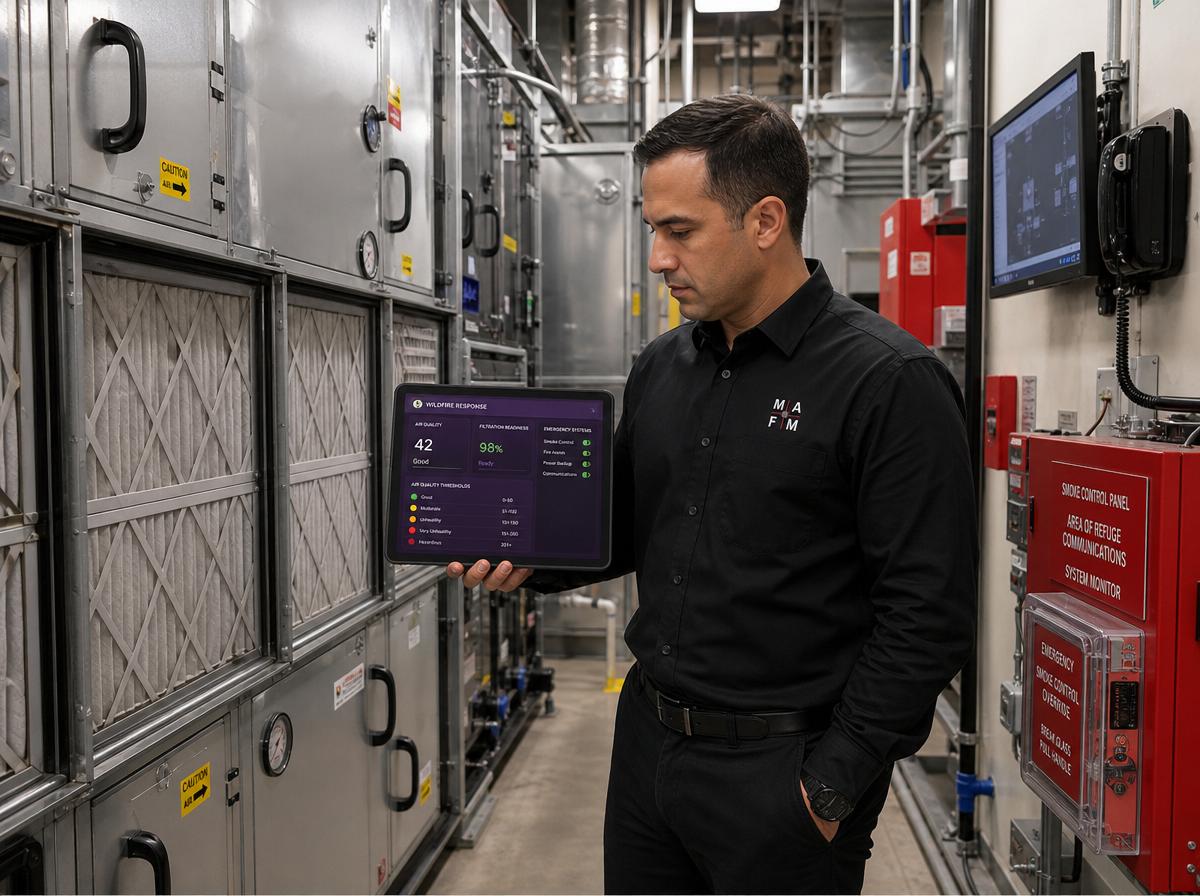
Wildfire smoke management through HVAC systems is a distinct operational challenge from general air quality management and requires specific preparation before fire season arrives.
Recirculation capability verification is the most critical HVAC preparation step. Your building must be able to operate in complete recirculation mode, closing all outdoor air dampers and circulating only interior air, when outdoor air quality is hazardous. Test this capability in June before you need it. Identify any economizer dampers that lack a full-close position, outdoor air intakes that cannot be isolated, or control sequences that do not properly initiate recirculation mode.
Buildings that discover in July that their HVAC cannot achieve full recirculation are in a desperate position. Damper actuator replacement, controls reprogramming, and ductwork modifications take weeks to procure and execute. The same work discovered and planned in June can be completed before the first significant smoke event.
Filter pre-staging ensures that when a smoke event requires filter replacement mid-season, your building has inventory rather than waiting days for delivery during regional supply shortage. Order one complete set of replacement filters for every air handling unit and store them in a dry, accessible location. If your building has upgraded to MERV 13 filters, ensure your staged inventory matches the upgraded specification.
Air quality monitoring protocol establishment creates a clear decision tree for your team: at what AQI level do you initiate recirculation? At what level do you deploy supplemental filtration? At what level do you communicate with tenants? Build this protocol in writing so that the response during an actual event is execution, not decision-making under pressure.
Portable HEPA unit deployment planning identifies the spaces where supplemental air filtration would be most valuable during extended smoke events. Large open-floor offices, conference rooms with high occupancy, and lobby spaces where tenants congregate all benefit from portable HEPA units during sustained poor air quality periods. Identify the units you will deploy and confirm they are in working order before June ends.
Fire season is the highest-demand period for every emergency building system, making June the essential verification window before those systems face their annual stress test.
Fire alarm system annual testing, if not yet completed for 2026, should be scheduled immediately. Testing conducted in June provides time to address any deficiencies identified before the period when alarm activation events are most likely.
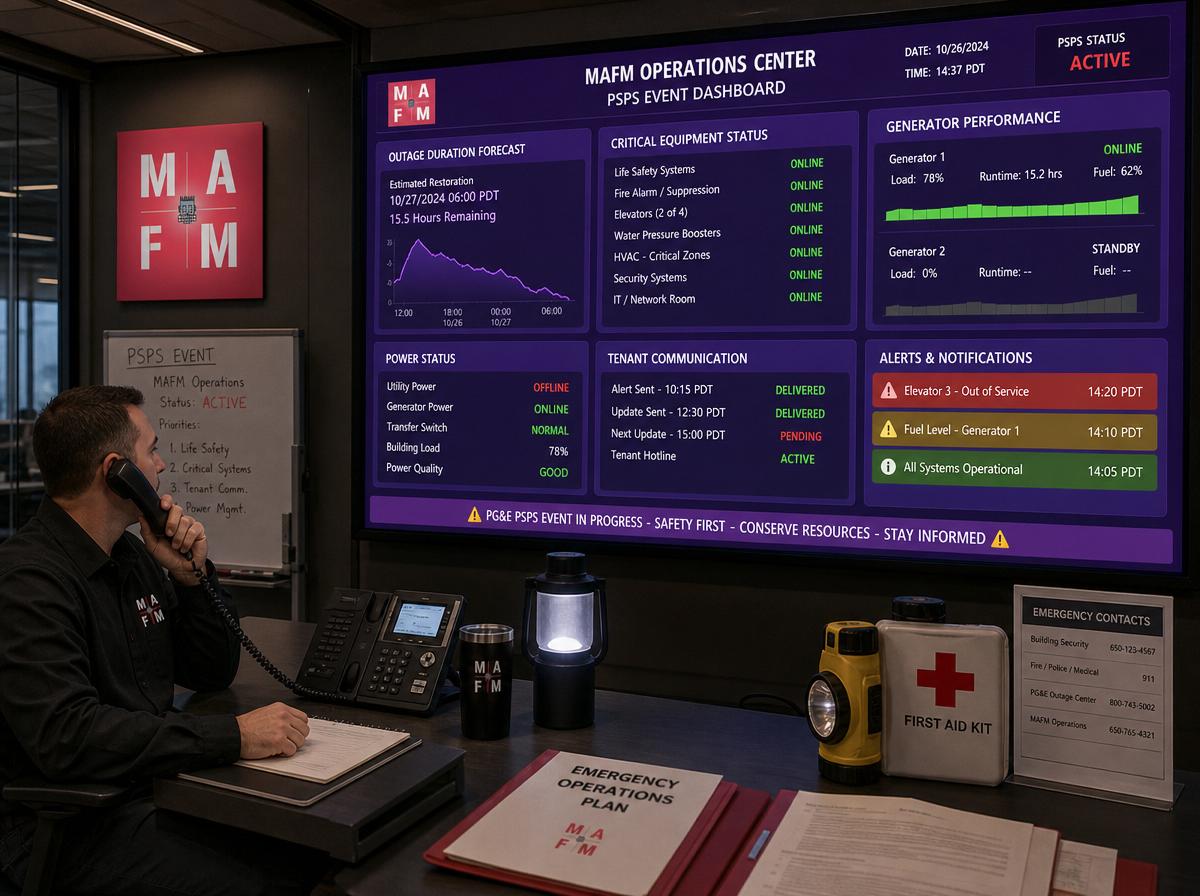
Emergency generator testing under full load verifies that the system can support all critical building loads during a utility outage, a scenario that accompanies both wildfire events (utility pre-emptive shutoffs) and wind events (infrastructure damage). If your annual full-load test has not been conducted this year, schedule it now. Verify fuel tank levels and establish a fuel delivery agreement that guarantees priority supply during regional emergencies when commercial fuel demand surges.
Emergency lighting and exit signage inspection confirms that every path of egress is properly illuminated if power is lost during an emergency. Smoke from nearby fire events can affect daytime visibility enough to make exit sign illumination critical even during daylight hours. Test every emergency luminaire and exit sign and replace any units that fail the 90-minute discharge test.
Emergency communication systems (public address capability, tenant notification platforms, and after-hours emergency contact protocols) require verification that every contact list is current and every system is operational. Fire season emergency communications are time-critical, and discovering a failed PA system or outdated tenant contact list during an actual emergency is an avoidable failure.
Fire season operations require coordination capability that normal building management does not demand. Establishing an operations framework before the season begins ensures that your building can manage complex, multi-agency events without improvising structure under pressure.
Incident command roles should be assigned and documented before fire season. For a commercial building, the relevant roles include incident commander (typically the senior facility manager or property manager), communications officer responsible for all tenant and external stakeholder communication, operations officer coordinating physical building response actions, and logistics officer managing supplies, equipment, and mutual aid contacts.
Pre-event decision authority matrix defines who can make which decisions without escalation. Can the facility manager initiate building evacuation independently, or does that require property owner authorization? Can HVAC recirculation be initiated without tenant notification, or is prior notice required? What authority exists to deploy emergency contractors without prior approval? Documenting these authorities before an event prevents the authorization delays that compromise response effectiveness.
Mutual aid agreements with neighboring commercial properties provide reciprocal support during large-scale events when individual building resources are insufficient. The adjacent building's emergency generator could serve your building if yours fails. Your building's water supply could support their emergency needs. These agreements, established before the season, convert neighboring buildings from independent entities into network resources.
Fire season tenant communication requires a proactive posture that keeps occupants informed without creating alarm, and a rapid-response capability for when conditions require immediate action.
Pre-season communication establishes the framework tenants need to understand before any event occurs. A June building-wide communication should cover your building's fire season preparation actions, the air quality threshold levels at which the building activates smoke protocols, what tenants can expect to receive during smoke events, and how tenants can monitor air quality conditions and access building status updates.
Event-specific communications during smoke events should be triggered by AQI thresholds you establish in advance. When outdoor AQI exceeds 100, send an advisory noting conditions and building response. When AQI exceeds 150, communicate that the building has initiated recirculation and describe any operational modifications. When AQI exceeds 200, communicate whether the building remains operational and provide guidance for tenants with health sensitivities.
Post-event communication closes the loop on each smoke event and builds tenant confidence in your management capability. A brief summary after each significant event (what conditions occurred, how the building responded, and what tenants experienced) demonstrates the operational transparency that distinguishes professional facility management from reactive scrambling.
California's fire season is not a risk to prepare for eventually, it is a risk that begins this month. The building operators who complete their preparation in June approach each subsequent weather event from a position of readiness. Those who defer preparation until conditions demand response are permanently behind.
Execute your fire season preparation checklist this week. Defensible space clearance, HVAC recirculation testing, filter pre-staging, emergency system verification, operations planning, and tenant pre-season communication all have June deadlines. The preparation investment is modest. The readiness it produces is irreplaceable.
MAFM executes comprehensive fire season preparation across every property we manage, ensuring our clients' buildings are ready before the first red flag warning of the year. Contact us for a fire season readiness assessment.
Schedule your consultation: Contact MAFM.PRO
MAFM offers comprehensive facility management solutions tailored to your business needs.
Get in Touch