
Strategy / Operations
Multi-Site Facility Management: How Silicon Valley Portfolio Operators Achieve Consistency Across Every Property
April 13, 2026
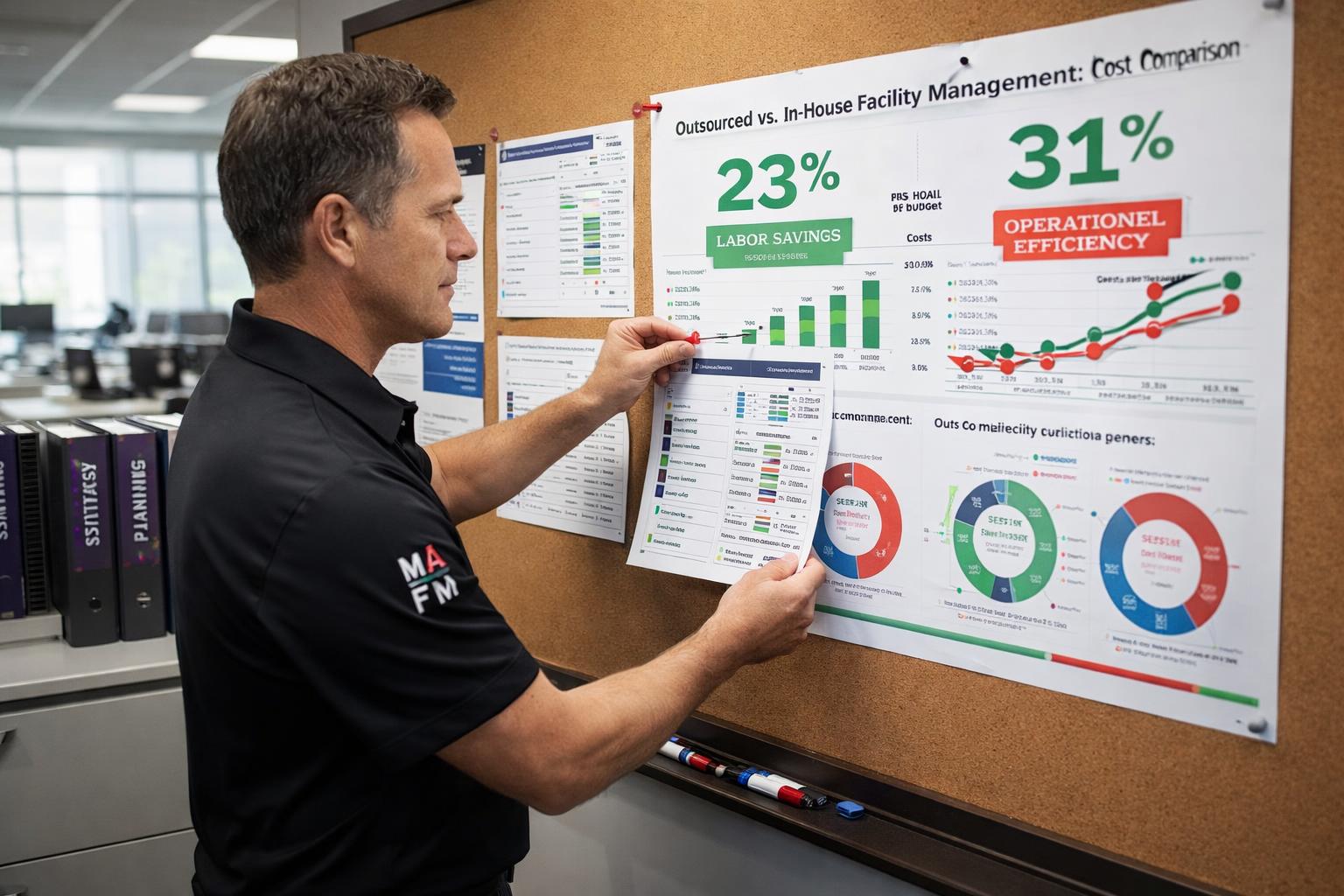
The question of whether to outsource facility management or build an in-house team is one of the most consequential operational decisions a Silicon Valley property owner faces. Get it right, and your buildings run efficiently with predictable costs and consistent quality. Get it wrong, and you either overpay for mediocre outsourced service or struggle with the hidden complexity of managing your own workforce.
The answer is not universal. Buildings with different profiles, ownership structures, and operational requirements benefit from different models. What works for a single-building owner-occupant fails for a multi-property investment portfolio, and what works for a Class A trophy tower fails for a suburban flex-industrial campus.
Here is the framework that strips emotion and vendor bias from the decision and produces a clear, data-driven answer for your specific situation.
The most common mistake in the outsource-versus-in-house analysis is comparing the wrong numbers. Property owners who look only at the outsourced contract price versus in-house labor cost consistently underestimate the true cost of in-house operations.
In-house facility management carries costs that do not appear on the janitorial line item. Workers' compensation insurance for cleaning staff in California runs significantly higher than standard commercial general liability coverage. Payroll taxes, health insurance contributions, paid leave accrual, and unemployment insurance add 25-35% to base labor costs. Equipment purchase, maintenance, and replacement create capital expenditure requirements. Chemical and supply procurement demands purchasing staff time, storage space, and inventory management. Supervisory overhead (the management time required to recruit, train, schedule, and oversee cleaning staff) consumes facility manager capacity that could be directed toward higher-value activities.
When these fully-loaded costs are calculated accurately, in-house operations for a typical 50,000 square foot Silicon Valley office building cost $2.80-$4.20 per cleanable square foot annually. Outsourced contracts for comparable scope and quality typically fall between $2.50-$3.80 per square foot. The cost advantage of outsourcing is real but narrower than most vendor proposals suggest.
The cost comparison becomes more nuanced for larger portfolios. Properties exceeding 200,000 square feet or portfolios with three or more buildings can achieve economies of scale with in-house operations that close or eliminate the cost gap. Shared supervision, bulk purchasing, and flexible staff deployment across multiple buildings create efficiencies that single-building in-house operations cannot access.
Cost is only half the equation. Quality consistency and operational control often matter more than the cost difference between models.
In-house operations provide maximum control over staffing decisions, training content, chemical selection, equipment standards, and day-to-day work priorities. When your cleaning staff reports directly to your facility manager, changes in scope, scheduling, or quality standards can be implemented immediately without contract amendment negotiations. Staff continuity tends to be higher because in-house employees often feel greater connection to the building and its occupants.
The downside of in-house control is that it comes with in-house responsibility. Every HR issue, worker injury, staffing shortage, and performance problem lands on your desk. Finding replacement staff for sick calls, managing worker disputes, handling terminations, and maintaining compliance with California's complex labor regulations all consume management bandwidth.
Outsourced operations transfer operational risk and management burden to the service provider. Staffing gaps become the vendor's problem to solve. Workers' compensation claims are managed under the vendor's policy. Training programs, equipment maintenance, and chemical compliance fall under the vendor's responsibility.
The quality risk with outsourcing is the principal-agent problem: the vendor's financial incentive to maximize profit by minimizing labor hours conflicts with your quality expectations. This tension is manageable through proper contract structure, performance accountability, and active oversight, but it requires that someone on your team invests the time to monitor vendor performance consistently.
Modern facility management increasingly demands specialized expertise that in-house operations struggle to maintain cost-effectively.
Floor care technology, green cleaning chemistry, infection prevention protocols, building automation integration, and regulatory compliance all require training and knowledge that evolve continuously. An outsourced provider serving dozens of Silicon Valley properties invests in this expertise once and deploys it across their entire portfolio. An in-house operation must develop and maintain the same expertise for a single building, which often means the investment never happens and the building operates with outdated methods.
Equipment is another specialization factor. Commercial floor machines, carpet extractors, pressure washers, and specialized cleaning equipment represent significant capital investment. An outsourced provider amortizes this equipment across multiple accounts, keeping technology current and well-maintained. In-house operations often run aging equipment long past its optimal performance life because replacement capital is difficult to justify for a single building.
For specialty services (window cleaning, post-construction cleaning, emergency water extraction, periodic deep cleaning) even buildings with in-house programs typically outsource these functions because maintaining the specialized skills and equipment in-house is economically impractical.
Despite the general efficiency advantage of outsourcing, several building profiles genuinely benefit from in-house facility management.
Owner-occupied single-tenant buildings where facility staff serve multiple roles beyond cleaning (light maintenance, receiving, event setup, errand running) often find in-house staff more versatile and cost-effective than a contracted cleaning service supplemented by additional contracted support functions.
Properties with extremely high security requirements where staff vetting, access control, and information sensitivity make frequent personnel changes unacceptable benefit from the staffing stability that in-house employment provides. Defense contractors, financial institutions, and certain technology companies fall into this category.
Large portfolios with dedicated facility management leadership that can absorb the supervisory overhead and leverage economies of scale across multiple buildings achieve cost parity with outsourcing while maintaining maximum operational control.
Buildings with unique operational requirements that standard janitorial contracts cannot accommodate efficiently (24/7 manufacturing facilities, medical environments, research laboratories) sometimes find that in-house staff trained specifically for their environment outperform contracted cleaning crews attempting to adapt generic procedures.
Outsourcing delivers the strongest advantage in scenarios where the property owner lacks the infrastructure or inclination to manage facility labor directly.
Multi-tenant investment properties managed by third-party property management companies almost universally benefit from outsourced facility services. The property management company already functions as an oversight layer, making the principal-agent concern manageable, and the property owner has no interest in becoming a janitorial employer.
Properties under 100,000 square feet where the supervisory overhead of in-house operations represents a disproportionate cost relative to the cleaning labor itself are natural outsourcing candidates. The management complexity of even a five-person cleaning crew (scheduling, training, HR administration, supply management) exceeds what most small-property facility managers can absorb alongside their other responsibilities.
Properties in transition (changing ownership, repositioning for new tenant markets, or undergoing major renovation) benefit from the flexibility of outsourced contracts that can scale up, scale down, or transition without the employment commitments of in-house staff.
The fastest-growing facility management model in Silicon Valley is neither pure in-house nor pure outsource, it is a hybrid that captures the advantages of both.
In the hybrid model, a small core of in-house staff handles the functions that benefit most from direct employment: day porter services, tenant interaction, light maintenance, and building-specific institutional knowledge. Outsourced providers handle the functions that benefit most from specialization and scale: nightly cleaning operations, floor care programs, specialty services, and periodic deep cleaning.
This model gives property managers direct control over the tenant-facing experience while leveraging outsourced efficiency for scope-driven production work. It also provides a natural backup system, in-house staff can cover temporary gaps in outsourced service, and the outsourced provider can scale up if in-house staffing challenges emerge.
The hybrid model works best when the roles are clearly delineated and both the in-house team and outsourced provider understand their respective responsibilities without overlap or gap.
The outsource-versus-in-house decision is not a philosophical debate, it is a business analysis that should be driven by your specific portfolio size, property type, management infrastructure, and operational priorities. Run the fully-loaded cost comparison honestly, evaluate your management capacity realistically, and match the model to your building's actual profile.
For most Silicon Valley commercial properties, outsourcing provides the strongest combination of cost efficiency, risk transfer, and specialized capability. For specific property types and portfolio sizes, in-house or hybrid models deliver superior results. The right answer is the one your data supports.
MAFM PRO provides outsourced facility management that delivers in-house-quality service with the efficiency and expertise of a specialized provider. Contact us to discuss which model best fits your portfolio.
Schedule your consultation: Contact MAFM.PRO
MAFM offers comprehensive facility management solutions tailored to your business needs.
Get in Touch