Strategy / Operations
Outsourcing vs. In-House Facility Management: The Decision Framework for Silicon Valley Property Owners
April 6, 2026
Managing a single building well is challenging. Managing five, ten, or twenty buildings to the same standard is an entirely different operational problem. The strategies that work for a single-property facility manager (personal oversight, direct relationship management, hands-on quality control) collapse under the weight of a growing portfolio. What replaces them determines whether a portfolio operator delivers consistent tenant experience across every property or accepts the inevitable quality variance that comes with growth.
Silicon Valley's commercial real estate market concentrates significant property portfolios in the hands of institutional owners, REITs, and private investment firms that expect uniform operational standards regardless of building age, size, or submarket. Meeting that expectation requires management systems designed for scale rather than individual building excellence replicated through sheer effort.
Here is the framework that portfolio operators use to achieve consistency without drowning in operational complexity.
Consistent outcomes across multiple properties require standardized inputs. Buildings managed under different scopes, different quality definitions, and different operational procedures will produce different results no matter how talented the individual facility managers are.
Develop a portfolio-wide operations manual that establishes uniform standards for every facility management function. This manual should define cleaning scope specifications by space type rather than by building, a Class A restroom receives the same service standard whether it is in your San Jose tower or your Mountain View flex building. Floor care programs, preventive maintenance schedules, vendor management protocols, and tenant communication procedures should all be documented at the portfolio level.
Standardization does not mean identical treatment. Different buildings have different requirements based on age, construction type, tenant profile, and market position. The standard defines the methodology and quality threshold. Building-specific supplements address the unique characteristics of each property within the standardized framework.
The operations manual serves as the training reference for every facility manager in your portfolio, the scope definition for every vendor contract, and the performance standard against which every property is measured. Without it, each building develops its own informal standards based on the preferences and habits of whoever happens to manage it.
The organizational structure that delivers multi-site consistency balances centralized strategic oversight with empowered local execution. Too much centralization creates bureaucratic delays that frustrate on-site teams and tenants. Too much local autonomy recreates the consistency problem that standardization was designed to solve.
The optimal structure places strategic functions at the portfolio level: vendor selection and contract negotiation, budget development and financial reporting, technology platform management, training program design and delivery, and quality audit methodology. These functions benefit from centralization because they leverage scale, ensure consistency, and reduce duplication.
Tactical execution belongs at the property level: daily cleaning supervision, tenant interaction and service response, routine maintenance execution, vendor coordination for site-specific work, and emergency response. These functions require local knowledge, immediate availability, and relationship-based judgment that centralized management cannot provide.
The connection between levels is the regional or portfolio facility director who translates strategic standards into operational reality, conducts regular property visits to verify execution quality, and serves as the escalation point for issues that exceed site-level authority.
For Silicon Valley portfolios spanning three to ten properties, a single portfolio director can maintain effective oversight with weekly property rotations, monthly performance reviews, and quarterly deep-dive assessments at each building.
Multi-site vendor management creates both leverage and complexity. The leverage comes from consolidated purchasing power, a portfolio offering five buildings to a single janitorial provider commands better pricing and more management attention than five individual building contracts. The complexity comes from maintaining quality consistency across multiple sites served by the same or different providers.
The strategic decision between single-vendor and multi-vendor approaches depends on portfolio geography and risk tolerance.
Single-vendor strategies, engaging one facility service provider across all portfolio properties, maximize leverage, simplify management, and create deep partnership. The risk is concentration: if the vendor underperforms, every property suffers simultaneously. Mitigate this risk through strong performance accountability provisions and the practical ability to transition properties individually if necessary.
Multi-vendor strategies, engaging different providers for different properties or property clusters, reduce concentration risk and create competitive tension that supports performance. The tradeoff is increased management complexity and reduced purchasing leverage.
The hybrid approach that many Silicon Valley portfolios adopt engages a primary vendor for the majority of properties while maintaining a secondary vendor on one or two buildings. This structure preserves most of the leverage advantage while keeping a viable alternative relationship active.
Regardless of vendor structure, standardized contracts are essential. Every vendor in your portfolio should operate under the same contract template with consistent scope definitions, performance standards, reporting requirements, and accountability provisions. Building-specific scope attachments customize service levels without diverging from the contractual framework.
Technology platforms are the most powerful tool for achieving multi-site consistency because they enforce standardized processes without requiring constant management oversight.
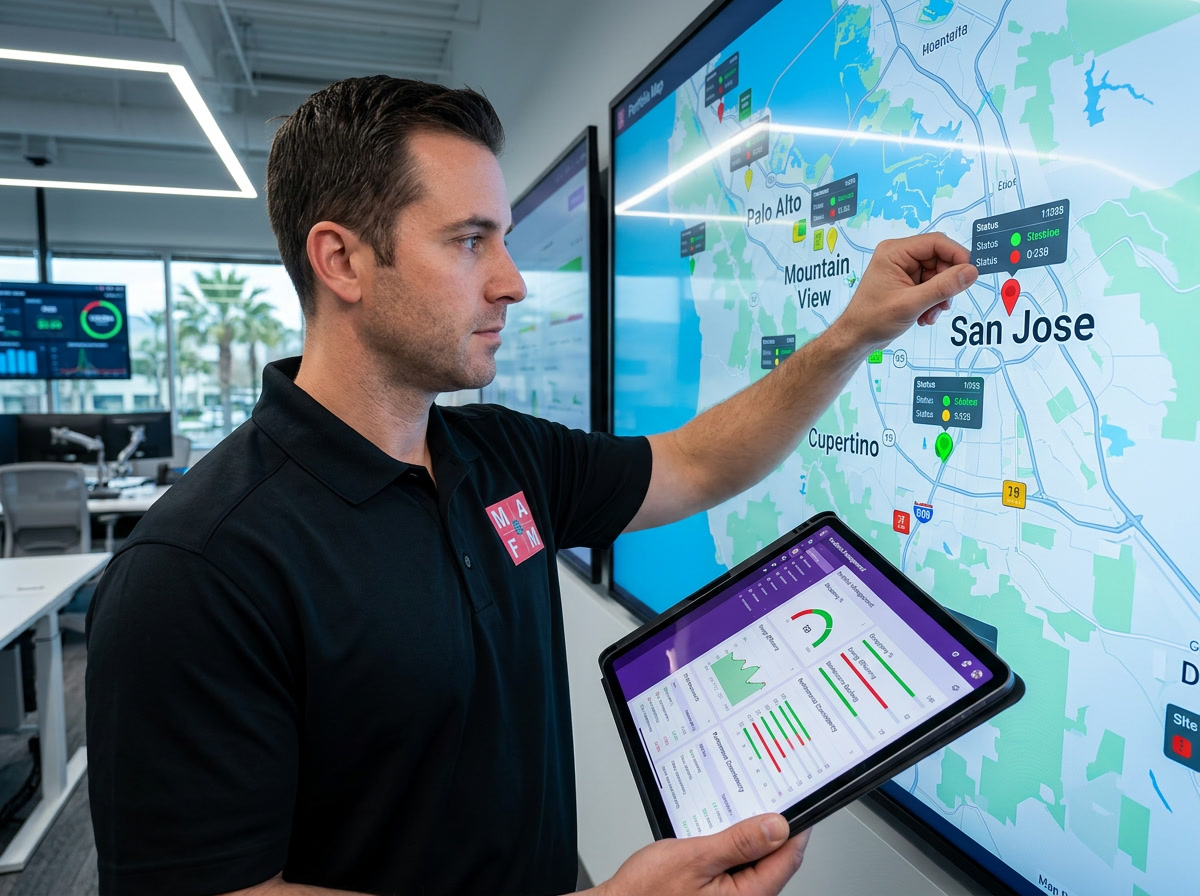
A portfolio-wide CMMS that connects every property into a single work order, preventive maintenance, and asset management platform provides centralized visibility that manual reporting cannot match. Portfolio directors can monitor work order volume, response times, PM compliance, and cost trends across all properties in real time from a single dashboard.
Standardized inspection platforms that deploy the same inspection criteria and scoring methodology across every property generate directly comparable quality data. When every building is inspected against the same checklist on the same schedule, portfolio-level quality analysis becomes meaningful and actionable.
Financial reporting systems that aggregate property-level cost data into portfolio dashboards reveal spending patterns, benchmark performance between properties, and identify outliers that require investigation. A property spending 30% more per square foot than a comparable building in the portfolio deserves scrutiny, and centralized reporting surfaces these variances automatically.
Mobile communication platforms that connect portfolio management with every on-site facility manager and vendor ensure that directives, alerts, and best practices propagate instantly across the entire portfolio rather than trickling through individual phone calls and emails.
Consistent quality requires consistent measurement. Portfolio-level quality auditing programs serve as the verification system that confirms whether standardization is actually producing standardized outcomes.
Implement a rotating audit schedule that brings portfolio-level inspectors to each property on a regular cycle. Monthly audits for high-priority properties and quarterly audits for stable performers provide adequate oversight without consuming excessive management bandwidth.
Audit methodology must be consistent and independent of on-site management. The portfolio auditor applies the same standards, uses the same tools, and evaluates the same elements at every property. Audit results that vary between properties reflect genuine quality differences rather than evaluator differences.
Benchmark every property against the portfolio average and against specific peer properties with similar profiles. Rankings create healthy competitive motivation among on-site managers and provide objective justification for intervention when specific properties underperform.
Share audit results transparently with on-site teams and vendors. Properties and vendors that know they are being measured against portfolio peers perform measurably better than those operating in isolation without comparative context.
Multi-site operations generate an advantage that single-property operations cannot access: the ability to learn from multiple operating environments simultaneously and transfer successful innovations across the portfolio.
When one property discovers an effective solution to a common problem, a cleaning technique that reduces restroom complaints, a preventive maintenance approach that extends equipment life, a tenant communication practice that improves satisfaction scores, that innovation should propagate to every applicable property in the portfolio.
Create formal mechanisms for best practice sharing. Quarterly facility manager meetings that bring on-site leaders together for peer learning are among the most valuable investments a portfolio operator can make. These sessions build peer relationships, facilitate knowledge transfer, and create a professional community that improves retention among management staff.
Document successful innovations in your operations manual as updated best practices. The manual should be a living document that evolves as your portfolio's collective experience grows.
Multi-site facility management is a systems challenge, not a staffing challenge. Adding more facility managers to a portfolio without the systems to support them simply multiplies inconsistency. Building the standardization, technology, vendor management, and quality assurance infrastructure outlined here creates a platform that scales efficiently and delivers the consistent tenant experience that institutional property ownership demands.
Evaluate your current portfolio management infrastructure against this framework. Identify the gaps between where you are and where consistency requires you to be. Close those gaps systematically, starting with the standardization foundations that everything else builds upon.
MAFM PRO serves multi-site portfolios across Silicon Valley with standardized operations, centralized oversight, and consistent quality at every property. Contact us to discuss portfolio-level facility management.
Schedule your consultation: Contact MAFM.PRO
MAFM offers comprehensive facility management solutions tailored to your business needs.
Get in Touch