Technology & Operations
How AI-Powered Facility Management Reduces Response Times by 67%
January 21, 2026
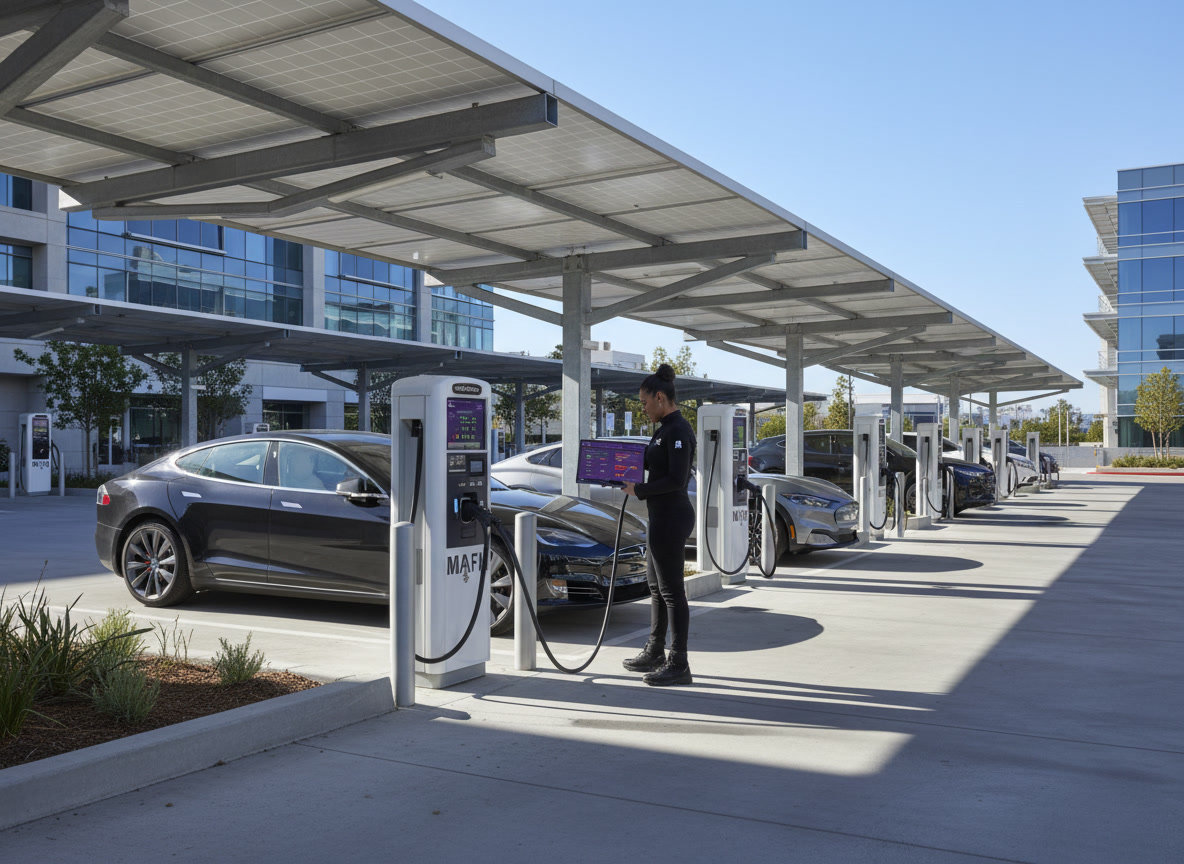
Electric vehicle charging infrastructure has crossed the threshold from tenant amenity to building necessity in Silicon Valley commercial real estate. Properties without EV charging are at a measurable leasing disadvantage, and the gap is widening as EV adoption accelerates across the Bay Area. Tesla, Rivian, and other EV manufacturers have saturated Silicon Valley's employee parking lots, and the tenants who drive these vehicles expect workplace charging as a standard building feature.
For facility managers, EV charging adds a new building system that requires operational management, maintenance attention, cost allocation, and tenant communication protocols that most FM professionals did not train for. The equipment is relatively straightforward, but the operational details (demand management, billing systems, maintenance scheduling, and capacity planning) create complexity that demands structured management.
Here is the comprehensive guide to operating EV charging infrastructure as a professional building amenity.
Commercial EV charging stations fall into three categories with fundamentally different cost, power, and use profiles.
Level 2 charging stations use 208 to 240V power and deliver 6 to 12 kW per connector, providing approximately 20 to 30 miles of range per hour of charging. Level 2 is the standard for workplace charging where vehicles park for extended periods. Equipment cost per connector runs $1,500 to $6,000 for the station plus $2,000 to $5,000 for electrical installation depending on distance from the electrical panel and existing infrastructure capacity.
DC Fast Charging stations deliver 50 to 350 kW and can charge a vehicle from 20% to 80% in 15 to 45 minutes. DCFC equipment costs $25,000 to $100,000 per station plus substantial electrical infrastructure investment. These stations are appropriate for retail, hospitality, and fleet applications but are generally unnecessary and cost-prohibitive for standard workplace parking.
For most Silicon Valley commercial office properties, Level 2 charging provides the optimal balance of tenant utility and cost efficiency. Employees who arrive in the morning and park for eight to ten hours receive a full charge from Level 2 equipment without the infrastructure expense of DC fast charging.
Network-connected stations that communicate through cellular or WiFi connections provide usage tracking, payment processing, remote monitoring, and energy management capabilities that non-networked stations cannot offer. The monthly networking fees, typically $15 to $30 per connector, are justified by the operational control they provide.
EV charging equipment requires regular maintenance that is distinct from standard electrical system maintenance.
Monthly visual inspections should verify connector condition, cable integrity, station housing condition, and indicator light function. Charging cables experience wear from daily connection and disconnection cycles, UV exposure, and vehicle traffic in parking areas. Frayed cables, cracked connectors, and damaged housings create safety hazards and liability exposure.
Quarterly electrical testing should verify circuit integrity, ground fault protection function, and power delivery accuracy. Charging stations include internal protective devices that can fail without visible indication, delivering less power than expected or failing to activate ground fault protection when needed.
Software and firmware updates for network-connected stations should be applied promptly when released by the manufacturer. Updates frequently address charging protocol compatibility with new vehicle models, security vulnerabilities in payment systems, and performance optimizations that improve reliability.
Cleaning and appearance maintenance ensures that charging areas present the same professional standard as other building amenities. Keep station surfaces clean, parking stall striping visible, and signage current. A charging area that looks neglected undermines the amenity value the equipment provides.
Establish a service relationship with a qualified EV charging equipment technician for repairs beyond routine maintenance. Many station manufacturers offer service contracts that provide priority response, and given the relatively specialized nature of the equipment, having a pre-established service relationship prevents extended downtime during equipment failures.
EV charging can represent a significant electrical load that affects both consumption costs and demand charges if not managed properly.
Load management systems distribute available electrical capacity across multiple charging stations, reducing or deferring individual station output during periods of high building demand. Without load management, a parking garage with twenty Level 2 stations can add 120 to 240 kW of simultaneous demand (equivalent to the cooling load of a 30,000 square foot office building) to your peak electrical demand.
Smart load management systems monitor building electrical demand in real time and throttle EV charging during peak periods, eliminating the demand charge impact that unmanaged charging creates. The cost of load management software, typically $10 to $25 per station monthly, is a fraction of the demand charge savings it produces.
Time-of-use scheduling that shifts charging to off-peak rate periods provides additional savings. Most network-connected stations support scheduled charging that delays session start until off-peak rates take effect. For Silicon Valley properties on TOU rate structures, shifting charging from peak to off-peak periods can reduce per-kWh charging costs by 40 to 60%.
Cost recovery models determine who pays for the electricity consumed by EV charging. Three common approaches exist. Free charging as a building amenity absorbs the cost into operating expenses, appropriate when charging demand is modest and the competitive leasing advantage justifies the expense. Cost-recovery charging that bills tenants or users at a rate matching the building's electricity cost recovers the direct expense without generating revenue. Revenue-generating charging that includes a margin above electricity cost creates a profit center, appropriate for properties with significant charging demand and a willingness to manage the billing administration.
EV adoption is accelerating, and the charging demand at your building will grow annually. Planning for future capacity now avoids the expensive retrofit of electrical infrastructure later.
Survey your current tenant base to understand existing EV ownership and expected near-term purchases. A building where 15% of parked vehicles are currently electric may see that percentage reach 30 to 40% within three years based on Silicon Valley adoption trends.
Install electrical conduit and panel capacity for future charging stations when you install your initial deployment. The marginal cost of running conduit and sizing panels for twenty stations while installing ten is a fraction of the cost of trenching, running conduit, and upgrading panels later. This make-ready approach is increasingly required by California building code for new construction and major renovations.
Implement a charging access policy that balances current demand with future growth. As EV adoption increases, dedicated charging spaces that serve a single vehicle all day become inefficient when other vehicles need charging. Policies that require vehicles to vacate charging spaces after reaching full charge, enforced through session time limits and notification systems, maximize the utility of each charging station.
Clear communication about EV charging availability, rules, and costs prevents the conflicts that arise when demand exceeds supply or expectations do not match reality.
Publish a written EV charging policy that covers who is eligible to charge, how sessions are initiated and billed, time limits and parking enforcement for charging spaces, consequences for ICE vehicles parking in charging spaces, and the process for requesting additional charging capacity.
Communicate charging station status proactively. Network-connected stations provide real-time availability data through mobile apps that tenants can check before walking to the garage. Promoting app adoption reduces the frustration of walking to the charging area to find all stations occupied.
Manage the transition period as demand grows. When a building has ten charging stations and twelve EVs that need daily charging, conflicts are inevitable. Implement a waitlist system, charging rotation schedule, or time-limited sessions that distribute available capacity fairly until additional stations can be installed.
EV charging infrastructure is a building system that will only grow in importance as adoption continues its upward trajectory across Silicon Valley. Facility managers who establish professional management practices now, structured maintenance, intelligent energy management, strategic capacity planning, and clear tenant communication, position their buildings as EV-ready properties that attract and retain the workforce that increasingly expects workplace charging.
Evaluate your building's current EV charging infrastructure against the management framework outlined here. If you have not yet installed charging, start your planning process now. If you have existing stations, verify that your maintenance, energy management, and capacity planning are adequate for the growth that is coming.
MAFM PRO manages EV charging infrastructure as part of comprehensive facility operations for Silicon Valley commercial properties. Contact us to discuss your building's EV readiness strategy.
Schedule your consultation: Contact MAFM.PRO
January 21, 2026
March 6, 2026
March 10, 2026
MAFM offers comprehensive facility management solutions tailored to your business needs.
Get in Touch