
Janitorial & Cleaning
Winter Lobby Floor Protection for Silicon Valley Buildings
January 19, 2026
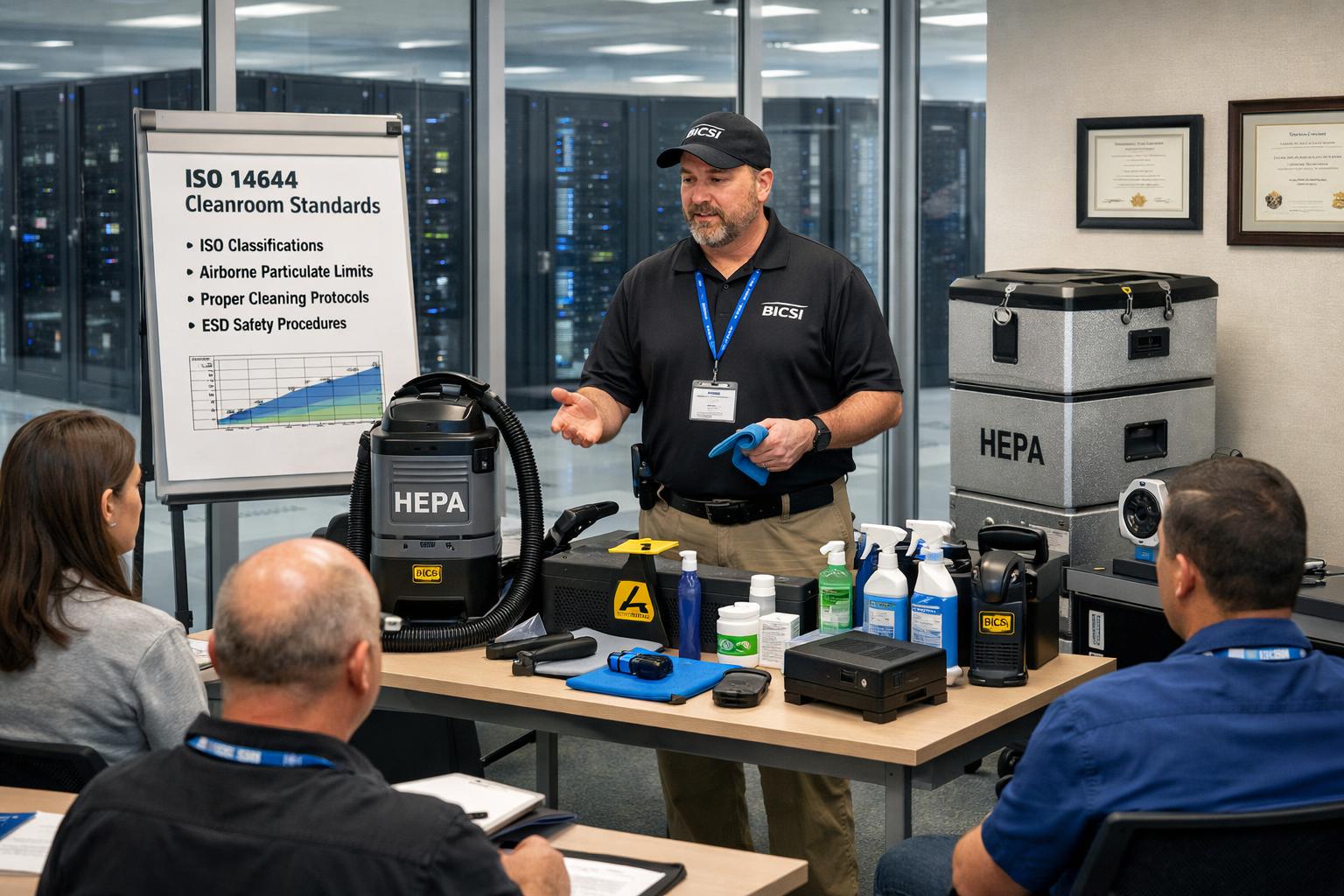
Data center cleaning in San Jose is contamination control, not housekeeping. The data hall is held to a measured air cleanliness standard, the floor can hold conductive debris, and ordinary mops, vacuums and chemicals can add the very particles and static charge the room is built to keep out. A standard office cleaning scope does not cover any of that.
That does not mean the whole facility needs specialist crews. Most data center buildings are a mix of white space (the equipment halls), gray space (support rooms and docks) and ordinary offices. This post explains what changes in the white space, where a facility manager draws the line, and how a facilities management partner helps coordinate the work.
Because the risks in a data hall are different from those in an office. An office crew works to look, smell and hygiene. A data hall is held to a particle limit, a tight temperature and humidity envelope, and a rule that nothing conductive or shedding may enter the airstream that feeds the servers.
A practical way to see the gap is to compare what each space can tolerate:
The facility's own operator writes the rules for who may enter the white space and what they may bring. A cleaning vendor works inside that written procedure, not around it.
Zinc whiskers, fibrous dust and wetted ionic dust are the main ones, and most come from the building, not from the outdoors. The best primary reference is the ASHRAE Technical Committee 9.9 white paper on data center contamination, written by committee members from IT equipment manufacturers and published in 2009. Its findings are still the basis for most operator rules.
The paper also says most data centers are in relatively clean environments and most contamination is benign, so the point is control, not alarm.
The usual target is ISO 14644-1 Class 8. The ASHRAE white paper says data centers must be kept clean to ISO Class 8, and its table sets the Class 8 limit at 3,520,000 particles per cubic meter at 0.5 micrometers and larger. Class 7, a stricter level, is 352,000.
For data centers without airside economizers, the paper says Class 8 can be met by filtering room air with MERV 8 filters and incoming air with MERV 11 or MERV 13 filters. Air-side economizers need filter choices based on site conditions.
A 2026 article in IFMA's Facility Management Journal puts the same idea in a facility manager's terms: most modern data halls target ISO Class 8 or better, and the room is measured, not assumed. A visual check is not evidence. Ask your operator which class applies to which room and who owns the particle count.
Slowly, in a set sequence, by people trained for it, with the room's pressure and airflow kept in mind. The IFMA article calls sub-floor cleaning a highly specialized engineering task. It describes keeping the main data hall at positive pressure relative to the sub-floor being cleaned so contaminants do not rise into the equipment area, working from the top surfaces down and from deep in the room toward the exit, and using sub-floor carts and HEPA vacuums to access the plenum in sequence.
Why the care? Lifting a tile disturbs both the airflow and anything loose beneath it. NASA documented whisker debris shed during maintenance activity, and the ASHRAE paper says whiskers can be dislodged when tiles are removed. Where whiskers are confirmed, the paper says remediation involves replacing the contaminated tiles and hiring professionals to clean the data center.
MAFM does not perform sub-floor or white-space technical cleaning itself. That work belongs with a specialist contractor approved by the operator. What a facility management partner can do is schedule it, line it up with maintenance windows, and make sure the office and support spaces around it are handled consistently.
Only what the operator approves, and usually less than you would expect. The common elements are consistent across the sources we reviewed:
Every chemical brought into the building also falls under hazard communication rules. Keep a current safety data sheet for each one, as required by 29 CFR 1910.1200, and have the operator approve the product list before work starts.
Split the building by risk, and write the split down. A simple three-way model works for most San Jose data center campuses:
The seams matter most. Decide who cleans the entry vestibule, where cleaning carts are staged, how trash leaves the building, and which door each crew uses. Matting at the transitions out of the dock and into support areas is cheap insurance, and our guide to entryway matting systems covers how to size it.
If you are also reviewing your air filtration, see our guide to HEPA filtration for Silicon Valley facilities.
Downtime is expensive enough that cleaning is an input to risk management, not just a line item. Uptime Institute's 2026 outage analysis announcement reports that in its 2025 annual survey, 57% of respondents said their most recent major outage cost more than $100,000, and for the second consecutive year 1 in 5 reported costs exceeding $1 million.
Those figures come from outages of all causes, and contamination is only one of them. We found no reliable published price per square foot for specialist data center cleaning, so do not trust a figure quoted without a scope. Compare bids on scope: which spaces, which equipment, how often, what particle-count verification and what reporting.
How often should a data center be cleaned?
There is no single published schedule. Frequency depends on the room's ISO class target, the operator's written procedure, the building's construction activity and what particle monitoring shows. Ask the operator for the schedule it already uses and align your support-space cleaning to it.
Can our regular cleaning company clean the server room?
Only if the operator approves the company, its equipment, its chemicals and its training for that room. A standard vacuum is not acceptable, per the IFMA article, so most buildings keep the white space with a specialist and use the regular crew for offices and support areas.
What is ISO Class 8 in plain terms?
It is a limit on airborne particles: no more than 3,520,000 particles per cubic meter at 0.5 micrometers and larger, per the ASHRAE white paper's table. It is the cleanliness level ASHRAE says data centers must be kept to.
Why do zinc whiskers matter?
They are tiny conductive filaments that can grow on zinc-coated floor parts and, if dislodged and drawn into equipment, can cause short circuits. NASA documented this on computer room floor tiles. Disturbing tiles and cables is the usual trigger.
MAFM is a facilities management company based in San Jose. We run janitorial service for the offices and support areas around technical spaces, and we plan and coordinate specialist vendors, access and schedules so the pieces fit. Talk to us about facility management, or look at our janitorial services and our work in San Jose.
MAFM offers comprehensive facility management solutions tailored to your business needs.
Get in Touch
