Budgets & Contracts
Reduce Facility Operating Costs in Silicon Valley, 2026
January 12, 2026
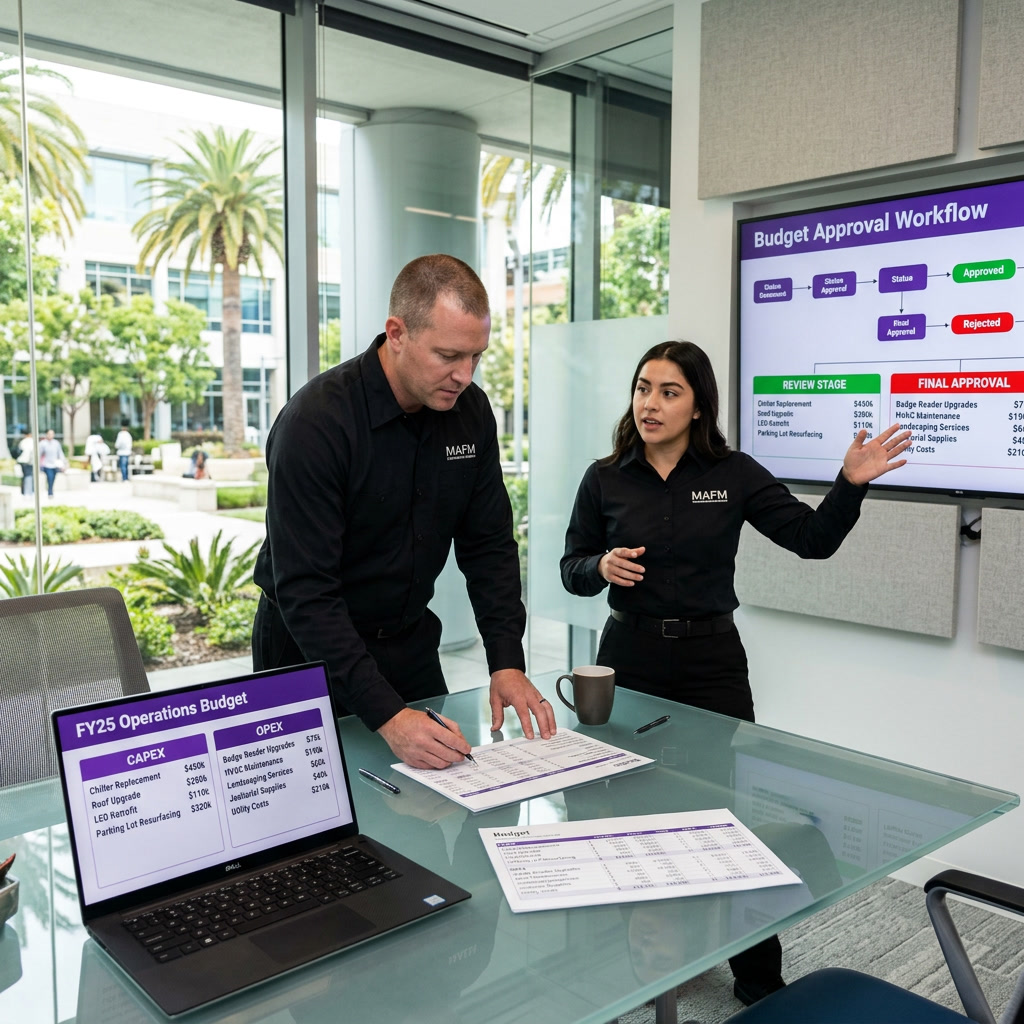
Yesterday we kicked off this week's series on locking in Q4 facility management budgets, and today we're digging into the single most common reason a facility budget bounces back from finance for revisions: misclassified spend. Every October, facility managers across Silicon Valley submit line items that make perfect operational sense (replace the aging chiller, resurface the parking lot, upgrade the badge readers) only to have finance kick them back because they were coded as opex when they should have been capex, or vice versa. That round trip costs two to three weeks minimum, and in a Q4 cycle that's already compressed by holidays and fiscal year-end close, two weeks can mean the difference between getting a project approved this fiscal year or pushing it into 2027.
The capex/opex distinction isn't just an accounting technicality. It determines whether a cost hits your operating budget this quarter or gets depreciated over 5-15 years, whether it needs a separate capital approval workflow (often requiring sign-off above the facility director level), and whether it affects the property's NOI calculations that matter to ownership or REIT reporting. For a multi-tenant commercial property or a corporate campus with a mixed portfolio of owned and leased buildings, getting this wrong on a $180,000 rooftop unit replacement or a $95,000 elevator modernization isn't a small clerical error: it's the kind of mistake that gets a budget package sent back to the bottom of the review pile.
This post walks through how to classify facility spend correctly before you submit, using the categories that actually matter for the buildings we manage across Santa Clara, San Mateo, and Alameda counties: HVAC and mechanical systems, building envelope and structural work, technology and life-safety systems, and routine maintenance contracts. Get this right in your Q4 submission and you avoid the rejection cycle entirely.
The IRS tangible property regulations (the "repair regs" under Section 263(a)) give facility managers a workable framework, even if your specific company applies its own internal thresholds on top of it. The basic test is whether the work restores an asset to its previous operating condition (repair, generally opex) or whether it materially increases the asset's value, capacity, or useful life (improvement, generally capex). A compressor replacement on a 12-year-old rooftop unit that keeps the unit running as designed is typically a repair. Replacing the entire RTU with a higher-efficiency unit that changes the building's cooling capacity is an improvement.
Where facility managers get tripped up is the "unit of property" question. If you're replacing one of four RTUs serving a 40,000 square foot building, is that RTU itself the unit of property, or is the entire HVAC system? Most internal capitalization policies we see in Silicon Valley portfolios treat each RTU as its own unit of property, which means single-unit replacement usually opex, but a phased replacement of all four units across two fiscal years often gets treated as one capital project by finance, even if you submitted it in pieces. If you know you're planning phase two in Q1 2027, flag that in your Q4 submission narrative now: finance will find the connection eventually, and it's better if you're the one who surfaces it.
The other common trap is bundling. A routine PM visit that turns into "while we're up there, let's also replace the belts, the filters, and the economizer actuator" can blur a $1,200 repair ticket into a $14,000 invoice that looks like capital work. Keep repair line items and improvement line items on separate purchase orders whenever the vendor visit covers both, even if it means an extra PO. It's a five-minute administrative step that saves a much longer finance conversation in November.
The federal de minimis safe harbor allows companies with an applicable financial statement to expense items up to $5,000 per invoice or item without capitalizing, and $2,500 for companies without one. But almost every mid-size and large company we work with in Silicon Valley has set its own internal capitalization threshold, and those numbers vary widely: we've seen everything from $2,500 to $25,000 as the line where a facility cost automatically routes to capex regardless of the repair-vs-improvement test.
Before you finalize your Q4 line items, confirm your current fiscal year threshold with your finance business partner, not last year's number. We've seen companies raise their threshold from $5,000 to $10,000 specifically to reduce capex committee overhead, which means projects that required capital approval in FY2025 can be submitted as straight opex in Q4 2026. That's good news if you have a backlog of $6,000-$9,000 projects (door hardware upgrades, small pump replacements, patch paving repairs) that were previously stuck waiting for capital committee review. Confirming the threshold before submission, rather than after rejection, can shift $30,000-$50,000 of pending work from the capital queue into your operating budget where you have more direct authority to execute.
Also confirm whether your threshold applies per invoice or per project. A single vendor invoice for $4,200 in door closer replacements across six suites might individually qualify for opex treatment, but if finance aggregates it as one $4,200 "door hardware project," that's still under most thresholds: but if you're doing $4,200 in door closers this month and another $3,800 in panic hardware next month as part of the same tenant improvement scope, some finance teams will aggregate those as a single $8,000 project that now crosses the threshold.
Fire/life-safety and code compliance spending deserves its own conversation because it often doesn't follow the standard repair-vs-improvement logic cleanly, and getting it wrong has consequences beyond a bounced budget line. Fire alarm panel replacements, sprinkler system upgrades to meet current NFPA 13 standards, ADA path-of-travel corrections triggered by a permit pull, and elevator modernization required by updated Title 24 or ASME A17.1 code cycles are frequently capital in nature because they involve system-level replacement, but the urgency and compliance driver means they can't wait for a normal capital committee cycle the way a discretionary lobby renovation can.
For Q4 2026 submissions, separate your compliance-driven capital requests into their own category with the triggering authority named explicitly: the AHJ inspection report number, the permit condition, the insurance carrier's loss control recommendation. Finance committees move compliance-driven capex through faster when the narrative makes clear that delay creates liability exposure or occupancy risk, not just facility preference. We've seen $85,000 fire alarm panel replacements get emergency-approved in under a week when framed correctly against a Santa Clara County Fire Marshal notice, versus sitting in a standard capital queue for six weeks when submitted as a routine line item.
If you have known compliance work coming in Q1 or Q2 2027 (an elevator recertification cycle, a backflow preventer replacement tied to a water district notice) get it into the Q4 conversation now even if the spend won't hit until next year. Capital committees plan in rolling 12-18 month windows, and a heads-up now makes the eventual approval faster later.
The fastest way to avoid the rejection cycle is to submit a one-page classification memo alongside your Q4 budget line items, before finance asks for one. For every item over your company's de minimis threshold, include: the unit of property affected, whether the work is repair or improvement under the restoration/betterment/adaptation test, the useful life extension if any, and the internal threshold comparison. This is maybe 90 minutes of work across a full Q4 submission, and it consistently cuts review time in half based on what we've seen across the properties MAFM supports.
Bring your finance business partner into this conversation in late September, not late October. Most Silicon Valley corporate real estate and finance teams close their Q4 capital committee calendar by the second week of October, and a memo that arrives with your initial submission rather than in response to a rejection email signals that you understand their process: which tends to earn faster turnaround on future requests too.
Finally, keep a running log of classification decisions across the fiscal year. When the same question comes up in Q1 2027 (is this new RTU a repair or an improvement, does this door hardware project cross the aggregated threshold) you want a documented precedent from Q4 2026 rather than re-litigating the same judgment call with a different finance analyst who wasn't part of the original conversation.
Classification isn't the most exciting part of Q4 budget planning, but it's the part most likely to derail an otherwise well-built facility budget. A clean capex/opex split, confirmed thresholds, a separated compliance category, and a short classification memo turn a multi-week back-and-forth with finance into a same-cycle approval. Tomorrow we'll look at vendor contract renewals and how to time Q4 negotiations so you're locking in 2027 rates before annual escalation clauses kick in.
If your Q4 facility budget submission is stuck in a classification back-and-forth with finance, MAFM's facility finance advisory team can review your line items and build a defensible capex/opex memo before your next committee deadline.
Link to Monday's Week 36 series-opener post on locking in Q4 facility budgets, and forward-link to Wednesday's post on vendor contract renewal timing for 2027 rate locks.
IRS Tangible Property Regulations (Repair Regulations) guidance under Section 263(a); NFPA 13 Standard for the Installation of Sprinkler Systems.
MAFM offers comprehensive facility management solutions tailored to your business needs.
Get in Touch