Budgets & Contracts
Reduce Facility Operating Costs in Silicon Valley, 2026
January 12, 2026
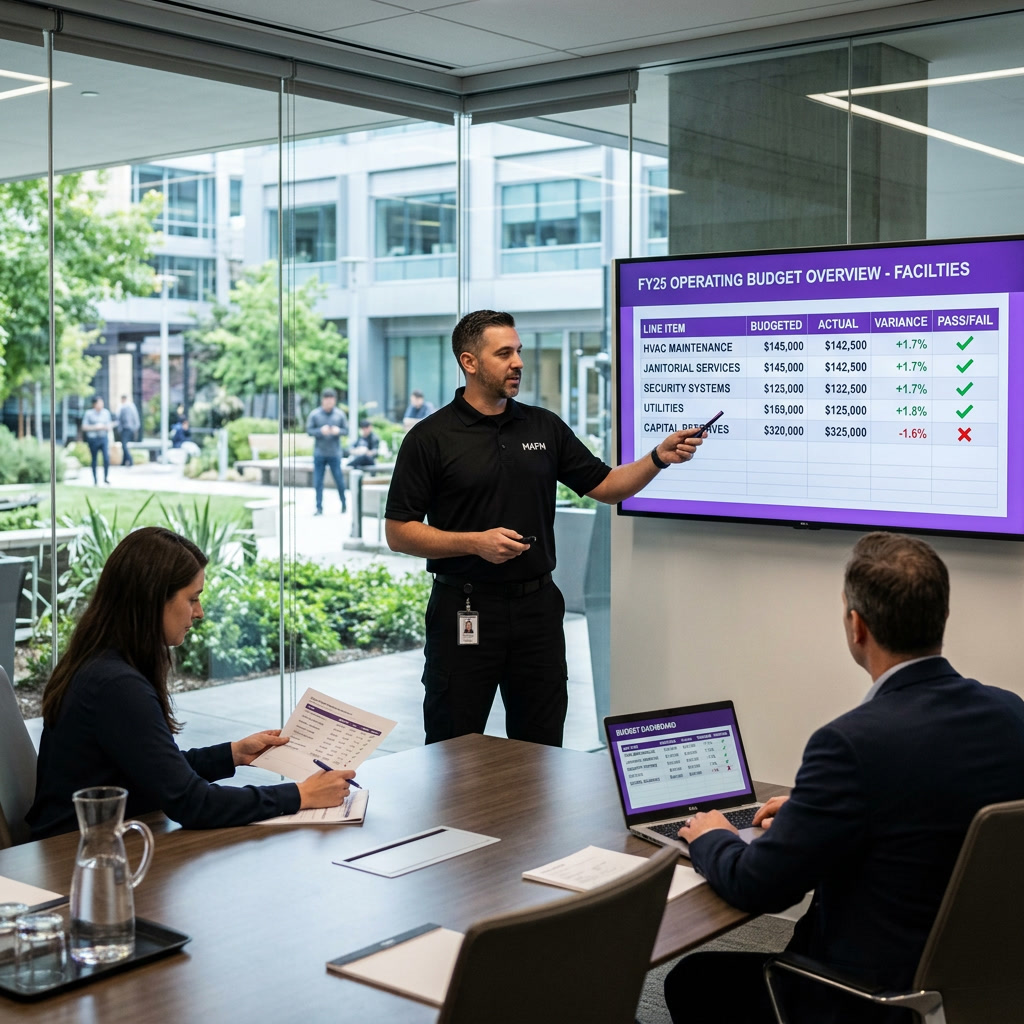
Monday we introduced this week's focus on Q3 planning and annual budget prep as the runway period before Q4 numbers get locked into next year's operating plan. Today we're getting into the mechanics: how to actually construct a facilities budget that holds up when finance asks why HVAC maintenance jumped 18% or why the janitorial line looks flat while everything else inflated.
Most facility budgets fail not because the numbers are wrong, but because they're unstructured. A single "building maintenance" line covering $340,000 in spend tells finance nothing and invites arbitrary cuts. A properly segmented budget (split by system, by fixed versus variable cost, and by planned versus reserve) gives you something defensible. It also gives you leverage: when you can show that a $45,000 chiller overhaul this year prevents a $180,000 emergency replacement in eighteen months, you're not asking for money, you're presenting a risk analysis.
This matters more in Silicon Valley than in most markets. Aging Class A and B office stock built in the 1990s and early 2000s is now hitting 25-30 year equipment lifecycles simultaneously (rooftop units, elevator controllers, fire panels) while tenant expectations for air quality, uptime, and amenity-grade common areas have only gone up. Building the FY2027 budget now, in August, gives you the lead time to get vendor quotes locked before year-end price increases and before contractor calendars fill for Q1 capital work.
The single biggest mistake in facilities budgeting is rolling forward last year's actuals with a flat inflation bump. That approach embeds every inefficiency from the prior year and gives finance zero visibility into why costs move. Instead, split every dollar into four buckets: fixed contracted services, variable/consumption-based costs, planned capital replacement, and emergency reserve.
Fixed contracted services covers janitorial, landscaping, security patrol, elevator maintenance contracts, and fire/life safety inspections, costs that are largely predictable because they're governed by existing agreements. Variable costs include utilities, HVAC filter and belt consumables, pest control call-outs beyond contract, and seasonal costs like snow removal or irrigation ramp-up. Planned capital replacement is where most of the strategic work happens: this is your equipment nearing end-of-life that you're scheduling proactively rather than reactively. Emergency reserve is the line finance hates funding but that saves you when a water heater fails on a Friday at 4pm.
For a typical 150,000 square foot Silicon Valley office or mixed-use property, a reasonable starting allocation looks like 55-60% fixed contracted, 15-20% variable, 15-20% planned capital, and 5-8% emergency reserve. If your planned capital bucket is under 10%, you're almost certainly deferring maintenance you'll pay for later at a premium. Walk into budget season with these four buckets clearly labeled and you immediately look more credible than a peer presenting a single undifferentiated maintenance number.
Every piece of major building equipment has a known useful life range, and your budget should reflect where each asset sits in that curve. Rooftop HVAC units typically run 15-20 years before major component failure becomes likely. Elevator hydraulic systems and controllers run 20-25 years, though controller boards often need replacement or upgrade around year 15 due to obsolescence and parts scarcity. Roofing membranes on flat commercial roofs last 15-20 years depending on system type and San Jose/Peninsula UV exposure. Boilers and water heaters run 10-15 years. Parking lot resurfacing and restriping cycles run 5-8 years for seal coating and 15-20 for full reconstruction.
Pull your building's equipment list (if you don't have one, this is the first task, not an afterthought) and tag each major asset with install year, expected remaining life, and estimated replacement cost in today's dollars. This becomes your capital forecast, and it should extend three years out, not just the coming fiscal year, because a five-year-old rooftop unit doesn't need budgeting this year but absolutely needs to be on finance's radar for year three.
Where this gets specific to our market: many Silicon Valley properties installed HVAC systems during the late-1990s and early-2000s build boom, meaning a meaningful share of the region's commercial rooftop units are now past the 20-year mark. If you own or manage a property from that era and haven't done a mechanical systems audit in the last two years, budget for that audit first (typically $3,000-$8,000 depending on building size) before you can credibly forecast replacement costs. Guessing at remaining useful life without an engineer's assessment is how budgets get blown mid-year.
Facility managers often underprice the true cost of deferring maintenance because they only account for the eventual repair or replacement bill. The real cost includes several categories that rarely make it into the budget conversation but absolutely should.
First, energy penalty: an HVAC system operating past its efficient service life can run 15-25% less efficient than a properly maintained unit of the same age, which shows up as elevated utility costs that get attributed to "market rates" rather than equipment condition. Second, emergency premium: reactive replacement of failed equipment typically costs 20-40% more than planned replacement, because you're paying rush labor rates, expedited shipping on parts, and often accepting whatever contractor has availability rather than competitively bidding the job. Third, tenant impact: an HVAC failure in a multi-tenant building during a Bay Area heat event doesn't just cost the repair, it costs tenant goodwill, potential rent concessions, and in lease renewal conversations, it becomes a documented service failure that tenants remember.
When you present deferred maintenance risk to ownership or finance committees, quantify all three categories, not just the repair estimate. A rooftop unit that's 22 years old and due for $52,000 planned replacement isn't a $52,000 line item risk, factor in the energy penalty accumulating at roughly $4,000-$7,000 annually and the 25-30% emergency premium if it fails unplanned, and you're looking at a $65,000-$80,000 total exposure that makes the planned replacement case for itself. This is the argument that gets capital approved instead of pushed to next year again.
Most budget templates default to a flat 10% contingency line, which is both arbitrary and hard to defend. A better approach ties contingency sizing to actual volatility drivers specific to your property and this region.
Labor cost volatility is real in Silicon Valley, janitorial and skilled trades labor markets here have seen consistent upward pressure, and any contract up for renewal in the coming fiscal year should be budgeted assuming a 4-7% increase over current rates rather than flat renewal, particularly for union-adjacent trades like elevator mechanics and licensed electricians. Supply chain volatility on HVAC components, particularly refrigerant-related parts tied to the ongoing R-22 to R-410A and now R-454B transition, has meant lead times of 12-20 weeks on certain compressor and coil replacements, which affects not just cost but your ability to execute planned capital work on schedule.
Weather-driven variable costs also deserve their own contingency logic rather than being buried in the general reserve. An unusually hot early fall, increasingly common in the South Bay, extends cooling season demand on aging systems by weeks, which shows up as both higher utility spend and elevated risk of mid-system failure from extended runtime. If your property has equipment already flagged as past 80% of expected useful life, weight your contingency allocation higher for that specific system rather than spreading it evenly. This is the difference between contingency as a formality and contingency as an actual risk management tool.
A defensible facilities budget isn't the one with the smallest number attached to it, it's the one that shows finance exactly where every dollar goes, why capital timing matters, and what happens financially if planned work gets deferred again. Building that case now, in early Q3, gives you time to get engineering assessments done, vendor quotes locked, and the narrative built before budget season becomes a scramble.
Later this week we'll look at how to sequence capital projects across the fiscal year once your budget is approved, so the numbers you fight for in August actually turn into completed work rather than a carryover line item next year.
If your last mechanical systems audit is more than two years old, MAFM can conduct a full asset-age assessment and build your three-year capital forecast before your budget is due, contact us to schedule a walkthrough this month.
Link back to Monday's post introducing the Q3 planning and annual budget series, and forward to later-week posts on capital project sequencing and vendor contract renewal timing.
IFMA's Operations and Maintenance benchmarking reports for facility cost data; ASHRAE guidance on HVAC equipment service life expectancy.
MAFM offers comprehensive facility management solutions tailored to your business needs.
Get in Touch