
Contract Management
Why January is the Perfect Time to Renegotiate Your Janitorial Contract
January 17, 2026
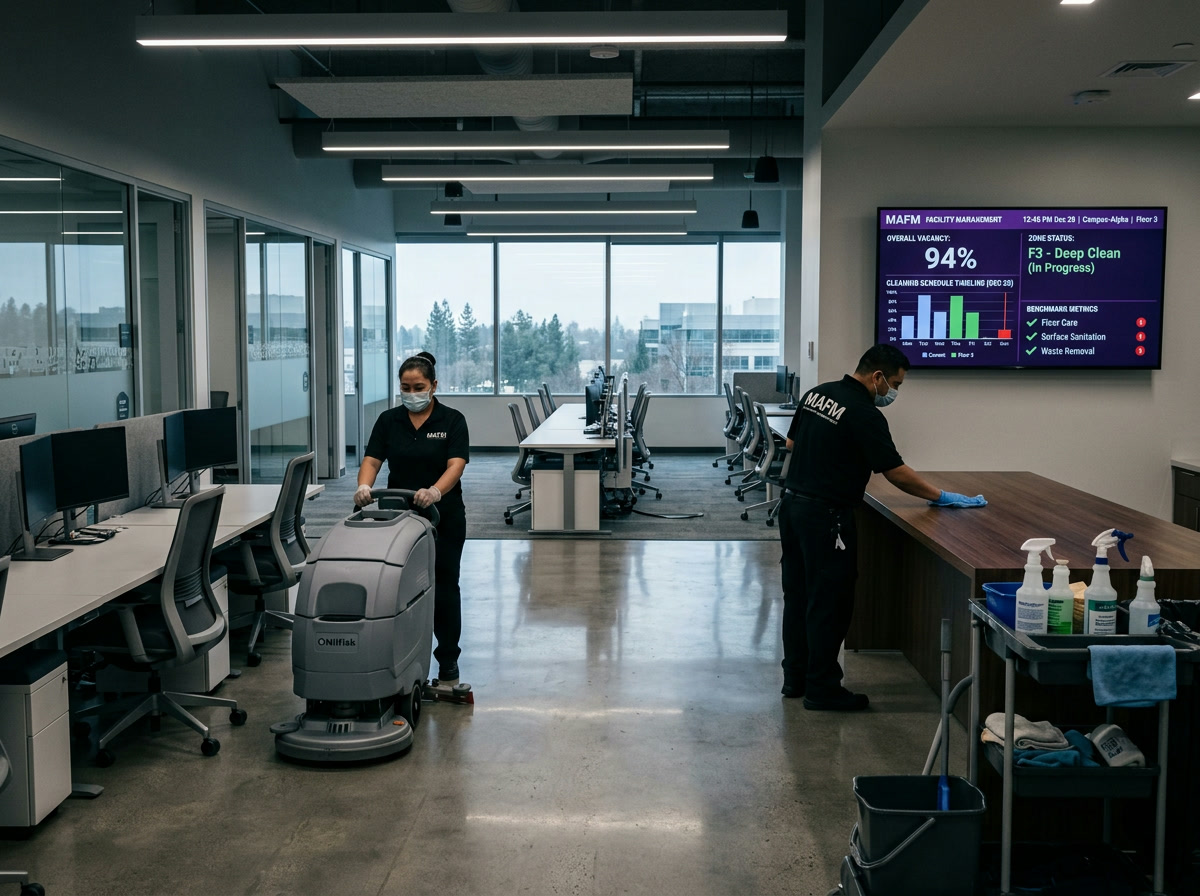
If you manage a building anywhere near Mountain View, Sunnyvale, or San Jose, you already know the rhythm: badge swipes drop by 70-90% between December 24 and January 2, break rooms sit untouched, and half your tenant roster is on a company-wide shutdown. This isn't a quiet week to ignore — it's the single best window of the year to get deep cleaning done without disrupting occupants, and it's also the window every other FM in the region is trying to book at the same time.
Earlier in this series we covered why year-end is the right moment to negotiate one-time deep clean pricing separate from your standing janitorial contract. This post gets more tactical: how do you actually structure the schedule — crew timing, access, scope sequencing — so the work gets done without creating a security or liability headache, and without paying holiday overtime rates for work that could've been done on a Tuesday afternoon in November.
The mistake we see most often is treating the "holiday deep clean" as a single line item instead of a scheduling problem with three overlapping constraints: occupancy patterns, vendor labor availability, and building access/security protocols. Get the sequencing wrong and you either pay 2x labor rates for crews working December 26, or you miss the window entirely and the carpet extraction gets pushed to February.
Don't assume every tenant follows the same closure pattern. In our experience managing mixed-tenant properties across Santa Clara and San Mateo counties, we typically see three distinct shutdown profiles: full closure (common at mid-size SaaS companies, roughly Dec 24-Jan 2), partial closure with skeleton crew (common at hardware/semiconductor firms that still need lab or server room access), and no closure at all (data centers, 24/7 support operations, some biotech labs with live research).
Before you lock a vendor contract, pull badge access data or ask property management for occupancy logs from the prior two holiday seasons. If you've got a 150,000-square-foot multi-tenant building and only 40% of tenants actually go dark, you can't schedule a building-wide floor strip-and-wax for December 27 — you'll be waxing around people's desks. Instead, segment the work by floor or suite based on each tenant's actual closure dates, which your leasing or property management team should have on file from annual holiday notices.
This mapping exercise also tells you where you can push harder on pricing. Vendors give better rates for work scheduled during confirmed full-building closures because they can run larger crews with fewer access restrictions and no need for escort personnel. A half-empty building costs you more per square foot in deep cleaning because crews have to work around occupied suites, which slows production rates and sometimes requires badge escorts.
Silicon Valley's commercial cleaning labor market gets tight fast once Thanksgiving passes. Every FM in the region with a Q4 budget surplus is trying to book floor care crews, window cleaning teams, and HVAC coil cleaning for the same two-week window between Christmas and New Year's. If you're negotiating with your incumbent janitorial vendor or bringing in a specialty subcontractor for carpet extraction or high-access window work, you need signed scope and crew commitments by mid-November — not "we'll pencil you in."
Holiday labor costs are the other piece. Crews working December 25, 26, or January 1 typically carry 1.5x to 2x hourly rate premiums under most union agreements common in the South Bay, plus shift differentials for overnight work. If your building allows daytime access during the shutdown — which most fully-closed tenants do, since there's no one there to disturb — you can schedule deep cleaning for December 29-31 at standard rates instead of paying holiday premiums for work on the 25th or 26th. That three-day stretch between Christmas and New Year's is the sweet spot: buildings are empty, but it's not technically a federal holiday, so you avoid the overtime multiplier.
Get this in writing in the contract addendum, not a verbal understanding. Specify exact dates, crew size, and which specific premium days (if any) are being used, because vendors will sometimes quote a "holiday rate" that blankets the entire period from December 20 through January 5 if you let them.
Deep clean scope during a shutdown window typically includes VCT floor stripping and waxing, carpet extraction, interior and exterior window cleaning, kitchen hood degreasing, upholstery cleaning in common areas and conference rooms, and HVAC coil and diffuser cleaning. The sequencing matters more than most contracts account for.
Floor work should happen first if you're also doing carpet extraction and window cleaning in the same space, since floor stripping chemicals need ventilation time and you don't want window crews tracking through wet wax. Kitchen hood degreasing should be scheduled with your fire suppression inspection if one's coming up in Q1 — many Silicon Valley fire marshals require hood cleaning documentation tied to suppression system certification, and bundling the two saves a redundant site visit.
If your building has any server rooms, data closets, or lab spaces with sensitive equipment, those need a separate scope entirely — anti-static vacuum equipment, no liquid cleaning agents near racks, and ideally a facilities or IT staff member present rather than relying on badge access alone. We've seen contracts where a general janitorial crew was given blanket access to a server room during a holiday deep clean and ran a standard wet-mop routine near raised flooring with network cabling underneath. That's an incident report waiting to happen, and it's entirely preventable with a scope exclusion written into the contract up front.
Window cleaning on multi-story buildings needs its own lead time too — IWCA-certified crews and rope or lift access require weather windows, and December in the Bay Area isn't always cooperative. Build a rain contingency date into the contract rather than assuming a single scheduled day will hold.
An empty building during the holidays is a different security environment than an occupied one, and your cleaning contract needs to reflect that. Confirm who issues badge or key access to the cleaning crew, whether a security guard or property manager needs to be on-site during the work, and how after-hours alarm systems will be handled if crews are working outside normal business hours.
Insurance certificates should be current and on file before anyone sets foot in the building — this is standard practice, but it's easy to let slide during year-end crunch when everyone's moving fast to get contracts signed. Confirm the vendor's certificate of insurance names your property or management company as additional insured, and that it covers the specific dates of the holiday work, not just a general annual policy.
Also clarify in writing what happens if something is damaged or goes missing during a low-occupancy deep clean. With fewer people around to notice issues in real time, you want a documented walkthrough — ideally photo-documented — before and after the crew's work, signed off by both your team and the vendor's site supervisor. This isn't about distrust of the cleaning crew; it's about protecting everyone involved when a dispute arises in January about a scratched floor or a missing piece of equipment, and there's no tenant around who witnessed anything.
The holiday shutdown window is a genuine opportunity to get deep cleaning done at a scale and intensity that's impossible during normal occupied hours — but only if you treat the scheduling with the same rigor as any other facilities project. Map your actual tenant closure calendar, lock crew commitments before Thanksgiving, sequence the scope logically, and nail down access and liability terms in writing. Do that, and you'll walk into January with a building that looks and smells like a fresh start instead of a contract dispute.
MAFM coordinates year-end deep clean scheduling across multi-tenant Silicon Valley properties, from occupancy mapping to crew booking to post-work documentation — reach out before mid-November to secure your building's holiday window.
Reference earlier this week's post on negotiating one-time deep clean pricing separate from standing janitorial contracts, and flag Thursday's upcoming post on contract language and vendor liability terms for holiday service agreements.
IWCA (International Window Cleaning Association) safety standards for high-access cleaning; NFPA 96 standards for commercial kitchen exhaust hood cleaning requirements.
January 17, 2026
March 5, 2026
August 21, 2026
MAFM offers comprehensive facility management solutions tailored to your business needs.
Get in Touch