Facility Maintenance
Commercial HVAC Maintenance for Silicon Valley Offices
February 12, 2026
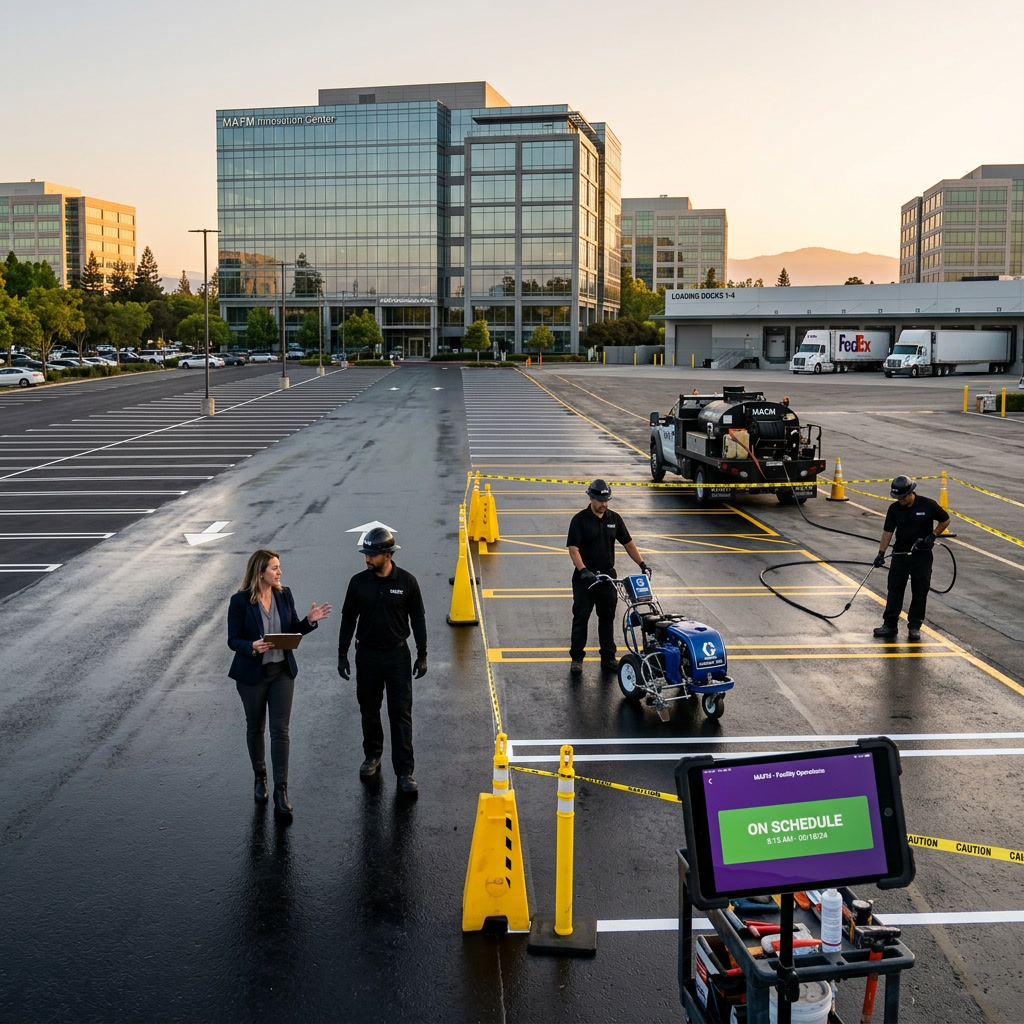
Every facility manager who has scheduled a sealcoating job has faced the same tense phone call on day two: a tenant's VP is standing at the edge of a taped-off lot at 8:15 a.m., asking why there's nowhere to park. The asphalt itself isn't the hard part of this project. Coal tar or asphalt emulsion sealer goes down in a predictable pattern, and any licensed paving contractor can apply it correctly. The hard part is doing it on a live campus with 400 employees, three shift changes, a loading dock that can't go dark, and a property manager who promised tenants zero disruption in the lease renewal packet.
This is the piece of late-summer sealcoating that rarely gets discussed in trade articles: the operational choreography. Silicon Valley's August-through-September window isn't just favorable because of temperature and humidity: it's favorable because it's one of the few stretches where a facility team can phase a multi-acre lot over several days without fighting rain delays, fog-related cure failures, or the compressed daylight of a fall schedule. That window is short. Getting the sequencing right is what determines whether your tenants remember this project as "the week the lot looked nice" or "the week nobody could find their car."
This post walks through how to build that schedule: the weather math behind the timing, how to phase a lot in sections instead of closing it all at once, what has to change on the striping layout while you're out there anyway, and how to keep tenants, security, and your own crew synchronized for three days instead of three weeks of complaints.
Asphalt sealer needs surface temperatures between roughly 50°F and 90°F to cure properly, and it needs at least 24 to 48 hours without moisture contact to set before it can handle traffic. In much of the Santa Clara Valley (San Jose, Sunnyvale, Santa Clara, Mountain View) June and early July mornings still carry marine layer fog that can push dew point contact on fresh sealer well past 9 or 10 a.m. That moisture doesn't just delay the job; it can cause the sealer to emulsify unevenly, leaving a mottled finish that shows up within a season and forces an early re-coat.
By mid-August, that coastal fog pattern has largely broken for inland business corridors along 101, 237, and 880. Mornings clear earlier, afternoon highs sit consistently in the 75 to 88°F range without the triple-digit spikes that hit in September in some pockets, and there's still a stretch of six to eight rain-free weeks before the first real chance of an October storm. That combination (dry mornings, moderate heat, and a rain-free runway) is what makes late August through mid-September the highest-percentage window for a cure that holds up through the winter wet season without blistering or premature wear.
The practical translation for scheduling: if your contractor tells you they need a 48- to 72-hour no-traffic window per phase, late August gives you the margin to build in a buffer day without gambling on weather. Try to run the same job in early June or late September and you're rolling dice on either fog delaying the first coat or an early rain event hitting cured-but-not-fully-set sealer.
The single biggest mistake facility teams make on this project is treating the parking lot as one job instead of three or four. A 300-stall lot closed all at once means 300 displaced cars, a scramble for overflow parking, and a tenant relations problem that lands on your desk regardless of how good the paving crew is. The fix is sectioning the lot into zones (typically split by natural boundaries like drive aisles, building entrances, or existing curb breaks) and sequencing the work so no more than 25 to 35 percent of total stalls are out of service at any given time.
A typical four-phase sequence for a mid-size business park looks like this: Phase 1 covers the visitor and ADA-adjacent stalls closest to the main entrance, done overnight Friday into Saturday morning when visitor traffic is lowest. Phase 2 and 3 rotate through employee parking sections, timed against badge-swipe data or shift schedules so the section with the lowest occupancy that day gets closed first. Phase 4 covers loading dock and rear-lot areas, which usually has the most flexibility since it's not tied to daily arrival patterns. Each phase gets its own 48-hour cure window, with the crew moving to the next section as soon as the prior one is traffic-ready.
This approach costs a little more in mobilization (squeegee machines, spray rigs, and striping trucks moving in and out of the site multiple times instead of once) but it eliminates the all-hands displacement event that generates the most tenant complaints. It also lets you use temporary signage and cones section by section instead of taping off an entire lot, which reads to tenants as "maintenance in progress" rather than "the lot is closed."
Sealcoating erases every existing line, which means restriping isn't optional: and it's the moment to correct anything that's fallen out of compliance since the last resurfacing, usually five to seven years prior. ADA parking requirements under the 2010 ADA Standards for Accessible Design set minimums based on total lot size: one accessible space per 25 stalls up to 100, with at least one in every six accessible spaces required to be van-accessible with an 8-foot access aisle. Lots that have added stalls piecemeal over the years, or that were striped before local jurisdictions tightened enforcement, frequently fall short. This is the cheapest possible moment to fix that, since the crew and paint are already mobilized: retrofitting later means an isolated mobilization charge just for a handful of stalls.
Beyond ADA counts, this is also the point to address fire lane markings required under California Fire Code Section 503, which most Silicon Valley municipalities enforce with specific red-curb and lettering requirements, and to add or update EV charging space markings if your property has installed or plans to install chargers. Santa Clara County and several cities, including San Jose and Palo Alto, have been tightening EV-ready parking requirements under CALGreen amendments, and striping those spaces correctly now avoids a second mobilization when chargers go in next year.
Layout changes are worth evaluating too: compact stall counts, angled versus perpendicular parking, and drive aisle widths can sometimes be adjusted during restriping to gain a few extra stalls or improve traffic flow at a busy entrance, changes that are far more disruptive to implement outside of a full resurfacing cycle.
None of the phasing logic works if tenants don't know about it in advance. The standard for a multi-tenant property should be a written notice at least 10 business days ahead, followed by a reminder 48 hours before each phase begins, distributed through whatever channel tenants already use for building notices: email, portal posting, or lobby signage. The notice needs three concrete pieces of information: which specific stalls or rows are affected, the exact closure window, and where displaced vehicles should park instead, whether that's a designated overflow area, a nearby garage, or a rotating arrangement with an adjacent property.
Security and access control need their own coordination pass, particularly on campuses with badge-controlled gates or lots. If temporary barriers block a normal drive aisle, make sure security staff and any automated gate systems are updated so badge holders aren't stuck trying to enter a route that no longer exists. For properties with third-party security patrol contracts, loop them into the phase schedule directly rather than relying on the property manager to relay it: patrol staff are often the first point of contact when a confused employee can't find parking at 7 a.m.
Finally, build in a buffer day between the contractor's projected completion and your own "all clear" communication to tenants. Sealer that looks dry at 40 hours may still be a day away from handling regular traffic without leaving tire marks or picking up debris, and reopening a section too early creates a mess that undoes the entire project's finish. A conservative communication schedule costs you nothing and prevents the exact kind of visible failure that generates tenant complaints months into a job that otherwise went well.
The technical side of sealcoating and striping is largely solved: contractors know the mix ratios, the application methods, and the cure science. What separates a smooth project from a tenant-relations headache is the scheduling discipline layered on top of it: using the late-summer weather window to its full advantage, phasing the lot instead of closing it wholesale, using the restriping pass to correct compliance gaps while the crew is already mobilized, and running a communication cadence that keeps tenants, security, and the contractor synchronized through every phase. Get that sequencing right and a project that touches every stall on the property can run without a single day of real business disruption.
MAFM plans and phases sealcoating and striping projects around your tenants' operating hours, not the other way around: contact us to schedule your late-summer resurfacing before the fall rain window closes.
Reference earlier posts in this week's sealcoating and striping series covering the science of asphalt cure timing in Silicon Valley's microclimates and a companion piece on budgeting for sealcoating cycles across a commercial property portfolio.
U.S. Access Board's 2010 ADA Standards for Accessible Design (accessibility.gov), and the California State Fire Marshal's guidance on California Fire Code Section 503 fire lane requirements.
MAFM offers comprehensive facility management solutions tailored to your business needs.
Get in Touch