Facility Maintenance
Smart HVAC Maintenance for Silicon Valley Office Buildings
February 12, 2026
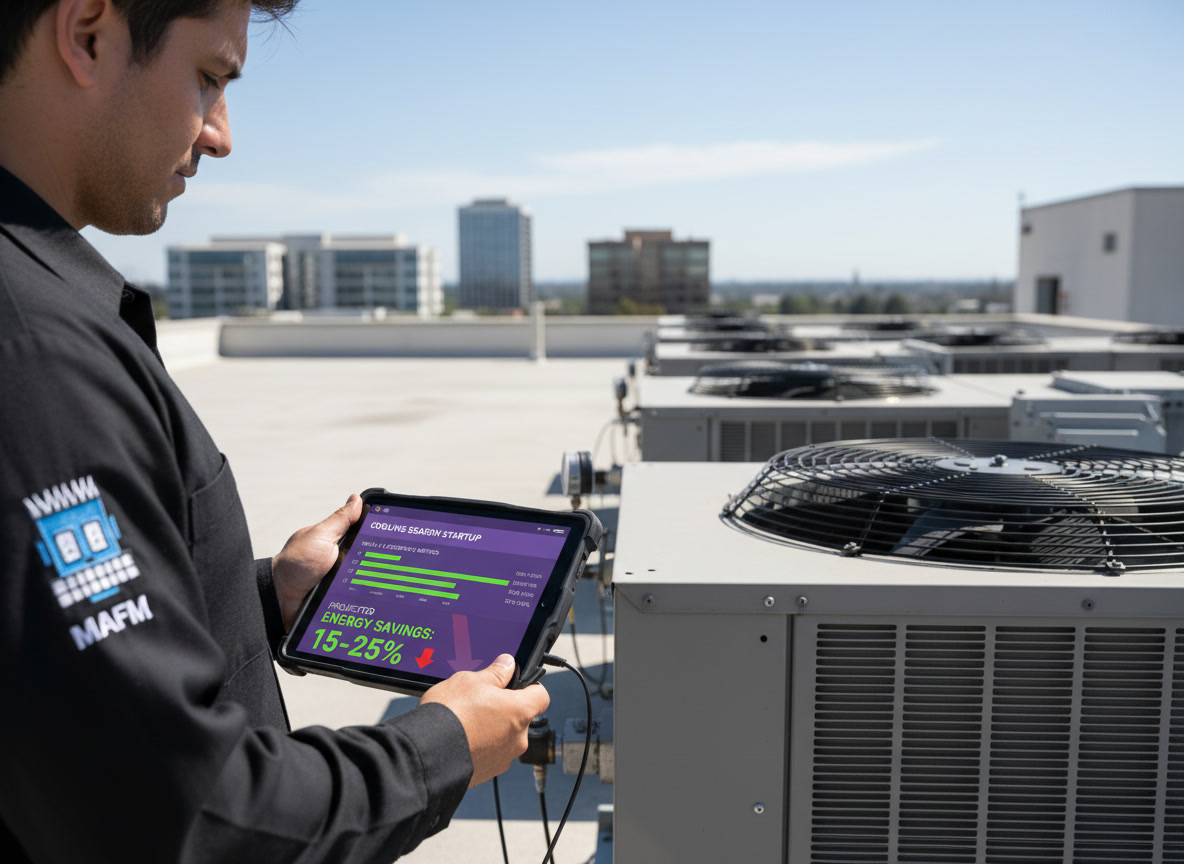
May in Silicon Valley marks the shift from mild spring temperatures to the sustained cooling demand that will dominate your building's energy profile through October. The facilities that coast through summer without tenant comfort complaints and without budget-busting utility bills are the ones that executed their preparation in March and April and now transition into a structured cooling season operating mode.
If you completed your spring HVAC preparation (coil cleaning, filter replacement, economizer testing, controls calibration) you are positioned for a strong summer. If you deferred some of that work, the window for catch-up is measured in days, not weeks. The first sustained heat event will reveal every gap in your preparation.
Here is the week-by-week execution guide that takes your building from cooling season launch through peak summer operations.
The first warm days of May provide your only opportunity to verify cooling system performance under actual load conditions before the temperatures that leave no margin for failure arrive.
Run every cooling system at full capacity during the first warm afternoon sequence. Do not wait for tenant complaints to discover that a rooftop unit is not staging properly or that a chilled water valve is stuck. Proactively engage full cooling mode and walk every floor with a handheld temperature sensor, checking actual zone temperatures against setpoints.
Document any zones that fail to reach setpoint within 30 minutes of full cooling engagement. These zones have capacity, distribution, or controls issues that require immediate attention. Common culprits include economizer dampers stuck in the open position, bringing in hot outdoor air instead of recirculating cooled air, thermostat sensors that have drifted and are reading inaccurately, zone dampers that are stuck partially closed restricting airflow, and dirty evaporator coils that were missed during spring maintenance.
Verify that your building automation system's cooling season schedule is active and correctly programmed. Confirm occupied and unoccupied temperature setpoints, morning pre-cooling start times, and weekend and holiday schedules. A BAS running on the wrong seasonal schedule wastes energy every hour it operates incorrectly.
Test your economizer changeover settings. Bay Area buildings rely heavily on economizer cycles during the shoulder months when outdoor temperatures are cool enough to provide free cooling. Your economizer should engage when outdoor air temperature drops below approximately 65 to 70 degrees and disengage when outdoor temperatures exceed that threshold. Incorrect changeover settings waste cooling energy during conditions that should provide free conditioning.
With system verification complete and any deficiencies corrected, shift focus to operational optimization that maximizes efficiency throughout the cooling season.
Implement your pre-cooling strategy. Silicon Valley utility rate structures charge significantly more for electricity consumed during peak demand hours, typically noon to 6 PM on weekdays. Pre-cooling the building during lower-rate morning hours and allowing the thermal mass to carry through the peak period reduces costs without affecting occupant comfort.
The pre-cooling protocol starts the cooling system two to three hours before occupancy, driving zone temperatures two to three degrees below the occupied setpoint. When the building reaches occupied mode, the BAS raises setpoints to normal levels, and the building's thermal mass maintains comfort through the peak rate period with reduced mechanical cooling demand.
This strategy consistently saves 8 to 15% on peak demand charges with zero impact on tenant comfort, one of the few optimizations that reduces cost without any operational tradeoff.
Establish your weekly energy monitoring routine. Pull electricity consumption data every Monday morning and compare it against the same week from the prior year, normalized for weather differences. Early identification of consumption spikes allows investigation and correction before the cost accumulates. A building consuming 15% more electricity than the same week last year has either a system malfunction or an operational configuration error that is costing money every hour.
Calibrate your demand response capability. If your building participates in a utility demand response program, or should, verify that your load shedding protocol works as designed. Test the sequence that reduces non-essential loads during demand events: raising temperature setpoints by two degrees, dimming non-critical lighting, and deferring discretionary equipment operation.
June through July represents the peak cooling demand period when your building's HVAC systems operate at or near maximum capacity for extended periods.
Monitor filter condition monthly rather than relying on your standard quarterly replacement schedule. High cooling loads drive higher airflow volumes, which load filters faster. A filter that normally lasts three months may reach its pressure drop limit in six to eight weeks during peak cooling season. Operating with loaded filters forces fans to work harder, increases energy consumption, and reduces cooling capacity at the worst possible time.
Track tenant comfort complaints with geographic precision. Map every temperature complaint to its specific zone and track patterns over time. Recurring complaints from the same zone indicate a system issue that routine adjustment cannot resolve, capacity limitation, distribution imbalance, or solar load that exceeds the zone's cooling capacity.
For zones with chronic solar load issues, typically south and west-facing perimeter offices, interior solar shading solutions provide meaningful relief. Interior window film, motorized blinds programmed to track sun angle, and even simple manual shade management protocols reduce solar heat gain by 40 to 60% and measurably reduce cooling demand in affected zones.
Manage after-hours cooling requests carefully. Tenant requests for extended HVAC operation after normal business hours are legitimate but expensive. Each hour of after-hours cooling costs $50 to $200 depending on building size and system type. Implement a formal after-hours HVAC request process with proper cost allocation to requesting tenants.
August often brings the highest sustained temperatures but also signals the approaching transition back to mixed-mode operation.
Maintain peak-season vigilance through August. The temptation to relax monitoring after successfully navigating June and July creates vulnerability to late-season equipment failures driven by cumulative thermal stress. Components that have operated at high load for three months are at their greatest failure risk precisely when the season feels like it is winding down.
Begin fall transition planning in late August. Schedule your fall HVAC maintenance window for early October when cooling demand typically subsides enough to take systems offline for service. Order parts for any known maintenance items now rather than competing for supply during the fall maintenance surge.
September's variable weather, warm afternoons alternating with cool mornings, challenges building automation systems with rapid changeover demands. Verify that your heating-cooling changeover controls respond correctly to these swing conditions. Buildings that heat in the morning and cool in the afternoon without proper deadband settings waste significant energy fighting themselves.
Cooling season represents the largest concentration of controllable energy cost in the annual facility budget. Proactive management during these months determines whether you finish the year on budget or explaining an overage.
Benchmark your monthly electricity cost against your budget projection and against the prior year. Present this comparison to ownership or stakeholders monthly during cooling season so there are no surprises. If costs are trending above budget, identify the cause (weather anomaly, system inefficiency, or occupancy change) and communicate both the cause and your response.
Investigate any utility bill that exceeds the prior year by more than 10% after weather normalization. Utility billing errors, meter malfunctions, and rate structure changes all occur and can create significant cost impacts that are fully recoverable if caught promptly.
Evaluate your utility rate structure annually. Silicon Valley's utility rate landscape offers multiple commercial rate options, and the optimal rate for your building may change as your consumption profile shifts. A 15-minute conversation with your utility representative or energy consultant to verify rate optimization can save thousands annually.
Summer cooling season is a five-month operational marathon that rewards systematic management and punishes neglect. The buildings that deliver consistent comfort at efficient cost follow the structured approach outlined here: verify under load in May, optimize in late May, manage peak demand through July, maintain vigilance through August, and transition deliberately in September.
Your cooling season has launched. Execute the plan, monitor the results, and adjust weekly. The difference between a building that thrives through summer and one that struggles is not luck or equipment quality, it is the discipline of consistent operational attention applied week after week from May through October.
MAFM PRO manages cooling season operations with the systematic attention that delivers comfort and cost efficiency. Contact us to optimize your building's summer performance.
Schedule your consultation: Contact MAFM.PRO
February 12, 2026

February 13, 2026
February 27, 2026
MAFM offers comprehensive facility management solutions tailored to your business needs.
Get in Touch