
Janitorial & Cleaning
Winter Lobby Floor Protection for Silicon Valley Buildings
January 19, 2026
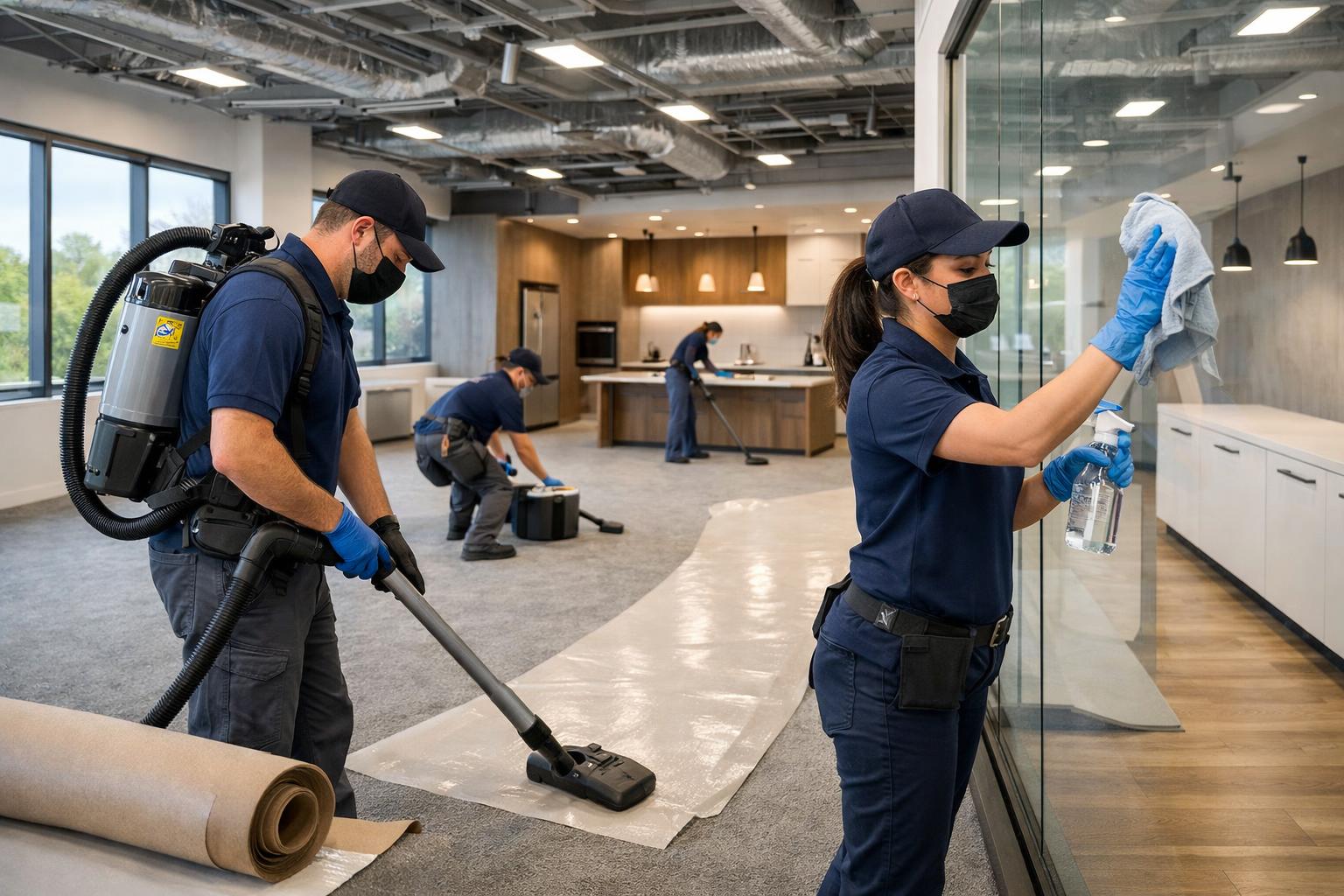
Post-construction cleaning is the staged cleaning that takes a finished tenant improvement from "contractor is done" to "ready for people to work in it." It is separate from the debris removal a contractor does and from the routine janitorial service that follows move-in, and it has to be planned into the schedule before the walls go up.
The short version for a facility manager: agree in writing who owns each stage of cleaning, use dust control methods that do not put silica back in the air, match every cleaning method to the finish being cleaned, and finish the cleaning before the HVAC flush and the move-in date, not after.
Because the contractor cleans to whatever the contract says, and that is often only enough to hand over the space. Construction leaves fine dust on ledges, in light fixtures, inside return grilles and across every horizontal surface, plus adhesive, tape, labels and paint on glass and fixtures. A "broom clean" handover removes the debris but not the film.
Dust control also matters beyond appearance. Cutting or grinding concrete, masonry, stone and similar materials can release respirable crystalline silica, and federal OSHA's construction rule applies to all occupational exposures to respirable crystalline silica in construction work except where exposure will stay below 25 micrograms per cubic meter as an 8-hour average. The person pushing a broom through that dust is a worker with an exposure of their own.
Read the construction contract before the job ends. If it says only that the contractor will leave the premises "broom clean," the final clean is a separate line item that someone has to budget, schedule and hire.
Cleaning crews commonly split the work into three passes, and the sequence matters more than the labels:
The order inside each pass is top to bottom and back to front, so that nothing you have just cleaned is dusted again. A crew that vacuums the floor before wiping the ledges has done the floor twice.
Use wet methods and HEPA-filtered vacuums, not dry sweeping or compressed air. Federal OSHA's housekeeping rule says employers shall not allow dry sweeping or dry brushing where it could contribute to silica exposure unless wet sweeping, HEPA-filtered vacuuming or other methods that minimize exposure are not feasible. It adds that compressed air may not be used to clean surfaces in the same situations unless a ventilation system captures the dust cloud or no alternative is feasible.
California's construction rule, Title 8 section 1532.3, carries the same housekeeping language. Whether it technically applies to a given cleaning job depends on the exposure, but the practical answer is the same: a HEPA vacuum and damp wipe cost little and a blown or swept dust cloud contaminates the work you just finished.
Ask any cleaning contractor which vacuums they bring, how they filter them, and how they handle dust-laden waste. The answers separate crews that clean construction sites from crews that sweep them.
Each finish has a manufacturer's instruction, and following it protects both the surface and the warranty. Four examples show how much it varies:
The general rule: find the product data sheet or care guide for each major finish, put the cleaning requirements in the scope of work, and ask the contractor for the installed products list before the final clean begins.
Clean first, then flush the air system. The LEED v4.1 construction indoor air quality credit says its flush-out options are carried out after construction ends and the building has been completely cleaned, once finishes such as millwork, paint and carpet are installed. Its flush-out path calls for supplying 14,000 cubic feet of outdoor air per square foot of gross floor area at 60 to 80 degrees Fahrenheit and no higher than 60% relative humidity, with an alternative that allows occupancy after 3,500 cubic feet per square foot.
LEED also asks that, during construction, permanently installed air handling equipment not run without filtration media of at least MERV 8 at each return opening, and that filters be replaced immediately before occupancy. You do not have to be pursuing LEED to use that as a checklist: protect the return air path while the dust is being made, and put clean filters in before people arrive.
If a cleaning crew works while the system is running without filters, the dust it lifts ends up in the ductwork. Ask the contractor and the mechanical vendor to confirm filter status before the final clean starts.
Put each cleaning stage in the construction schedule with a named owner, a date range and a trigger. The final clean should follow the last trade, not a calendar date, because trades slip. Leave time between the final clean and move-in for a walkthrough and a short correction round.
A short checklist covers most of what goes wrong:
For the wider coordination problem, see our post on managing facility operations during tenant improvement construction.
What is the difference between post-construction cleaning and regular janitorial?
Regular janitorial maintains a clean space on a recurring schedule, while post-construction cleaning removes the film of dust, adhesive and residue left by building work. It is a one-time, staged job that usually involves HEPA vacuums, wet methods and finish-specific products.
Who pays for post-construction cleaning in a tenant improvement?
It depends on the lease and the build-out agreement. Some contracts make the contractor responsible for a basic clean, with a detailed final clean paid by the landlord or tenant. Settle it in writing before work begins.
How long should we wait to clean new floors and walls?
Follow each product's instructions, since they differ. One luxury vinyl manufacturer says to wait 48 hours after installation before cleaning, and Benjamin Moore recommends at least two weeks for painted walls. Cleaning too early is a common way to damage a new finish.
Do we need a HEPA vacuum for construction dust?
OSHA's construction housekeeping rule names wet sweeping and HEPA-filtered vacuuming as the accepted alternatives to dry sweeping where silica exposure is possible. Even where the rule does not strictly apply, HEPA filtration keeps fine dust out of the air and out of the building's vents.
A tenant improvement finishes well when cleaning is scheduled as a stage of the project and not as an afterthought. MAFM's janitorial crews coordinate with your contractor and building team in the Bay Area and beyond, from the final detail clean through the touch-up and the handoff to routine service, and our moves and changes team can sequence it with the move itself. Talk to us about janitorial services or about office moves and changes.
MAFM offers comprehensive facility management solutions tailored to your business needs.
Get in Touch
