Office Moves & Workplace
Tenant Satisfaction Surveys: How to Measure and Act
February 18, 2026
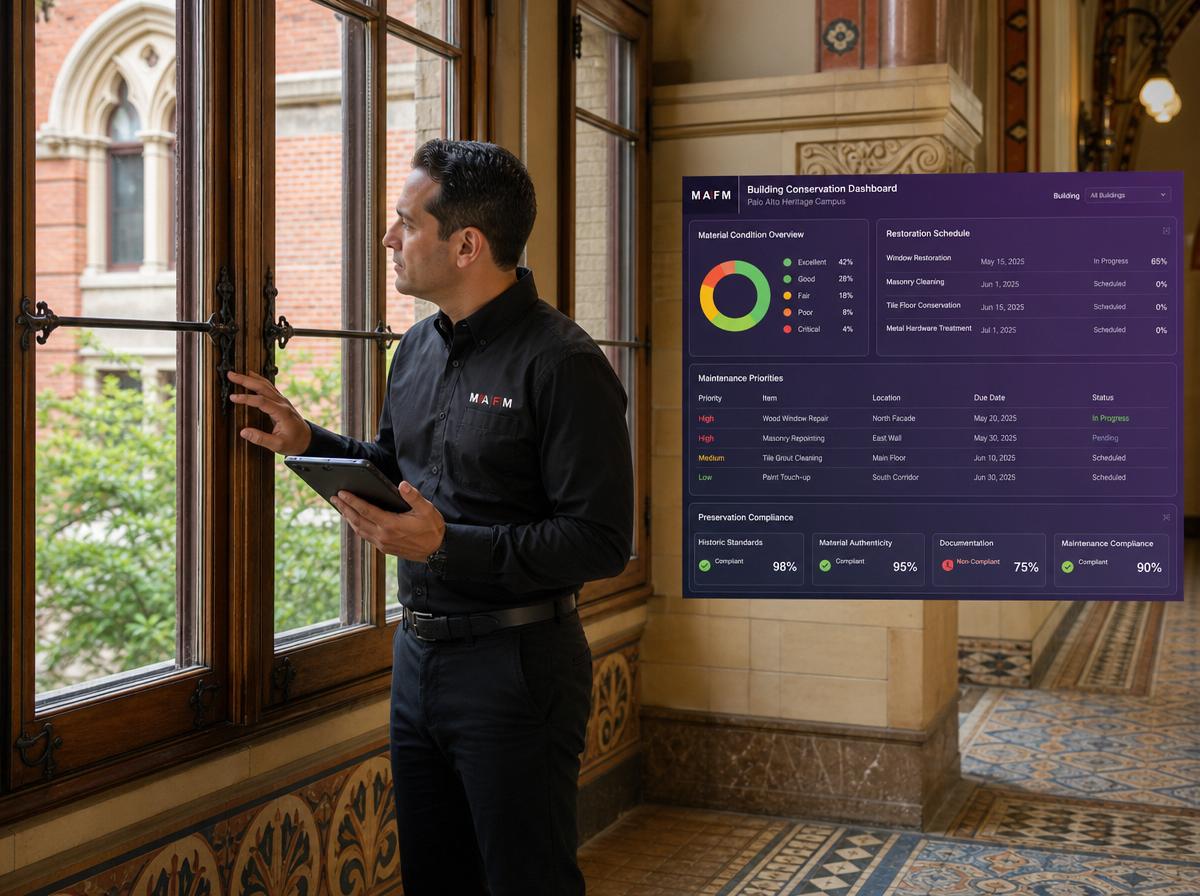
Silicon Valley's rapid development narrative tends to focus on what is being built rather than what is being preserved. But the region contains a meaningful inventory of architecturally significant properties, late 19th century civic buildings in San Jose, mid-century modernist office parks in Palo Alto, Spanish Colonial Revival commercial buildings in downtown Santa Clara, and significant post-war industrial structures repurposed as creative office and innovation campus space.
These buildings present facility managers with a challenge that no standard commercial maintenance program can adequately address: maintaining properties that were designed and built under fundamentally different construction principles, with materials that have unique care requirements, under regulatory frameworks that restrict modifications standard maintenance might otherwise employ.
The facility manager who applies standard commercial maintenance protocols to a historic building, pressure washing masonry with the same equipment and chemistry used on a concrete parking structure, repainting historic wood windows with modern latex paint, replacing deteriorated historic light fixtures with contemporary alternatives, may be causing irreversible damage while believing they are providing routine care.
Not every old building is historically significant in the regulatory or preservation sense, and understanding the specific designation status of your building determines which regulatory requirements and preservation standards apply.
National Register of Historic Places listing provides federal recognition of a building's significance but does not automatically impose maintenance restrictions on privately owned buildings. Nationally registered buildings become eligible for federal Historic Tax Credits, 20% income tax credits for qualified rehabilitation expenses, which can significantly offset the cost of historically appropriate renovation work. Buildings must maintain their significant historical characteristics to qualify for these credits.
California Register of Historical Resources listing applies California-level historic status with similar tax credit eligibility provisions and stronger local government leverage for requiring historically appropriate maintenance in some jurisdictions.
Local historic landmark designation (through the City of San Jose, the City of Palo Alto, or other Silicon Valley municipalities) often carries the most direct regulatory impact on day-to-day facility maintenance decisions. Locally designated landmarks may require permits for changes that would be routine permit-free work on non-historic properties, and the permit review process evaluates whether proposed maintenance or modifications are historically appropriate.
Historic district inclusion places the building within a defined geographic area where the district's character-defining features are protected collectively. Individual buildings within historic districts may face restrictions even if they are not individually designated landmarks.
Regardless of official designation, architecturally significant buildings benefit from the preservation principles that minimize irreversible interventions and maintain the building's physical integrity, both because these principles produce better long-term outcomes and because market repositioning of the building in the future may depend on preserved historic character.
Historic masonry (brick, stone, terra cotta, cast iron, and the mortars that hold them together) requires fundamentally different maintenance approaches than contemporary commercial construction materials.
The porosity problem with historic masonry cleaning is perhaps the most common source of serious damage by well-intentioned facility managers. Historic brick and stone were laid with softer lime mortars and finished with surface treatments designed to allow moisture to move through the masonry rather than trapping it inside the wall. Modern cleaning chemicals, high-pressure washing equipment, and masonry sealants that work effectively on contemporary concrete masonry can cause severe damage to historic masonry by introducing water under high pressure, creating chemical reactions with historic materials, or applying sealants that trap moisture inside the wall system.
The appropriate cleaning method for historic masonry requires consultation with a preservation specialist, typically a conservator or a masonry contractor specifically experienced in historic building work, before any cleaning is attempted. The Secretary of the Interior's Standards for the Treatment of Historic Properties provide the guiding framework, and method selection should proceed from the gentlest possible approach (low-pressure water washing) to more assertive approaches only when gentler methods prove inadequate.
Mortar repointing is required when historic mortar joints have deteriorated to the point of allowing water infiltration. This is one of the highest-stakes maintenance activities in historic building management because mortar selection can either protect the building or accelerate its deterioration. Repointing mortar must be softer than the historic masonry units, a mortar that is harder than the brick will transfer stress to the brick face rather than the joint, eventually causing the brick faces to spall. Modern Portland cement mortars are too hard for most historic brick construction and must not be used for historic repointing.
Historic windows are among the most commonly mismanaged elements of architecturally significant buildings. Property owners who replace original wood windows with contemporary aluminum or vinyl alternatives typically reduce the building's historic integrity, lose eligibility for historic tax credits, and may trigger local landmark permit requirements, while providing less durable windows than properly maintained historic wood would have delivered. Well-maintained historic wood windows, with properly glazed single panes, appropriate paint systems, and functional hardware, can last indefinitely and are genuinely compatible with modern building performance through the addition of interior storm windows.
Interior historic materials, decorative plasterwork, historic tile, original hardwood flooring, period hardware, original light fixtures, and decorative metalwork, require care protocols that standard commercial maintenance does not contemplate.
Decorative plaster ceilings and ornamental plasterwork are among the most irreplaceable historic building materials. Once damaged through improper maintenance, water exposure, or structural movement, decorative plaster is extremely expensive to restore and nearly impossible to authentically replicate. The maintenance priority is preventing the water infiltration and building movement that damage plaster rather than attempting to repair damage that has already occurred.
Historic tile flooring (whether ceramic, encaustic, terrazzo, or stone) requires cleaning protocols matched to the specific material type. Commercial floor cleaning products that are appropriate for modern ceramic tile can etch historic soft stone and encaustic tile, remove original surface treatments, and permanently alter the material's appearance. Identify each historic tile material precisely before selecting cleaning products.
Original hardware (door knobs, escutcheons, hinges, and window hardware) deserves conservation rather than replacement when it is damaged or non-functional. Period hardware is increasingly difficult and expensive to replace with authentic period-appropriate alternatives, and modern reproduction hardware rarely matches the material quality or visual authenticity of original pieces. A locksmith or hardware conservator experienced with historic materials can restore functional capability to original hardware in the vast majority of situations.
The most challenging facility management decisions in historic buildings involve upgrading mechanical, electrical, and plumbing systems to contemporary standards while preserving the historic fabric.
Concealment versus exposure of mechanical systems is the primary design decision. New HVAC distribution, electrical conduit, and plumbing chases can be routed through historic buildings with concealment strategies that minimize visible impact, using existing wall cavities, routing through historic closet and utility spaces, and selecting distribution equipment sized for minimal ceiling penetration. These approaches require more engineering creativity than surface-mounted solutions but preserve the historic interior character that creates the building's market appeal.
ADA accessibility upgrades in historic buildings create tension between accessibility obligations and preservation requirements that California and federal law both address through specific historic building provisions. Historic buildings are generally held to a reasonable feasibility standard rather than full compliance when full compliance would require destroying significant historic character-defining features. A preservation architect familiar with both accessibility requirements and historic building provisions should guide accessibility upgrade planning.
Energy efficiency improvements in historic buildings require compatibility assessment before implementation. Spray foam insulation in historic wall cavities can trap moisture in ways that cause structural deterioration. Window replacement, as addressed above, is rarely the historically appropriate or cost-effective efficiency approach that it may appear to be. Air sealing at non-historic penetrations, insulation of accessible attic and crawlspace areas, and mechanical system optimization typically provide the greatest efficiency gains with the least preservation impact.
Historic buildings require more comprehensive maintenance documentation than standard commercial properties because the building itself is an irreplaceable artifact.
Photographic documentation of building conditions before any maintenance activity provides the baseline record that reveals whether subsequent work maintained or altered historic features. Photograph not just the overall building appearance but specific historic details (window hardware, masonry joint profiles, decorative plaster elements, original fixtures) before any work that approaches or affects these features.
Material records documenting the cleaning products, paint systems, mortar mixes, and treatment chemicals used on historic materials create the institutional knowledge that allows future maintenance to maintain consistency and avoid introducing incompatible materials.
Consultant and contractor records identifying the preservation specialists, historic masonry contractors, conservators, and other specialized vendors who have worked on the building provide the reference network for future work that requires the same specialized expertise.
Historic and architecturally significant buildings are among the most valuable properties in Silicon Valley's commercial real estate inventory, not just because of their rarity, but because the authenticity of their materials and craftsmanship creates a workplace character that contemporary construction cannot replicate. The facility managers who understand how to care for these buildings protect assets that appreciate in ways that standard commercial construction rarely does.
If you manage an architecturally significant property, invest this month in a preservation assessment by a qualified professional. Identify the building's designation status, understand the care requirements of its specific historic materials, and build a maintenance program specifically designed for its unique needs. The building will reward that investment for generations.
MAFM develops specialized maintenance protocols for architecturally significant and historic commercial properties. Contact us to discuss the preservation-appropriate facility management your building deserves.
Schedule your consultation: Contact MAFM.PRO
MAFM offers comprehensive facility management solutions tailored to your business needs.
Get in Touch