Office Moves & Workplace
Tenant Satisfaction Surveys: How to Measure and Act
February 18, 2026
Ask hybrid workers what brings them to the office more frequently and food consistently ranks in the top five factors, above technology amenities, above parking, and in some surveys above meeting room availability. The building café, the quality of the food truck rotation, the espresso bar in the lobby, these are not luxury amenities in Silicon Valley's commercial real estate market. They are attendance drivers with measurable impact on the utilization rates that determine whether tenants feel their office investment is delivering value.
A 2025 workplace attendance study across 40 Silicon Valley commercial buildings found that buildings with quality food service amenities, staffed café or cafeteria programs operating during core business hours, saw hybrid workers come into the office 21% more frequently than comparable buildings without food service. In market conditions where landlords are competing for tenant square footage and tenants are evaluating whether office space is worth its cost, that attendance differential represents a meaningful competitive advantage.
For facility managers, food service management sits at the intersection of amenity programming, vendor management, food safety compliance, and tenant satisfaction, a multidisciplinary challenge that requires more structured attention than most buildings currently provide.
Silicon Valley commercial buildings operate food programs across a wide spectrum, from standalone vending machines to full-service cafeterias, and the right point on that spectrum depends on building size, occupancy density, and the competitive positioning the ownership wants to achieve.
Vending and micro-market programs represent the minimum viable food amenity for smaller buildings. Modern micro-market programs (self-checkout stations stocked with fresh food, healthy snacks, beverages, and prepared meals) provide significantly better tenant experience than traditional vending at comparable or slightly higher cost. Fresh food stocking two to three times weekly maintains quality that traditional vending cannot match.
Mobile food and rotation programs bring outside food vendors (food trucks, pop-up lunch services, catering rotations) to the building on scheduled days. For mid-size buildings where a staffed café is not economically viable, a reliable lunch rotation with high-quality vendors provides a significant amenity at lower fixed cost than permanent food service infrastructure. The key to success is reliability and quality consistency, tenants who experience three consecutive cancellations or quality disappointments stop planning around the program.
Coffee and beverage programs anchored by a quality espresso and coffee service represent the highest-frequency touchpoint in any building food program. Coffee is consumed multiple times daily by most office workers, and its quality has an outsized impact on the building experience perception relative to its cost. A genuinely good espresso bar (not a pod machine, not generic commercial drip) creates a positive daily interaction that sustains occupant satisfaction between the larger amenity touchpoints.
Full-service café or cafeteria operations require sufficient building population to justify the fixed operational cost, typically 400+ daily occupants at minimum for café viability, 800+ for full cafeteria operations. Staffed food service programs provide the highest amenity level but require active operator management, food safety compliance oversight, and lease negotiation that most facility managers have not had to navigate previously.
For buildings deploying staffed food service programs, operator selection and ongoing management are the highest-stakes facility management decisions in the amenity category.
The RFP process for café operators should evaluate culinary capability, operational track record in similar commercial settings, financial stability, staffing approach, and menu flexibility alongside the standard pricing and fee structure considerations. A café operator with exceptional food quality but poor operational discipline (inconsistent hours, staff turnover, supply chain reliability issues) creates more tenant frustration than a less culinarily ambitious operator with reliable execution.
Reference checks with properties where the operator currently manages food service reveal the actual day-to-day management experience that proposal presentations always portray favorably. Ask specifically about hours consistency, quality consistency over time, staff stability, management responsiveness to building owner feedback, and how they handled specific operational challenges.
Financial model transparency is essential because café operations are financially complex and the fee structures that determine building owner financial exposure vary widely. Some operators require base rent plus a percentage of revenue; others operate on management fee structures; others require capital investment from building ownership. Understand the complete financial structure including who funds tenant improvement construction, equipment procurement, and ongoing supply costs before committing.
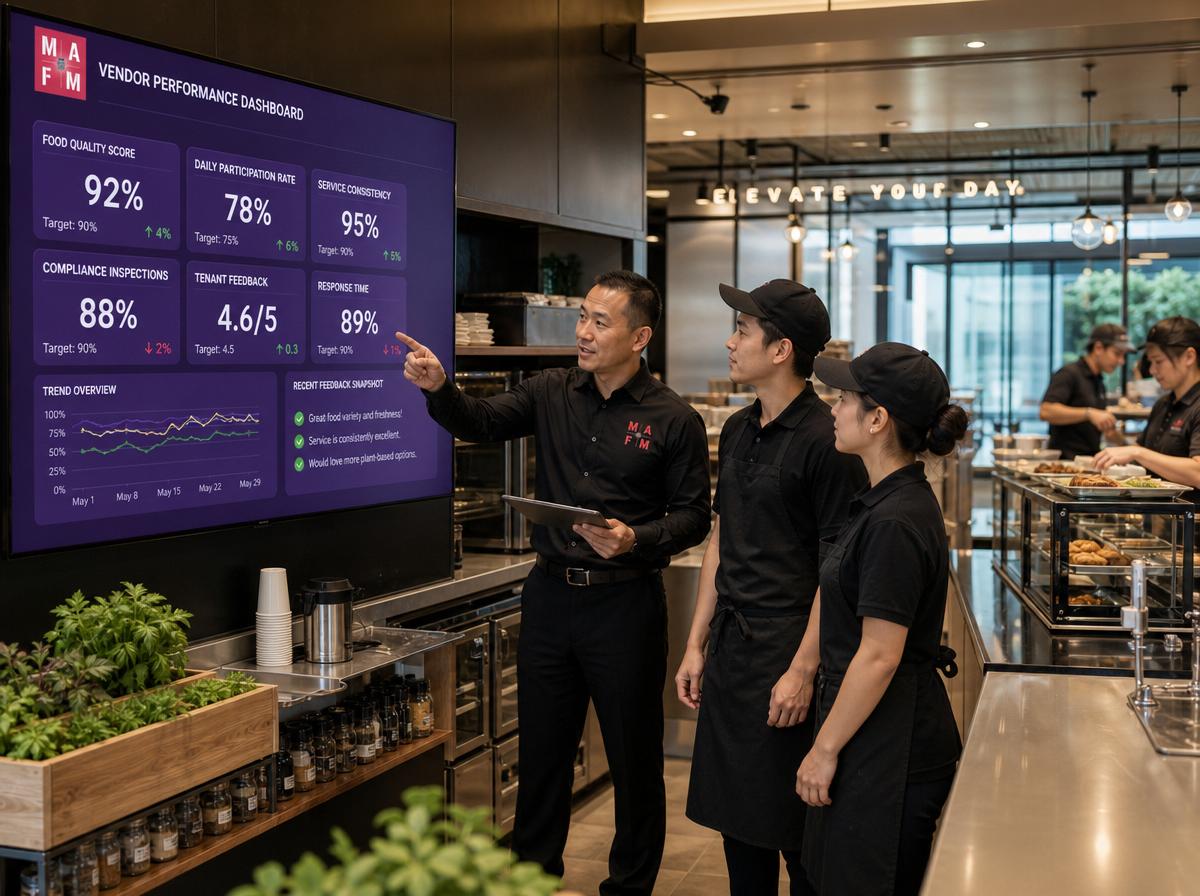
Operator performance management through quarterly reviews using a consistent vendor scorecard framework maintains accountability without the adversarial dynamic that informal performance management creates. Evaluate hours consistency, food quality ratings (simple customer satisfaction surveys available through the building app), operational cleanliness (inspected by building management monthly), and financial performance against targets.
Building owners who host food service operations assume food safety compliance responsibilities that many facility managers are not aware of.
Health department permits for commercial food service operations require specific kitchen infrastructure, equipment, ventilation, and operational standards that must be in place before service begins and maintained throughout the operation. The building owner is often a party to these permits and faces liability for violations that occur within building food service operations.
Facility support requirements for food service compliance, adequate commercial ventilation for cooking operations, proper grease trap infrastructure, hand-washing stations meeting health code specifications, and pest management that addresses the additional food-related attractants, are building management responsibilities that precede and sustain permit compliance.
Monthly health and safety walk-throughs of café and food service areas by building management, not leaving this oversight exclusively to the operator, maintain the building's awareness of conditions and catch developing compliance issues before they escalate to permit-threatening violations.
Fire suppression systems for commercial cooking operations require annual inspection and semi-annual testing of suppression system nozzles and fusible links that most building fire suppression programs do not cover because cooking suppression systems are distinct from standard commercial systems. Confirm that your café operator's lease terms clearly assign responsibility for this compliance.
Food service programs designed for pre-pandemic full-time occupancy patterns require recalibration for hybrid work realities.
Tuesday through Thursday staffing and inventory concentration matches food service investment to the occupancy peaks that hybrid work creates. A café that operates with the same staffing Monday through Friday and runs out of popular items on Wednesday and has excess waste on Monday and Friday has not adapted its model to actual demand.
Grab-and-go optimization serves the hybrid worker who arrives mid-morning focused on getting to work rather than waiting in a lunch line. Stocking quality grab-and-go options (fresh sandwiches, salads, protein boxes) starting from building opening rather than just for the lunch rush serves the broader range of arrival times that hybrid workers create.
Mobile ordering through the building app allows tenants to place café orders for pickup, eliminating the wait time that some hybrid workers cite as a barrier to using the building café. This feature requires café operator technology capability and app integration but meaningfully increases café utilization by removing the primary friction point.
Catering service for meetings and events provided by the building café converts the food service operation from a break-time amenity to a business support service. Tenants who can order catering for their meetings through the same channel as their lunch simplify their operational workflow while increasing the café's revenue and utilization.
Food service is an amenity investment that should be evaluated against specific performance metrics.
Daily participation rate measures the percentage of building occupants who use the food service on a given day. A café with 35% daily participation on peak occupancy days is performing well; one with 10% participation is either not meeting quality expectations or not meeting the needs of the occupant population it serves.
Net Promoter Score for the food service specifically, separate from the building's overall NPS, measures whether tenants would recommend the building's food service to colleagues. Food service NPS below 30 indicates meaningful quality or value gap that is suppressing the amenity's contribution to tenant satisfaction.
Revenue per occupant tracks the average daily spend per building occupant, which provides a normalized comparison across days with different occupancy levels and a trend metric that reveals whether the food service is capturing a growing or declining share of the food spending that occurs in and around the building.
Food service is the commercial building amenity with the highest daily touchpoint frequency and the most direct connection to the hybrid work attendance decisions that determine how well tenants utilize their office investment. Buildings that manage this amenity with the same rigor as their physical infrastructure, through structured operator selection, active performance management, food safety compliance oversight, and hybrid-optimized programming, deliver a competitive advantage that their tenants experience every day.
Assess your current food service program against the framework this month. If you have a staffed operation, conduct a quality and compliance review. If you have a vending-only program, evaluate whether a micro-market or coffee service upgrade would improve the building's attendance value proposition. Food is not a peripheral amenity, in the hybrid work era, it is a core occupant experience driver.
MAFM manages food service amenity programs as part of our comprehensive tenant experience approach. Contact us to discuss your building's food service strategy.
Schedule your consultation: Contact MAFM.PRO
MAFM offers comprehensive facility management solutions tailored to your business needs.
Get in Touch