Facility Maintenance
Commercial HVAC Maintenance for Silicon Valley Offices
February 12, 2026
Every facility manager we work with in Santa Clara, San Mateo, and Alameda counties knows the sprinkler system needs an annual test. Most know the fire alarm panel does too. What catches people off guard is how many of these cycles were started at slightly different times over the past few years (a sprinkler inspection scheduled in March, a fire pump flow test booked in July, an alarm certification that happened to fall in November) and how, by year three or four of ownership, they've all drifted toward the same overloaded quarter. For a lot of Silicon Valley buildings, that quarter is right now.
This matters more than a generic "stay compliant" reminder suggests. Fire and life safety systems are the one category of building infrastructure where a lapsed certification isn't just a paperwork problem: it's a building closure risk, an insurance exposure, and in a multi-tenant office or lab building, a potential liability against every lease you've signed. Santa Clara County Fire, the Palo Alto Fire Department, and the various city AHJs across the Peninsula have gotten noticeably less lenient about grace periods since 2023, and several MAFM clients have had inspectors show up unannounced for re-checks after a failed or overdue test was flagged in a records pull.
This post is part of our October series on the systems worth certifying before the year turns over. Today we're going deep on fire and life safety specifically: what's actually due, what the testing standards require, and how to sequence four to five separate contractor visits into something that doesn't eat your Q4 operating budget or your facilities team's calendar.
The compliance confusion almost always comes from treating "fire safety inspection" as one event instead of five or six separate ones governed by different NFPA standards. Fire alarm systems fall under NFPA 72 and require annual testing of all initiating devices (smoke detectors, pull stations, duct detectors) plus a full functional test of the panel and notification appliances. Sprinkler systems fall under NFPA 25, which actually specifies a tiered schedule: monthly gauge checks, quarterly inspections of valves and standpipes, and an annual internal and external inspection of the full system, with a 5-year internal obstruction investigation that a surprising number of building owners have never scheduled.
Fire pumps have their own NFPA 25 requirement for an annual flow test, which needs a licensed fire protection contractor and, in many East Bay and Peninsula jurisdictions, advance notice to the water utility since the test pulls significant flow. Portable fire extinguishers need annual service tags from a licensed inspector under NFPA 10, plus a 6-year internal maintenance cycle and 12-year hydrostatic testing that gets forgotten because it's not annual. And if your building has a fire-rated smoke control or stairwell pressurization system, common in mid-rise Silicon Valley office towers built after 2005, that's a separate annual test under the mechanical code, often missed entirely because it lives in the HVAC contractor's scope, not the fire contractor's.
The practical issue is that these five systems are frequently serviced by three or four different vendors, each running their own scheduling software, each defaulting to "we'll call you when it's due." When MAFM audits a new client's fire safety file, the single most common finding isn't a failed test: it's a missing one nobody flagged because the vendor who used to handle it changed ownership or dropped the account two years ago.
A completed test means nothing to an inspector without the paper trail behind it, and this is where a lot of otherwise well-maintained buildings get dinged. Every fire alarm test needs a signed NFPA 72 inspection and testing form, not just a service invoice: the form itself documents device-by-device results, and several California AHJs will reject a general invoice as insufficient during a records request. The same applies to sprinkler systems: NFPA 25 has a specific reporting format, and the underlying test data (static pressure, residual pressure, flow in gpm) needs to be recorded, not just a checkbox that says "passed."
Buildings that lease space to multiple tenants have an added layer: many commercial leases in Silicon Valley, especially R&D and lab space, require the landlord to provide current fire safety certificates to tenants or their insurance carriers on request, sometimes with 30-day notice provisions. If your documentation lives in scattered vendor email threads instead of a centralized compliance binder or digital log, that 30-day window gets tight fast, particularly if a certificate turns out to be missing and a re-test has to be scheduled.
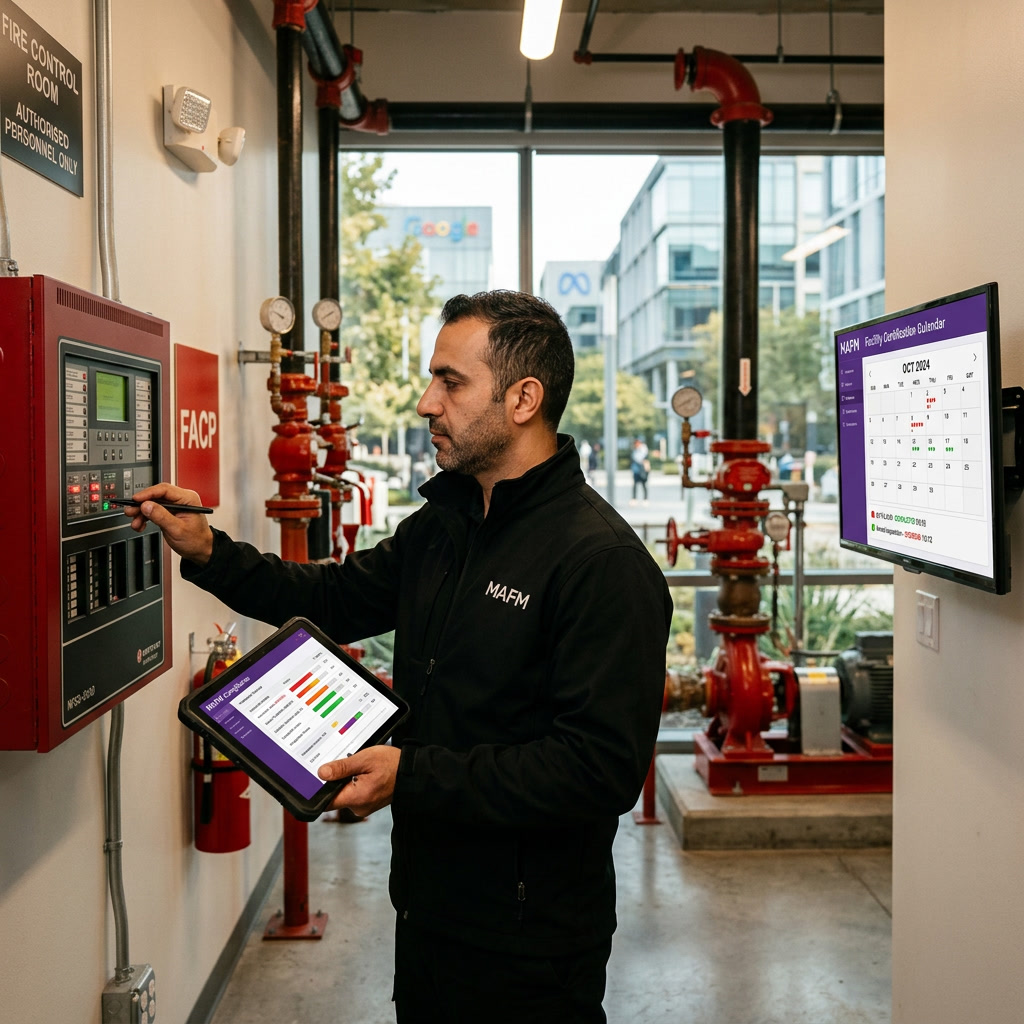
We keep a standing compliance calendar for every client property that cross-references test due dates against county fire marshal audit cycles where those are publicly known, and against insurance renewal dates, since most commercial property insurers now request current fire system certifications as part of underwriting. Building owners who've been burned by a coverage gap tend to take this section seriously; everyone else tends to learn about it the hard way, usually right when a claim is filed.
Fire alarm and sprinkler testing both require taking systems temporarily out of service, which means fire watch procedures, tenant notifications, and in the case of research and lab buildings, sometimes evacuation of sensitive equipment areas during alarm silencing. Running all five test categories as separate, uncoordinated vendor visits means five separate disruption events, five sets of tenant notices, and five instances of your building engineer standing around during a fire watch instead of doing anything else productive.
The better approach, and what MAFM builds into fall inspection scheduling, is grouping compatible tests into a single service window. Fire alarm functional testing and sprinkler quarterly inspections can often be scheduled back-to-back with the same fire watch coverage, since both require the alarm monitoring company to be notified regardless. Extinguisher servicing can happen any time and doesn't require system downtime, so it should never be the thing driving your calendar: but it's often the item people forget because it feels the least urgent.
Fire pump flow testing is the one that needs its own separate slot, both because of the water utility coordination and because it's genuinely loud and disruptive in a way tenants notice: we recommend scheduling it for early morning or a weekend, and giving tenant-facing notice at least a week out with a plain-language explanation ("you may hear a loud pump and see water discharge near the loading dock; this is a required annual safety test"). Buildings that skip that tenant communication step generate a disproportionate number of complaint calls and, occasionally, 911 calls from confused occupants who think there's an active emergency.
The direct cost of a lapsed fire alarm or sprinkler certification is rarely the re-test fee, which typically runs a few hundred to low thousands of dollars depending on building size. The real cost shows up in three places. First, insurance: a documented lapse discovered during a claim investigation can result in a reduced payout or denied coverage entirely, and property insurers serving Silicon Valley commercial buildings have gotten more aggressive about requesting certification files after a claim, not before. Second, tenant relations: a red-tagged building or a fire watch requirement that drags on for weeks because a contractor is backed up creates real friction with tenants who signed leases expecting fully operational life safety systems, and it's the kind of issue that surfaces in lease renewal negotiations.
Third, and most underappreciated, is the compounding scheduling cost. A missed annual test doesn't just mean one overdue item: it usually means the next cycle's due date resets from whenever the late test finally happens, which can permanently shift your fire safety calendar away from a sensible fall inspection window and into an awkward mid-year slot that fights with other maintenance priorities for years afterward. Getting back on a clean annual cycle, ideally anchored to Q4 alongside your other year-end certifications, is worth the one-time hassle of an off-cycle test to reset the clock properly.
Fire and life safety compliance is less about any single inspection and more about managing five overlapping calendars without letting any of them slip quietly out of view. The buildings that handle this well aren't necessarily spending more on fire protection contractors: they're just tracking due dates centrally, batching disruptive tests into single windows, and keeping documentation that would actually satisfy an AHJ records request rather than a loose collection of invoices.
If your fire safety file is scattered across three vendor relationships and you're not entirely sure when the fire pump was last flow-tested, October is the right month to find out: before an insurance renewal, a tenant records request, or a routine AHJ audit finds out first.
MAFM offers a fire and life safety compliance audit that consolidates your NFPA 72, NFPA 25, and NFPA 10 testing history into one calendar and flags every gap before your AHJ does: reach out to schedule yours before Q4 fills up.
Reference earlier posts in this week's October Facility Inspection Calendar series covering HVAC and mechanical system certifications, elevator and vertical transportation compliance, and roofing/envelope inspections, framing this post as the fire and life safety installment in that same sequence.
NFPA 25 (Standard for the Inspection, Testing, and Maintenance of Water-Based Fire Protection Systems) at nfpa.org; California State Fire Marshal guidance on commercial building inspection requirements at fire.ca.gov.
MAFM offers comprehensive facility management solutions tailored to your business needs.
Get in Touch