Facility Maintenance
Smart HVAC Maintenance for Silicon Valley Office Buildings
February 12, 2026
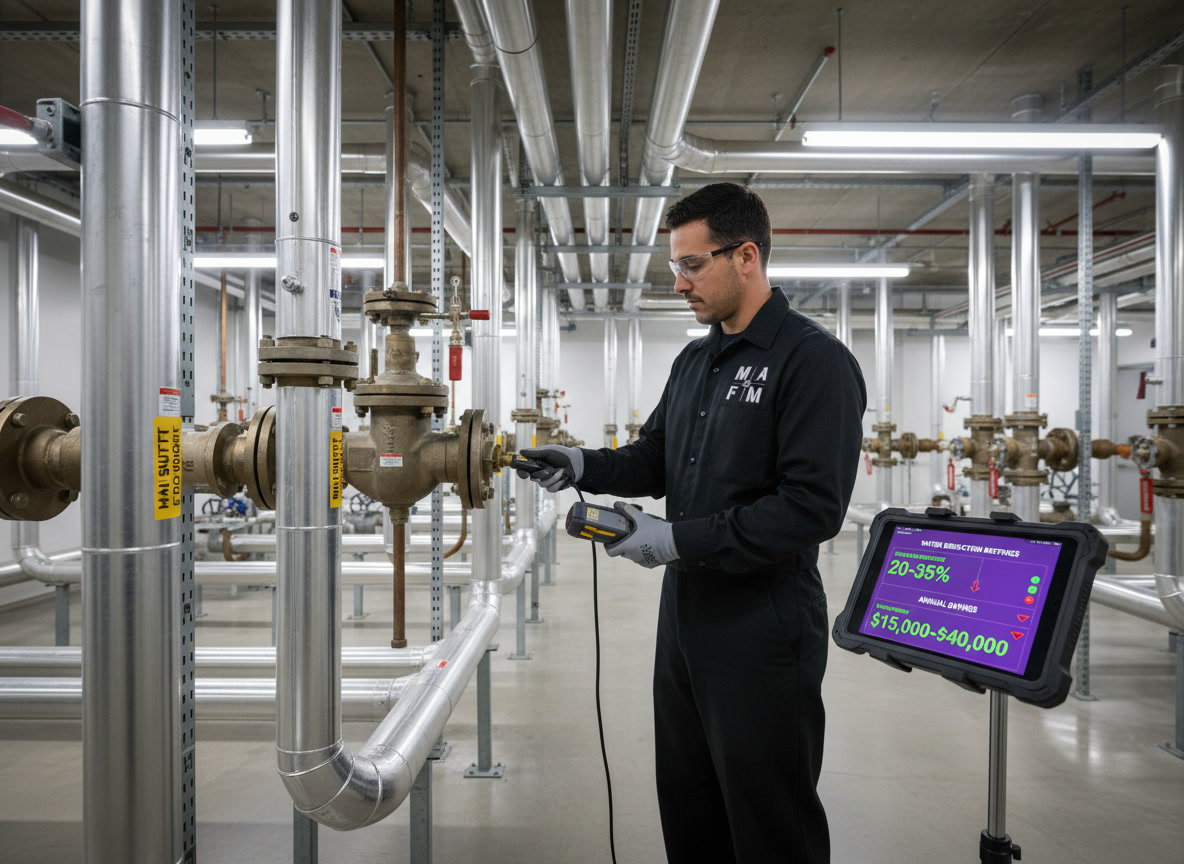
Commercial plumbing systems operate quietly behind walls and beneath floors, delivering water and removing waste without the visible attention that HVAC, electrical, and cleaning systems receive. This invisibility creates a dangerous management gap. Plumbing failures announce themselves catastrophically (a burst supply line, a backed-up sewer main, a corroded fitting that releases water into a ceiling cavity) and the resulting damage routinely exceeds six figures in a Silicon Valley commercial building.
Simultaneously, water costs in the Bay Area have increased 40 to 60% over the past decade, and conservation mandates continue tightening. Buildings that waste water through inefficient fixtures, undetected leaks, and poorly managed irrigation face both financial penalties and regulatory exposure.
The smart approach addresses both risks with a unified strategy: proactive plumbing maintenance that prevents failures while systematically reducing water consumption.
Commercial plumbing maintenance follows a hierarchy of attention that prioritizes the components most likely to fail and most costly when they do.
Supply line connections are the highest-risk failure point in commercial plumbing systems. The flexible braided connectors that connect supply valves to toilets, urinals, faucets, and water heaters have a finite service life and fail without warning when they exceed it. These connectors should be inspected annually for bulging, corrosion, or weeping and replaced on a seven-to-ten-year cycle regardless of visible condition.
A single flex connector failure during off-hours can release hundreds of gallons per hour, creating damage that saturates multiple floors before anyone discovers it. For a $4 connector replaced proactively, you prevent potential damage exceeding $50,000.
Water heater systems require annual inspection of tank condition, anode rod evaluation, temperature and pressure relief valve testing, and connection integrity verification. Commercial water heaters in Silicon Valley typically operate in hard-water conditions that accelerate sediment buildup and tank corrosion. Flushing water heaters annually and replacing anode rods every three to five years extends tank life from eight years to twelve to fifteen years.
Drain systems need preventive attention that most facility teams underdeliver. Commercial drains accumulate grease, mineral deposits, and organic matter that progressively restrict flow. By the time a drain backs up, the restriction has typically been building for months. Implement quarterly drain maintenance using enzymatic treatments that break down organic buildup, and schedule annual professional drain cleaning for all kitchen and break room drains and main building drain lines.
Backflow prevention devices require annual testing by a certified tester as mandated by California code and your local water utility. Failed tests require immediate repair. Backflow prevention protects the municipal water supply from contamination and protects your building from regulatory penalties and potential health liability.
Undetected leaks waste water, inflate utility bills, and create concealed moisture conditions that drive mold growth and structural deterioration. The EPA estimates that commercial buildings lose an average of 10 to 15% of their water consumption to leaks.
Implement a monthly water audit that compares metered consumption against expected usage based on occupancy and fixture count. A building consuming significantly more water than its occupancy profile predicts likely has one or more concealed leaks.
Toilet flapper leaks are the most common and most overlooked source of commercial water waste. A single leaking toilet flapper can waste 200 gallons per day (73,000 gallons annually) without producing any visible sign of malfunction. The toilet simply runs silently between flushes, consuming water that registers on the meter but serves no purpose.
Test every toilet in the building quarterly using dye tablets or food coloring in the tank. If color appears in the bowl without flushing, the flapper is leaking and should be replaced immediately. At Bay Area water rates, a single leaking toilet costs $500 to $1,200 annually in wasted water.
Irrigation system leak detection requires separate attention from building plumbing. Walk your irrigation zones monthly during the active season, looking for saturated soil, erosion patterns, broken spray heads, and zones that remain wet between scheduled watering cycles. Underground irrigation leaks can waste thousands of gallons before surface evidence appears.
Smart water meters that provide real-time consumption data with alert thresholds for abnormal flow patterns are the most effective leak detection technology available. These systems identify leaks within hours of onset by detecting continuous flow during periods when the building should have zero water consumption, overnight and weekends. The investment of $2,000 to $5,000 for a smart metering system typically pays for itself within the first year through waste elimination.
Replacing inefficient plumbing fixtures with current high-efficiency models is the most impactful water conservation measure available and often the most cost-effective.
Toilets manufactured before 1994 use 3.5 to 7 gallons per flush. Current high-efficiency toilets use 1.28 gallons or less, a 63 to 80% reduction per flush. For a 50,000 square foot office building with 30 toilets, upgrading from 3.5-gallon fixtures to 1.28-gallon models saves approximately 200,000 to 350,000 gallons annually. At current Bay Area water and sewer rates, that translates to $3,000 to $6,000 in annual savings against a fixture replacement cost of $8,000 to $15,000, a two-to-three-year payback.
Urinals present an even stronger conservation case. Traditional urinals use 1 to 3 gallons per flush. High-efficiency urinals use 0.5 gallons or less, and waterless urinals eliminate flush water entirely. The water savings from converting five conventional urinals to waterless or ultra-low-flow units can exceed 100,000 gallons annually.
Faucet aerators and flow restrictors are the lowest-cost, highest-impact retrofit available. Installing 0.5 GPM aerators on all lavatory faucets, replacing the standard 2.2 GPM flow, reduces faucet water consumption by 77% with minimal impact on user experience. Aerators cost $3 to $10 each and install in minutes.
Sensor-operated faucets and flush valves eliminate the waste from fixtures left running and provide precise flow control. While the upfront cost exceeds manual fixtures, sensor-operated units reduce water consumption by 30 to 50% compared to manual alternatives and eliminate the maintenance complaints associated with fixtures that drip or run continuously.
Landscape irrigation typically represents 30 to 50% of total water consumption for Silicon Valley commercial properties with maintained landscapes. This category offers the largest single conservation opportunity for most buildings.
Smart irrigation controllers that adjust watering schedules based on real-time weather data, soil moisture sensors, and plant water requirements reduce irrigation consumption by 20 to 40% compared to fixed-timer systems. The controller investment of $2,000 to $5,000 pays for itself in water savings within twelve to eighteen months.
Drip irrigation for shrub beds and planting areas delivers water directly to root zones with 90% efficiency compared to 50 to 70% for conventional spray heads. Converting shrub bed irrigation from spray to drip reduces water use for those zones by 30 to 50% while improving plant health through more consistent moisture delivery.
Irrigation audits by qualified landscape irrigation specialists identify distribution uniformity issues, pressure problems, and scheduling inefficiencies that waste water without improving landscape quality. An annual irrigation audit costing $500 to $1,000 typically identifies savings of $2,000 to $5,000 annually.
Reclaimed water use for irrigation is available in several Silicon Valley jurisdictions and provides a sustainable water source at lower cost than potable water. If your property is located near a reclaimed water distribution line, the connection investment typically pays back within three to five years through reduced potable water consumption.
Beyond conservation, active management of water costs protects your facility budget from the rate increases that Bay Area utilities continue implementing.
Review your water and sewer billing for accuracy quarterly. Commercial water bills are calculated from meter readings, and meter errors, while uncommon, can persist for months before discovery. Verify that your metered consumption aligns with your expected usage profile.
Investigate sub-metering for tenant spaces that generate disproportionate water use. Dental offices, medical clinics, food service tenants, and fitness facilities consume significantly more water than standard office occupancy. Sub-metering allows equitable cost allocation and incentivizes conservation by making tenants aware of their actual consumption.
Apply for available water utility rebates. Most Bay Area water utilities offer rebates for high-efficiency fixture installations, smart irrigation controller upgrades, and landscape conversion projects. These rebates can offset 30 to 50% of conservation project costs.
Commercial plumbing maintenance and water conservation are complementary strategies that protect your building from catastrophic failures while systematically reducing one of your largest utility costs. The investment is modest, proactive maintenance and fixture upgrades cost a fraction of the damage they prevent and the water they save.
Start with a comprehensive plumbing assessment and water audit this month. Identify your highest-risk failure points and your largest conservation opportunities. Address both simultaneously, and your building will operate with lower risk, lower water costs, and full compliance with Bay Area conservation requirements.
MAFM PRO integrates plumbing maintenance and water conservation into comprehensive facility management programs. Contact us for a water audit and plumbing risk assessment.
Schedule your consultation: Contact MAFM.PRO
February 12, 2026

February 13, 2026
February 27, 2026
MAFM offers comprehensive facility management solutions tailored to your business needs.
Get in Touch