How to Win Facility Management Contracts in Silicon Valley: The Business Development Playbook for FM Companies
How to Win Facility Management Contracts in Silicon Valley: The Business Development Playbook for FM Companies
Winning facility management contracts in Silicon Valley is fundamentally different from winning them in most other markets. The decision-makers are sophisticated, the competition includes national and international providers, and the evaluation process favors demonstrated capability over low pricing. Companies that approach the Silicon Valley market with generic proposals and race-to-the-bottom pricing lose consistently to providers who understand what this market actually values.
The facility management companies that build thriving Silicon Valley practices share a common approach: they sell outcomes rather than labor hours, they demonstrate market-specific expertise rather than general capabilities, and they build relationships that survive the inevitable service challenges that every contract experiences.
Here is the business development playbook that helps facility management companies compete and win in the most demanding commercial real estate market in the country.
Understanding What Silicon Valley Buyers Value
Silicon Valley property managers and facility directors evaluate FM providers differently than buyers in other markets. Understanding these evaluation priorities is the foundation of effective business development.
Demonstrated local expertise outweighs national scale. A facility management company with ten Silicon Valley properties on its client list holds more credibility than a national firm with a thousand properties in other markets. Local references, knowledge of Bay Area labor market conditions, relationships with local vendors and suppliers, and familiarity with California regulatory requirements signal to buyers that you understand their specific operating environment.
Technology-enabled operations are expected, not differentiating. Silicon Valley buyers assume that any serious FM provider uses a CMMS, mobile work order management, and digital quality tracking. What differentiates is how you use technology to deliver measurable results: real-time quality dashboards that clients can access, automated reporting that eliminates manual data requests, and data-driven staffing optimization that demonstrably improves cost efficiency.
Cultural fit matters more than most FM companies recognize. Silicon Valley commercial buildings serve tech companies, biotech firms, and professional services organizations with specific workplace expectations. An FM company whose supervisory staff communicates professionally, whose cleaning teams present a polished appearance, and whose management demonstrates intellectual engagement with facility challenges fits the Silicon Valley environment in ways that operationally competent but culturally misaligned providers do not.
Sustainability credentials are increasingly a qualification threshold rather than a differentiator. Buyers expect green cleaning products, waste diversion compliance, and environmental awareness as baseline requirements. Companies that position sustainability as a specialty are behind the market. Companies that integrate it as standard practice match expectations.
Building Your Silicon Valley Portfolio
The path from zero to a competitive Silicon Valley FM portfolio follows a predictable progression that requires patience and strategic targeting.
Start with properties where your competitive advantage is strongest. If you are a smaller FM company competing against larger providers, target mid-size properties between 25,000 and 75,000 square feet where your management attention advantage is most visible. Large providers spread their management resources thin across many accounts. Smaller companies can offer the hands-on, principal-involved management that mid-size properties value most.
Win your first three references. The initial portfolio-building phase is the most challenging because buyers want local references you do not yet have. Bridge this gap by offering performance-guaranteed trial periods, providing references from comparable markets if your local history is limited, and demonstrating your operational systems through detailed proposals that showcase your management methodology.
Once you have three strong Silicon Valley references, business development accelerates. Property managers talk to each other, brokers hear about service quality from their clients, and your reputation begins generating inbound inquiries. Protect these early references with disproportionate management attention, losing a reference account during the portfolio-building phase sets your development timeline back significantly.
Expand strategically through property management relationships. When you deliver strong results for a property manager who oversees multiple buildings, ask for the opportunity to propose on their other properties. Multi-property relationships with a single management company provide portfolio growth with reduced business development overhead.
The Proposal That Wins
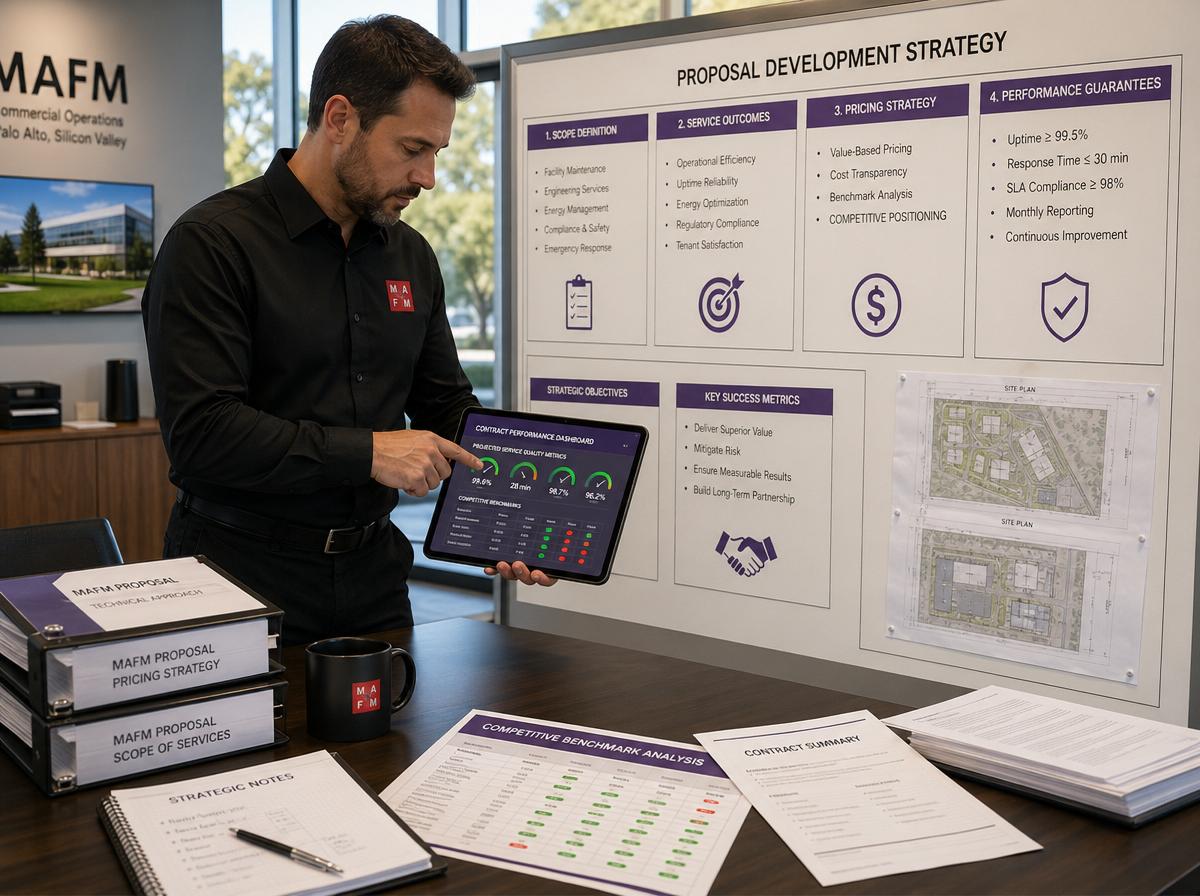
Winning proposals in Silicon Valley share characteristics that separate them from the generic submissions that get filtered out early in the evaluation process.
Lead with your understanding of the property's specific challenges rather than your company's general capabilities. The first page of your proposal should demonstrate that you have studied the building, identified its particular needs, and designed a solution tailored to those needs. Property managers who read proposals that begin with two pages of company history before addressing their building know they are receiving a template rather than a custom solution.
Present your staffing plan with transparency and specificity. Show exactly how many people will work in the building, during which hours, performing which tasks, supervised by whom. Include staffing calculations that demonstrate your proposed team can accomplish the scope of work without cutting corners. Sophisticated buyers back-calculate labor costs from your pricing, if the math does not support paying legal wages with appropriate benefits, your proposal loses credibility regardless of the total price.
Include your quality management methodology with specific metrics, inspection frequencies, and reporting formats. Show sample reports, sample dashboards, and sample inspection forms. Buyers who can visualize what their quality oversight experience will look like under your management feel more confident committing to your company.
Address transition planning comprehensively. Property managers fear transition disruption more than almost any other aspect of changing FM providers. A detailed 90-day transition plan that covers staff recruitment timelines, building orientation procedures, supply and equipment staging, tenant communication, and ramp-up quality milestones directly addresses their primary anxiety.
Price competitively but never cheaply. Sophisticated Silicon Valley buyers understand that below-market pricing signals understaffing, underpayment, or unsustainable margins that will eventually surface as service quality problems or mid-contract rate increase requests. Price your proposal to deliver your promised service level profitably and defend your pricing with transparent cost structure explanation.
Relationship Development
In Silicon Valley's commercial real estate community, relationships drive opportunity flow more than any other business development channel.
Property management company relationships are the highest-leverage connections an FM company can develop. A single property management company may control facility services procurement for twenty or more buildings. Building trust with a property management firm's operations leadership creates a pipeline that no amount of cold outreach can replicate.
Develop these relationships through industry events, professional associations, and targeted networking. BOMA, IREM, and local commercial real estate organizations provide regular opportunities for face-to-face interaction with the people who make or influence FM provider selection decisions.
Broker relationships are underutilized by most FM companies. Leasing brokers who tour buildings with prospective tenants form impressions of facility quality that influence their recommendations. A broker who has seen your work and been impressed by it becomes an unsolicited reference during tenant tours at your client's building.
Vendor relationships with complementary service providers (elevator companies, HVAC contractors, landscapers, security firms) create referral networks that generate qualified leads. These companies interact with the same property managers you want to reach and can provide introductions that bypass the cold-contact barrier.
Client Retention as Business Development
The most efficient business development activity is retaining the clients you already have. Every retained contract is a contract you did not have to win through competitive bidding, and the revenue stability of retained accounts funds the growth investments needed to win new ones.
Retention starts with consistent service delivery but extends well beyond it. The FM companies that retain clients for ten or more years supplement operational excellence with proactive account management that anticipates client needs, identifies improvement opportunities, and continuously adds value beyond the contracted scope.
Schedule quarterly business reviews with every client, not just performance reviews but strategic conversations about the building's future needs, the client's evolving priorities, and opportunities to enhance service delivery. These conversations demonstrate partnership mentality that transactional competitors cannot match.
Invest in continuous improvement within retained accounts. The FM company that delivers the same service year after year eventually becomes the provider the client replaces for lack of innovation. The company that regularly brings new ideas, tests improvements, and demonstrates measurable progress becomes embedded in the client's operation in ways that make replacement unappealing.
Address problems with speed and transparency. Every FM contract encounters service challenges, the defining moment is not whether problems occur but how the provider responds. Companies that acknowledge issues immediately, investigate root causes honestly, implement corrective actions quickly, and communicate throughout the process earn client loyalty that survives imperfect performance.
Conclusion
Winning and retaining facility management contracts in Silicon Valley requires a market-specific approach that values demonstrated expertise, transparent operations, professional culture, and relationship investment over the price-driven strategies that work in less sophisticated markets.
Build your Silicon Valley practice with intention. Target the right properties, craft proposals that demonstrate genuine understanding, develop relationships that generate opportunity flow, and retain clients through partnership that extends beyond service delivery. The Silicon Valley FM market rewards companies that earn their position, and the rewards for those who do are substantial.
MAFM PRO has built its Silicon Valley practice through the operational excellence and client partnership described in this playbook. Contact us to experience facility management that earns your continued business every day.
Schedule your consultation: Contact MAFM.PRO
Ready to Optimize Your Facilities?
MAFM offers comprehensive facility management solutions tailored to your business needs.
Get in Touch