Who Holds the Keys? Access Control and Security Planning for Polling Place Buildings
Who Holds the Keys? Access Control and Security Planning for Polling Place Buildings
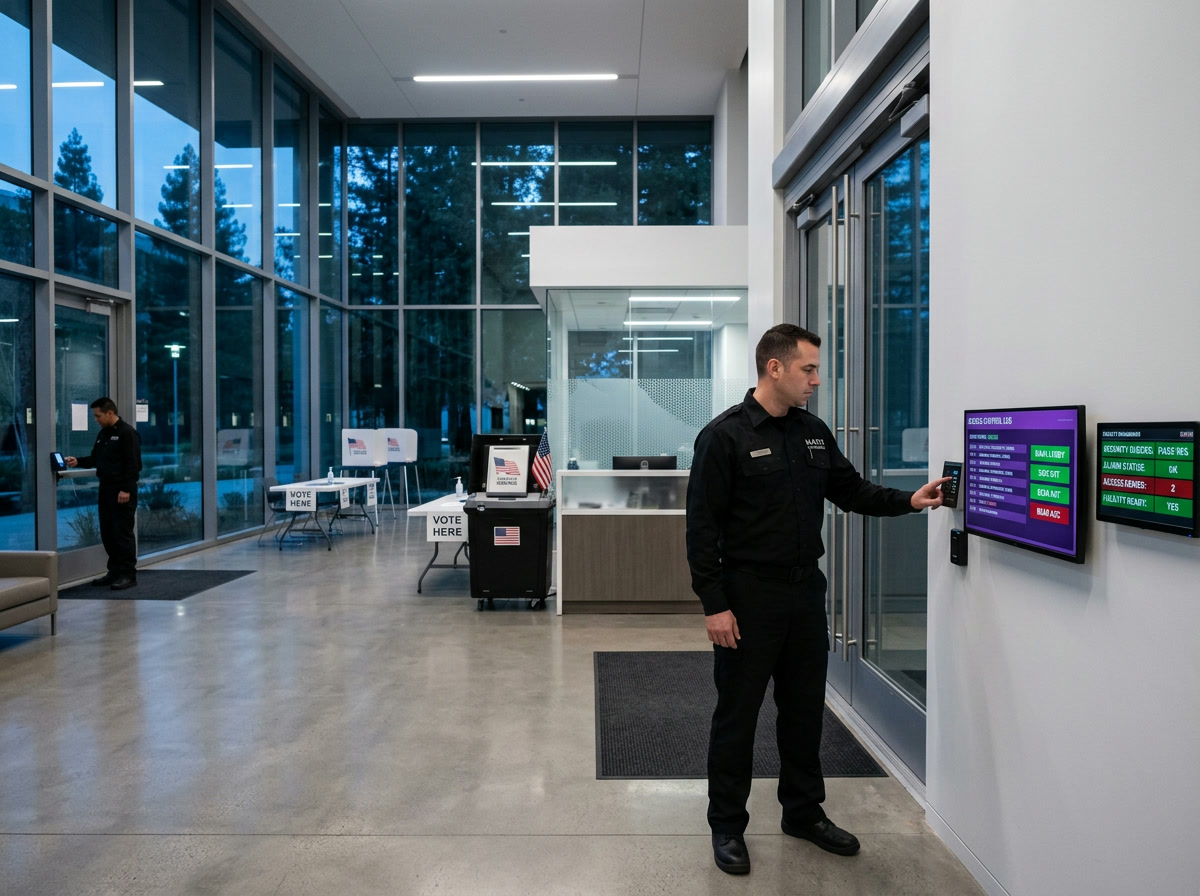
If your lobby, conference center, or parking structure is on this year's list of Santa Clara or San Mateo County polling locations, you already know the drill in broad strokes: poll workers show up before dawn, voters trickle in from 7:00 a.m. to 8:00 p.m., and somewhere around 8:15 p.m. a chain-of-custody envelope leaves your building in a locked transport case. What doesn't get discussed enough is what happens to your building's normal access control architecture during those 14-plus hours — and the week leading up to them.
Most commercial buildings in the Silicon Valley market run on layered access: badge readers at the perimeter, a different credential tier for elevator banks, a separate system for loading docks, and often a third-party security vendor managing it all under a service contract that was never written with "county election official needs master access to the east stairwell at 5:45 a.m." in mind. When a building gets designated as a polling site — voluntarily or because the Registrar of Voters has leased space from the landlord — the facility team becomes the operational bridge between county election law and building security policy, usually with about six to eight weeks of notice.
This post covers the access control, staffing, and liability mechanics specifically. We're not covering ADA pathways or custodial turnaround today (that's its own post this week) — this one is about who gets in, when, and how you prove it later if anyone asks.
Building Access Timeline Vs. Your Existing Schedule
Every county Registrar of Voters office (Santa Clara County's included) requires poll worker and equipment access well before polls open at 7:00 a.m. — typically 5:30 or 6:00 a.m. for setup of voting booths, the electronic poll book stations, and the ballot marking devices. If your building's HVAC, lighting, and access control systems are on a standard commercial schedule — say, unlock at 6:30 a.m., HVAC ramp-up at 6:00 a.m. for a 7:00 a.m. tenant occupancy — you have a 30- to 60-minute gap where poll workers are standing outside a dark, locked building in November at 45 degrees.
The fix is mechanical, not complicated, but it has to be scheduled as a work order at least two weeks out: temporarily override the access control panel's unlock schedule for the designated entrance only (not the whole building), confirm the HVAC BAS trends are adjusted so the polling room itself is at comfortable temperature by 5:30 a.m. rather than 7:00, and designate which entrance poll workers use versus which stays on normal tenant schedule. In multi-tenant office buildings, this usually means isolating the ground-floor conference room or community room polling site from the elevator lobby and upper floors entirely — a single-door unlock rather than a building-wide schedule change, which also limits your liability exposure for the rest of the tenant population.
On the close-out end, polls close at 8:00 p.m. sharp, but processing, ballot reconciliation, and the public tally posting can run until 9:00 or 9:30 p.m. Your access control schedule and your after-hours security guard shift both need to cover that tail, not just the published poll hours. We've seen buildings get this wrong by scheduling guard coverage to end at 8:00 p.m. precisely, leaving poll workers locked out of restrooms or unable to exit through a card-access door after their credential-holding supervisor has already left for the night.
Credential Management and The Keyholder Problem
The core access control question for any FM team is: how does a poll worker or county elections official — someone with zero history in your badge system — get verified, temporary access without creating a permanent credential that someone forgets to deactivate on November 4th?
The cleanest approach, and the one MAFM recommends to property clients, is a dedicated temporary credential batch tied to a single door group and a hard expiration timestamp, not a manual deactivation task on someone's to-do list. Most modern access control platforms (Lenel, Genetec, Brivo) support time-bound credentials natively — set the activation window to 5:00 a.m. and expiration to 10:00 p.m. on November 3rd, and the system self-revokes without requiring a technician to remember. If your building still runs on a legacy proximity system without time-bound capability, the fallback is a physical keyed override with a sign-out log — but that requires a designated on-site keyholder for the full window, which is a staffing cost, not a free option.
The keyholder question matters more than most property managers initially estimate. Someone from your facility team, or a contracted security officer with building-specific training, needs to be physically present or on 15-minute call-back the entire time the polling site is active — not just to unlock doors, but to handle the inevitable: a jammed door closer, a tripped alarm zone when the county's equipment delivery truck backs into a motion sensor at 5:40 a.m., a water leak in the ceiling above the polling room discovered mid-morning. The Registrar of Voters' setup crew is not your facility team and won't troubleshoot your building systems — that liability and response obligation stays with the property.
Document everything. A simple access log — who entered, what credential, what timestamp — isn't just good practice, it's often requested by county election officials after the fact as part of their own chain-of-custody documentation, particularly for any room where voted ballots or voting equipment were stored overnight before or after Election Day.
Security Staffing, Vendor Coordination, and Insurance
Polling locations attract a different risk profile than a typical Tuesday in a Silicon Valley office park, and your existing security staffing level was almost certainly sized for neither the foot traffic nor the duration. A ground-floor lobby that normally sees 40 badge swipes an hour during business hours can see several hundred walk-in voters over the course of the day, most of whom have never been in your building and don't know where the restrooms, accessible entrance, or fire exits are.
If your building contracts security through a third-party guard service, this is the week to confirm — in writing — that your contract's scope covers the extended hours and the specific duties (crowd flow at the entrance, monitoring for electioneering violations within the 100-foot buffer required under California Elections Code, and coordinating with poll workers rather than county-trained election officials, who have their own separate authority inside the polling room itself). Guard rates for extended or unusual-hours coverage in the South Bay market typically run $32–$42/hour for a licensed, unarmed officer, and most vendors require 10–14 days' notice to guarantee staffing on Election Day, since demand across the county spikes simultaneously at every designated polling site.
Confirm your certificate of insurance and your building's own general liability coverage specifically contemplate third-party public access for voting purposes — this is not always automatically assumed under a standard commercial GL policy written around tenant and invitee use, and it's worth a five-minute call to your broker rather than an assumption. Also loop in your property's crisis communication plan: if there's a security incident, a protest, or a dispute at the polling site, your front-line staff needs a clear, rehearsed answer about who calls the county Registrar's office, who calls the non-emergency line, and who calls your property manager — in that order, before anyone improvises.
Reverting The Building to Normal Operations
The part that gets rushed, understandably, is the morning-after reset. Your facility team wants the building back to standard tenant operations by Wednesday morning, and most of the time that's achievable — but only if the reversion was planned alongside the setup, not improvised at 9:00 p.m. on election night.
Confirm every temporary credential batch actually expired as scheduled rather than assuming the system handled it — a five-minute audit log pull the next morning is cheap insurance against a stale badge sitting active for a week. Restore your access control door schedules, HVAC setpoints, and alarm zone configurations to their standard tenant-hours programming; leaving a door group on an extended unlock schedule because nobody reset it is one of the more common post-election findings we see in building security audits. Walk the polling room itself for furniture, signage, and equipment left behind — county elections staff are usually efficient about equipment pickup, but tape residue on walls, floor scuffing from booth stands, and borrowed folding tables from a neighboring conference room are common enough that it's worth a dedicated 30-minute facility walkthrough rather than discovering it when a tenant complains Wednesday afternoon.
Finally, retain your access logs and any incident documentation for a reasonable retention period — most counties don't require the building owner to retain records long-term, but if a results dispute or recount triggers a records request, having a clean, time-stamped access log for your polling room is the kind of documentation that resolves questions quickly rather than becoming its own liability.
Conclusion
Hosting a polling location is, at its core, a short-duration, high-visibility access control problem layered onto a building that was engineered for an entirely different occupancy pattern. The buildings that get through Election Day without an incident aren't the ones with the newest security systems — they're the ones where the facility team treated it as a scheduled, documented project six weeks out, not a day-of improvisation.
If your property is on this year's polling location list and you haven't yet confirmed your access control schedule changes, guard staffing, and insurance coverage, there's still time to get it right before the polls open.
Cta
MAFM's commercial security and access control team can audit your building's Election Day readiness — credential scheduling, guard staffing coordination, and post-election reversion — with turnaround in under a week. Contact us to schedule a polling-site readiness walkthrough before November 3rd.
Internal Links
Reference earlier this week's post introducing the Election Day facility management series, and point ahead to upcoming posts this week covering ADA accessibility compliance for polling rooms and janitorial/high-traffic cleaning protocols for Election Day.
External Links
Santa Clara County Registrar of Voters polling place requirements (sccvote.org); California Secretary of State Elections Code provisions on electioneering buffer zones and polling place access (sos.ca.gov).
Ready to Optimize Your Facilities?
MAFM offers comprehensive facility management solutions tailored to your business needs.
Get in Touch