The Thanksgiving Staffing Math Nobody Talks About: What It Really Costs to Keep a Silicon Valley Facility Running
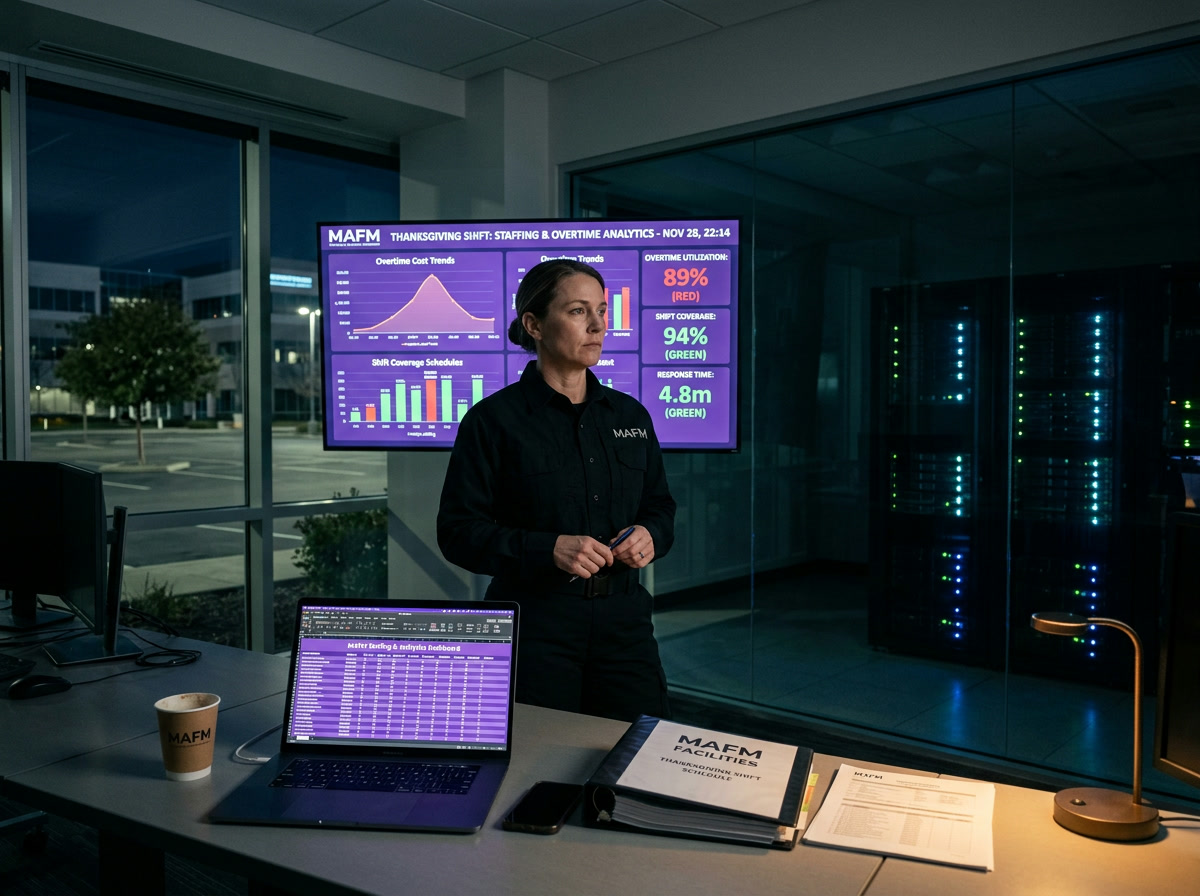
The Thanksgiving Staffing Math Nobody Talks About: What It Really Costs to Keep a Silicon Valley Facility Running
Every facility director in Silicon Valley has run this calculation at some point in late November: how few people can we staff this building with and still sleep at night. It's not a philosophical question. It's a spreadsheet with real numbers attached — overtime differentials, agency backfill rates, the cost of a chiller failure at 2 a.m. on Thanksgiving versus a Tuesday in March. Most of that spreadsheet never makes it into a board report or a tenant newsletter, but it shapes nearly every operational decision facility teams make this week.
Earlier this week we talked about why facility teams don't get a holiday and what tenants expect even when buildings go quiet. Today we're going under the hood of that reality — the actual math and risk calculus behind holiday coverage decisions. Because "someone's always on call" sounds simple until you start pricing out what that someone costs, what happens if they're stretched too thin, and what it actually takes to keep them from burning out or walking away by January.
For facility managers overseeing lab space in Mountain View, data halls in Santa Clara, or mixed-use retail and office towers in downtown San Jose, Thanksgiving isn't a pause button. It's a stress test of staffing models that most organizations only think about twice a year — and this is one of them.
The Systems That Don'T Know It'S Thanksgiving
Walk through any Silicon Valley campus on Thanksgiving morning and the building itself is working exactly as hard as it was the day before. Chillers are still cycling. Building management systems are still logging thousands of data points an hour. Generators tied to critical loads are still expected to transfer seamlessly if PG&E hiccups during a storm — and late November is exactly when the Bay Area starts seeing its first real rain events of the season, which means roof drains, storm water systems, and backup power all get tested whether anyone's watching or not.
For the life sciences tenants scattered across Redwood City, Foster City, and South San Francisco's biotech corridor, the stakes are higher than comfort. Freezer farms holding reagents and cell lines don't get a holiday schedule. A compressor failure on a -80°C ultra-low freezer on Thanksgiving Day isn't an inconvenience — it's a six-figure loss of research material if nobody catches the alarm in time. Data center operators have the same math with different units: a cooling failure that goes unnoticed for even twenty minutes during a low-staff holiday shift can mean thermal shutdown on racks that took months to provision.
This is the uncomfortable truth facility leaders live with: the equipment that's most expensive to let fail is exactly the equipment that doesn't care what day it is. Holiday staffing plans aren't really about keeping lobbies swept — they're about making sure someone is positioned to catch the alarm before it becomes a claim.
The Real Cost of Holiday Coverage
Here's where the spreadsheet gets uncomfortable. A building engineer working Thanksgiving Day typically costs 1.5x to 2x base rate depending on whether it falls under a standard overtime policy or a recognized holiday differential — and many union agreements and competitive non-union shops in this market have moved to double-time specifically to keep coverage reliable. For a facility running a two-person holiday shift across a 400,000-square-foot campus, that's not a rounding error. It's often the single most expensive labor day of the entire fourth quarter on a per-hour basis.
Then there's the backfill question. If your primary on-call engineer gets sick or has a family emergency on Thanksgiving itself — and it happens more than people admit — the replacement options are thin. Staffing agencies that supply skilled trades typically charge a premium of 25% to 40% over standard bill rates for confirmed holiday placements, and that's assuming they have anyone available at all. Most of the qualified people are already committed to their own employer's holiday shift.
The smarter facility teams we work with don't treat this as an annual surprise. They build Thanksgiving coverage into Q4 labor budgets back in August, when they're still forecasting janitorial contracts and HVAC maintenance cycles for the fall. They know exactly which systems require physical presence versus remote monitoring, and they staff to that reality instead of defaulting to "same crew, less people" — which is usually the most expensive mistake a facility can make, because it under-resources the one day actual response time matters most.
Why Skeleton Crews Are Riskier Than They Look
A skeleton crew sounds efficient on paper. In practice, it concentrates risk in ways that don't show up until something goes wrong. A full weekday staff might include three building engineers, two janitorial shifts, a dedicated security team, and a facility manager reachable within minutes. Cut that to one engineer and a single roaming security guard, and you've removed the redundancy that normally catches problems early — the janitorial staff member who notices a water stain on a ceiling tile before it becomes a flooded server room, the second engineer who double-checks a BMS alert that the first one dismissed as a sensor glitch.
Vendor availability compounds the problem. HVAC contractors, elevator service techs, and fire/life safety vendors all run reduced holiday schedules too, which means a mechanical failure that would normally get a two-hour response time on a Tuesday can turn into a six-hour wait on Thanksgiving — assuming the vendor answers at all. We've seen facility teams discover, the hard way, that their "24/7 emergency service" contract has an asterisk around major holidays that nobody read closely until it mattered.
The compounding effect is what makes holiday staffing genuinely different from a slow Sunday. It's not just fewer people — it's fewer people, slower outside response, and higher consequences if something slips through, all stacked on the same day. Facility teams that plan well don't just reduce headcount proportionally; they identify the two or three failure points that would be catastrophic if missed and staff specifically against those, even if it means the lobby goes unswept for a few extra hours.
Recognition As a Retention Strategy, Not a Gesture
Here's the part that gets lost in the operational math: the people working Thanksgiving in a mechanical room or a security booth are making a real sacrifice, and how a company handles that moment has a direct effect on retention heading into the next year. Skilled building engineers and experienced facility technicians are not easy to replace in this labor market — Silicon Valley's cost of living alone makes it hard to keep qualified trades staff, and the companies that treat holiday coverage as an afterthought tend to see turnover spike in Q1, right when they can least afford to be short-staffed.
Real recognition isn't a pizza in the break room, though plenty of facility teams still get exactly that and nothing more. It's holiday differential pay that reflects the actual sacrifice, not the contractual minimum. It's a facility director who shows up or calls in personally rather than delegating the gesture to an email blast. It's flexibility on the back end — an extra floating day in December, first pick of the next holiday rotation, genuine input into how next year's schedule gets built instead of being told what shift they're working two days before Thanksgiving.
The facility teams with the lowest turnover in our market have usually figured out that recognition and retention are the same conversation. The crews who feel genuinely valued for holiday coverage are the ones who stick around for the next emergency, the next 2 a.m. call, the next stretch of short-staffed weeks — and that institutional continuity is worth more than almost anything else in facility operations, because the person who knows exactly which valve to turn without checking a manual is not a resource you can rebuild overnight.
Conclusion
The math behind Thanksgiving facility coverage is more complicated than most organizations want to admit, and the cost of getting it wrong — in equipment damage, vendor delays, or quiet attrition — almost always exceeds the cost of doing it right. The facility teams who handle this week well aren't the ones who spend the least; they're the ones who understand exactly where the risk concentrates and staff, pay, and recognize their people accordingly.
Tomorrow we'll close out this week by pulling together a practical roadmap for building a holiday staffing plan that works — one that balances cost, coverage, and the people who actually make it possible.
Cta
If your facility's holiday staffing plan is more improvisation than strategy, MAFM can build a coverage model tailored to your property's actual risk points — talk to us before the next long weekend catches you short.
Internal Links
Reference earlier posts in the Week 44 Thanksgiving series, including the Monday post introducing the theme and the mid-week post on tenant expectations during holiday coverage; set up Friday's synthesis/roadmap post on building a holiday staffing plan.
External Links
U.S. Bureau of Labor Statistics data on holiday pay and overtime practices (bls.gov); BOMA International resources on facility staffing and operational continuity standards (boma.org).
Ready to Optimize Your Facilities?
MAFM offers comprehensive facility management solutions tailored to your business needs.
Get in Touch