The Real Cost of a Janitorial Wage Increase: Why $1 More Per Hour Actually Costs You $1.40
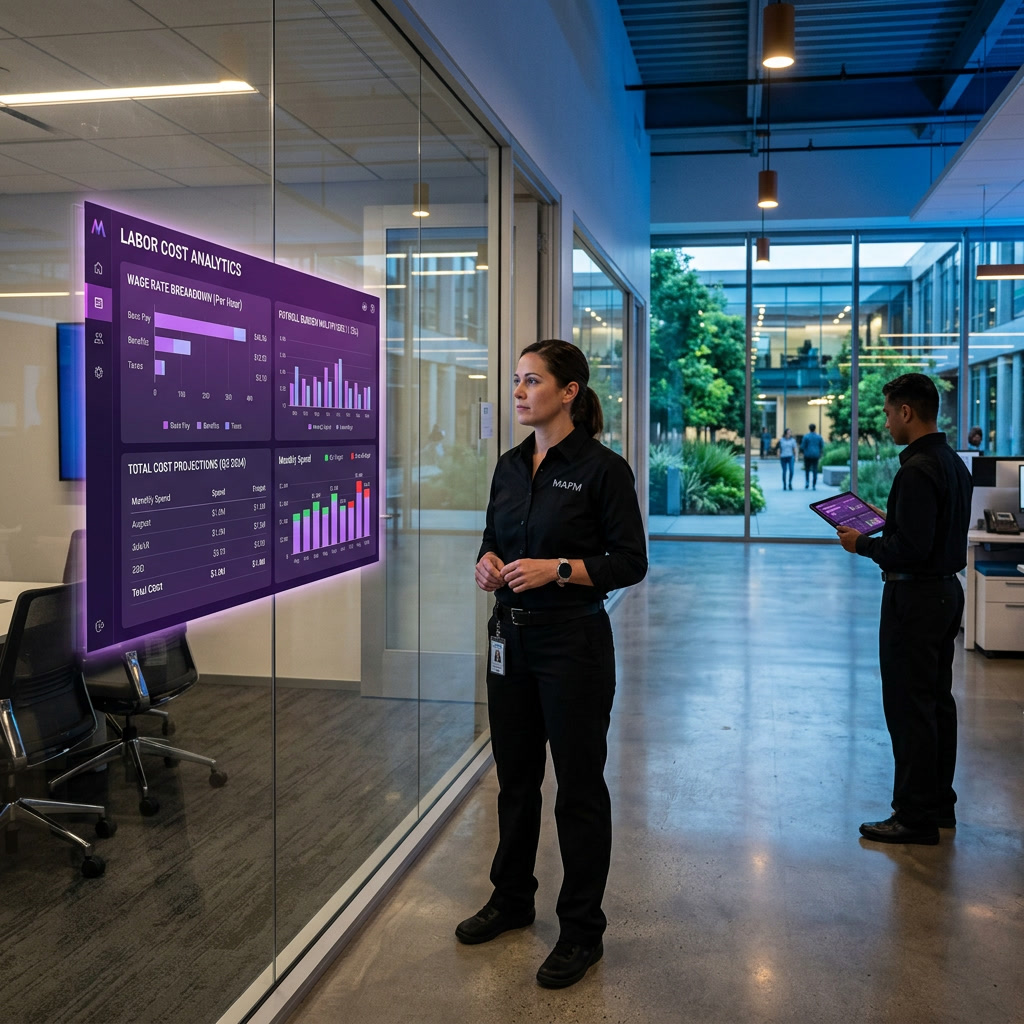
The Real Cost of a Janitorial Wage Increase: Why $1 More Per Hour Actually Costs You $1.40
Earlier this week we walked through the base wage trends driving up janitorial costs across Santa Clara, San Mateo, and Alameda counties heading into 2027. If you took those numbers and simply multiplied them by your headcount, you're already underbudgeting — probably by 30 to 40 percent. Base wage is the number everyone quotes, but it's not the number that hits your P&L.
Every dollar you add to a janitorial worker's hourly rate drags a chain of secondary costs behind it: payroll taxes, workers' compensation premiums, mandated benefits, paid sick leave accrual, and — often ignored until it's too late — the cost of replacing workers who leave for a better offer down the street. Facility managers who budget on base wage alone consistently blow through their janitorial line item by Q3, then scramble to explain the variance to ownership.
This post breaks down the actual labor burden multiplier you should be applying to any wage projection for 2027, with the specific line items driving it in the Silicon Valley market, so your budget survives contact with reality.
Beyond The Base Rate: The Real Multiplier On Every Wage Dollar
In commercial cleaning, the fully burdened cost of an hourly employee typically runs 1.35x to 1.45x the base wage before you've spent a dollar on supervision, equipment, or supplies. That multiplier covers FICA and Medicare (7.65%), federal and California unemployment insurance, workers' compensation, and — the biggest variable — mandated benefits and paid leave that vary by jurisdiction.
Take a concrete example. A janitorial contractor in San Jose paying $19.50/hour in 2026 isn't actually paying $19.50 for that labor hour once it's deployed on your property. Add employer payroll taxes (roughly $1.65/hour), workers' comp at a typical janitorial rate (another $1.20 to $1.80/hour depending on experience modifier), and mandated paid sick leave accrual (roughly $0.35/hour when annualized), and the real cost lands closer to $23.00 to $24.50/hour. If that base wage moves to $20.75 in 2027 — a realistic projection based on this week's earlier analysis — the burdened cost moves to roughly $24.60 to $26.30/hour, not the $1.25 difference the headline number suggests.
For a 15,000 square foot Class A office building running two janitors nightly at five nights a week, that burden differential alone adds $9,000 to $12,000 in annual cost that a base-wage-only budget model completely misses. Multiply that across a 200,000 square foot campus with a crew of 12 to 15, and the miscalculation becomes a six-figure budgeting error — the kind that gets facility managers called into uncomfortable meetings in January.
Workers' Compensation and The Janitorial Risk Class
Workers' compensation is the burden line item facility managers most consistently misjudge, largely because it's invisible on any wage survey and buried inside a contractor's overhead rate. Janitorial work falls into California workers' comp classification code 9014 (building cleaning), and base rates for that class have trended upward statewide as claims frequency in the sector — driven by slip-and-fall incidents, chemical exposure, and repetitive strain from floor equipment — has climbed alongside overall claims costs.
What most facility managers don't factor in is the experience modification rate, or "mod," that individual janitorial contractors carry. A contractor with a clean claims history might carry a mod of 0.85, effectively discounting their workers' comp cost. A contractor with a rough claims year — say, a slip on a wet floor that wasn't properly barricaded, or an employee injured using a floor buffer without training — can see their mod spike to 1.3 or higher, which flows directly into what they have to charge you to stay profitable.
This matters for your 2027 budget in two ways. First, if you're bidding out your janitorial contract, ask every bidder for their current experience mod rate — it's a legitimate, standard request and it tells you whether their quoted rate is sustainable or artificially low because they're absorbing risk they'll eventually pass to you mid-contract. Second, if you manage in-house janitorial staff directly, your own facility's incident history is now part of your labor cost structure. A single serious injury claim can move your mod enough to add real dollars per labor hour for the following three policy years. Wet floor protocols, proper PPE for chemical handling, and documented equipment training aren't just compliance boxes — they're budget protection.
Local Ordinances Are Stacking, Not Replacing, Each Other
Silicon Valley facility managers are dealing with a patchwork of city-level minimum and living wage ordinances that don't simply track the state minimum — they often exceed it, and they change on different calendar cycles depending on the municipality. San Jose, Sunnyvale, Mountain View, and Santa Clara City all maintain their own minimum wage schedules, several of which have run a dollar or more above California's statewide minimum for the past several years. Properties spanning multiple cities — not uncommon for portfolio managers with sites in both Sunnyvale and San Jose — need separate wage floors modeled for each address, because a single blended rate assumption will misstate costs on at least one side of the portfolio.
Layered on top of local minimum wage is California's expanded paid sick leave requirement (five days or 40 hours annually, whichever is greater), which took full effect statewide and continues to apply regardless of which city ordinance governs the base wage. For a janitorial crew with any turnover at all, tracking accrual correctly across new hires, part-time staff, and multi-site transfers becomes a real administrative cost, not just a benefits line item — someone has to manage it, and that someone's time belongs in your budget too.
For 2027 specifically, watch for scheduled increases that were passed in 2025 and 2026 but phase in on January 1 or July 1 dates that don't align with your fiscal year. If your budget cycle closes in November but a city's wage floor jumps in January, you need next year's rate in this year's budget model, not this year's rate carried forward. This is the single most common line-item error we see in facility budgets submitted for approval in Q4.
Turnover Cost — The Line Item Most Budgets Miss Entirely
Commercial cleaning has one of the highest turnover rates of any facility services trade, with industry estimates commonly citing annual turnover between 200% and 300% for entry-level custodial positions. That statistic sounds abstract until you translate it into what a single vacancy costs: recruiting time, onboarding and safety training, the productivity gap while a new hire learns a building's specific layout and client expectations, and — most damaging to tenant experience — the quality dip that shows up as complaints about missed trash pulls, streaked glass, or restrooms that weren't restocked.
A reasonable estimate for full replacement cost of one janitorial worker, factoring recruiting, training hours, and the productivity ramp, runs $2,800 to $4,500 per departure once you account for a supervisor's time and the overtime often paid to cover the gap. If your contractor or in-house crew is running at 250% annual turnover across a 10-person team, that's effectively 25 replacement events a year — a hidden cost of $70,000 to $112,000 that never appears as a line item because it's absorbed inside the contractor's markup or, if self-performed, scattered across overtime and temp staffing budgets where nobody connects it back to turnover.
The direct budget implication for 2027: wage increases that keep pace with the local market aren't just a compliance requirement, they're a turnover mitigation strategy. Facilities that pay a dollar or two above the local floor consistently see materially lower turnover and correspondingly lower replacement cost — often enough to make the "more expensive" staffing option the actually cheaper one once turnover is priced in. When you evaluate a janitorial proposal for 2027, ask what the average tenure is on the crew that will be assigned to your building, not just what the hourly rate is.
Conclusion
A wage increase that looks like a single-digit percentage bump on paper can translate into a much larger real cost once you account for the burden multiplier, workers' comp exposure, stacked local ordinances, and turnover replacement cost. Facility managers who budget on base wage alone are working from a number that was never accurate to begin with. The ones who build in the full burden — and who scrutinize their contractor's experience mod and turnover rate as closely as their hourly quote — walk into 2027 with a number that actually holds.
Cta
MAFM builds janitorial staffing proposals with fully burdened, jurisdiction-specific labor costs baked in from day one — no mid-contract surprises. Contact us for a 2027 budget review that shows you the real number before your board sees it.
Internal Links
Reference earlier posts in this week's series covering 2026-2027 base wage trend data and city-by-city minimum wage schedules for Silicon Valley, plus a related post on writing janitorial RFPs that require bidders to disclose experience mod rates and crew tenure.
External Links
California Department of Industrial Relations workers' compensation classification and rate information (dir.ca.gov); U.S. Bureau of Labor Statistics Occupational Employment and Wage Statistics for Building Cleaning Workers (bls.gov/oes).
Ready to Optimize Your Facilities?
MAFM offers comprehensive facility management solutions tailored to your business needs.
Get in Touch