The People Behind the Building: Why Frontline Facility Staff Rarely Get the Credit They've Earned
The People Behind the Building: Why Frontline Facility Staff Rarely Get the Credit They've Earned
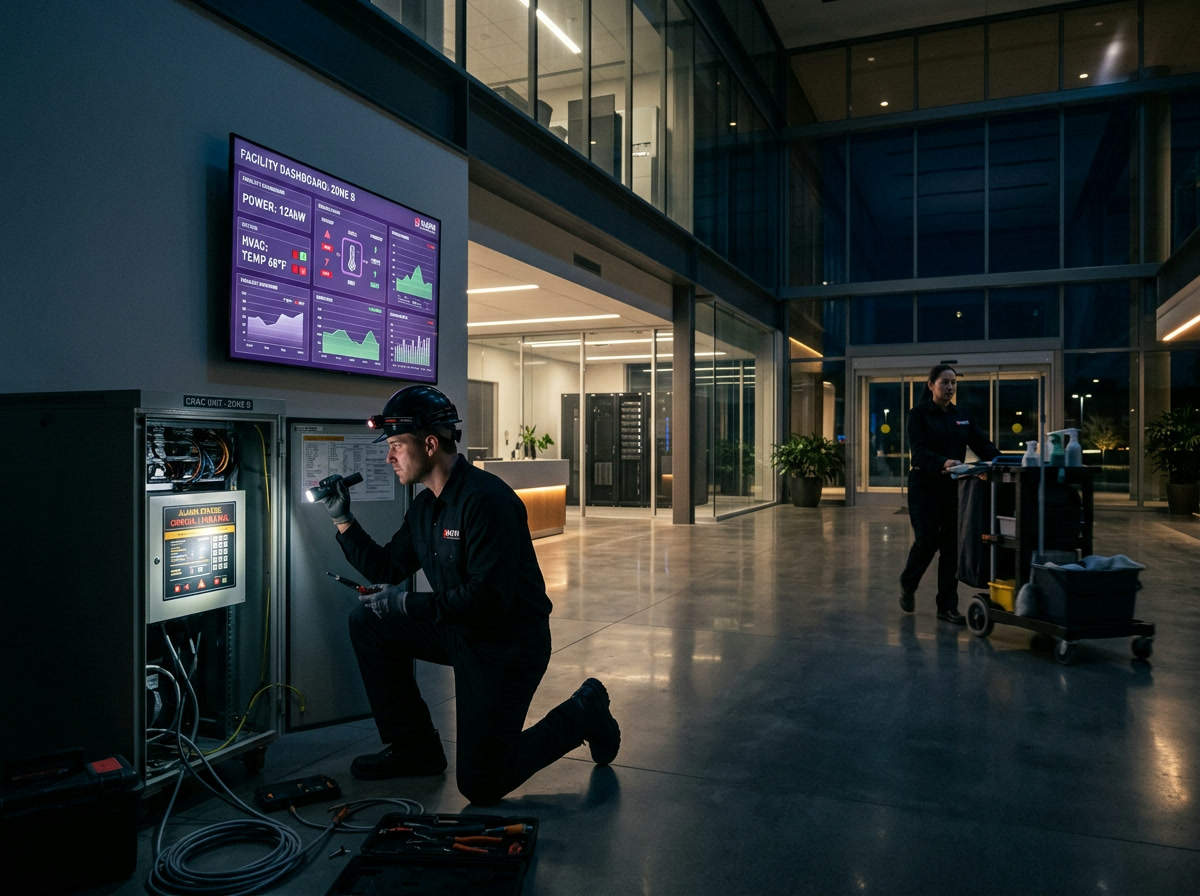
Earlier this week we opened our series on gratitude in facility management by framing a simple idea: the people who keep buildings running are usually the last ones thanked for it. Today we want to get specific about one group in particular — the frontline staff. The janitorial crew that cleans a 200,000-square-foot campus between 6 p.m. and 2 a.m. The HVAC technician who gets paged at 11 p.m. because a data center's cooling unit is throwing alarms. The porter who handles the lobby, the loading dock, and the overflowing trash enclosure on the same shift, usually without anyone noticing unless something goes wrong.
In Silicon Valley specifically, this matters more than most markets realize. Tenant expectations here are shaped by tech-company campuses with concierge-level amenities, which means facility staff are held to a standard that's invisible until it slips. A streaked window, a jammed badge reader, a restroom that runs out of paper towels during an all-hands meeting — these become visible failures. The hundreds of shifts where nothing went wrong never get mentioned. That asymmetry is the core problem with how most buildings treat their frontline teams, and it's also the biggest retention risk most facility directors aren't tracking.
This post looks at why frontline recognition gets skipped, what it actually costs when it does, and what specific, low-cost practices change the equation — not generic "employee of the month" programs, but recognition built into how shifts, inspections, and vendor contracts actually run.
Why Frontline Recognition Gets Skipped in The First Place
Most commercial buildings staff their frontline positions through a layered structure: a property management company contracts with a facility services vendor, who in turn employs the janitors, porters, and sometimes the technicians who do the actual work. That layering is efficient for cost control, but it creates distance. The tenant's office manager knows the building engineer by name. The property owner rarely meets the cleaning crew at all, because they work third shift and the contract relationship lives with a vendor account manager, not the building.
That structural distance means recognition — when it happens — tends to flow to the people closest to the top of the chain: the facility director, the GC who ran a tenant improvement project, the engineer who presented at the quarterly ownership meeting. The night-shift crew that executes the actual cleaning specification, strips and waxes the floors on a rotating schedule, and handles biohazard cleanup after a medical emergency in a break room — that work happens while decision-makers are asleep, and it stays administratively invisible unless a complaint surfaces.
There's also a timing problem specific to facilities. Recognition programs in most companies run on an annual review cycle. Frontline facility staff, especially those employed by third-party vendors, often fall outside that cycle entirely. They may never appear in the building's own HR systems, never get invited to all-hands meetings, and never see a company-wide email that mentions their work. If a property owner wants to recognize the team that keeps a 500,000-square-foot campus running, they often don't even know who's on it.
The Turnover Math Silicon Valley Facility Directors Are Already Living With
The commercial cleaning and facility services industry nationally runs turnover rates frequently cited between 75% and 200% annually for janitorial staff — and Bay Area labor costs push that higher, not lower. Every open shift here competes against warehouse work, gig delivery, and hospitality jobs that often pay comparably with more flexible scheduling. When a vendor loses a cleaner who knows a building's floor plan, its specific surface materials, and its tenant quirks (the CEO who wants the glass conference room spotless by 7 a.m., the lab space with special decontamination protocols), that knowledge walks out the door and has to be rebuilt from zero with the next hire.
The direct cost of replacing a frontline facility worker typically includes recruiting fees, onboarding and training time, uniform and badge issuance, and a measurable dip in service quality during the ramp-up period — conservatively 20-30% of annual wages per replacement when you account for all of it, and that's before counting the tenant complaints that surface during the gap. On a campus running a crew of fifteen janitorial staff with even moderate turnover, that's a recurring five-figure cost that rarely gets attributed back to the actual root cause: staff who didn't feel seen and left for a job that paid the same but felt the same everywhere else.
Retention-focused vendors and in-house teams consistently report that pay alone doesn't explain who stays. Crews with low turnover tend to share something else: a building management team that knows their names, acknowledges tenure, and treats the vendor relationship as a partnership rather than a commodity contract renewed on price. That's a controllable variable, and it costs far less than the turnover it prevents.
What Actually Works — Specific, Not Generic
Generic recognition — a pizza party during Facilities Management Appreciation Week, a certificate at an annual banquet — tends to land as an afterthought because it's disconnected from the actual work. What moves retention numbers is recognition built into the operational rhythm of the building.
Start with visibility in inspections. When a facility director or property manager walks a building for a quarterly QA inspection, naming the specific technician or cleaner responsible for a well-maintained area — directly, in person, during the walk — carries more weight than a company-wide newsletter mention. It signals that someone with authority actually knows whose work they're looking at.
Build recognition into vendor contracts themselves. Some Silicon Valley property owners now write language into janitorial and maintenance service agreements requiring the vendor to report tenure and turnover metrics quarterly, alongside a mechanism for the building's management team to nominate standout staff for bonus pay funded jointly by owner and vendor. This moves recognition out of the realm of goodwill and into the realm of contractual accountability, which means it survives changes in property management staff or vendor account managers.
Address the shift-visibility gap directly. Night-shift and weekend crews are structurally cut off from daytime recognition moments. A simple fix some campuses use: a standing agenda item in monthly building operations meetings where the day-shift lead reports specific praiseworthy incidents from the overnight crew — the time the cleaning team caught and reported a water leak at 1 a.m. before it reached server racks below, for instance. That incident gets name-attached and reported up to ownership, not buried in a work order log.
Finally, pay attention to tenure markers that aren't tied to annual reviews. A technician's five-year anniversary on a specific campus, a cleaner's three-year mark without a single safety incident — these are concrete, verifiable milestones that can be recognized the week they happen rather than batched into an annual event months later.
What Property Owners and Facility Directors Can Do This Quarter
None of this requires a large program. It requires specificity and consistency. A facility director managing a multi-tenant Silicon Valley campus can start by requesting a simple staffing roster from every vendor — names, roles, tenure — so the building's own management team actually knows who is on site each shift. This alone often surfaces the first problem: many building owners don't currently have this information at hand.
Next, build recognition into the existing inspection and meeting cadence rather than creating a new program. If your team already does monthly walkthroughs, add a five-minute segment where staff performance is discussed by name, not by vendor company. If your team already holds quarterly vendor review meetings, add tenure and turnover as a standing metric alongside cost and compliance.
Third, talk to your vendor partners about profit-sharing or bonus mechanisms tied to retention rather than headcount. A vendor incentivized purely on coverage will staff a building with whoever is available. A vendor incentivized on retention and tenure will invest in the same crew staying on your specific property, which compounds in service quality over time — fewer training gaps, more institutional knowledge about your building's quirks, faster incident response because staff already know where the shutoff valves are.
Fourth, treat the holiday season — which is when this gratitude series lands intentionally — as a starting point, not an endpoint. A November gesture that isn't followed by any structural change by February reads as performative to staff who've seen it before. The programs that actually reduce turnover are the ones still running in June.
Conclusion
Frontline facility staff keep Silicon Valley's commercial buildings functional in ways that are easy to overlook precisely because the work is designed to be invisible when done well. The cost of that invisibility isn't abstract — it shows up in turnover rates, retraining cycles, and the kind of service gaps that tenants eventually notice even when they can't name the cause. Recognition that's specific, tied to actual performance, and built into existing operational structures costs little and changes retention outcomes measurably.
Later this week, we'll look at how these same principles extend beyond frontline staff to the vendor and contractor relationships that round out a building's full operational team.
Cta
MAFM helps Silicon Valley property owners build staffing accountability and recognition metrics directly into their facility service contracts — contact us to review how your current vendor agreements measure retention.
Internal Links
Link back to this week's Monday post introducing the gratitude in facility management series, and forward to later posts in the week covering vendor relationships and year-end team recognition practices.
External Links
Building Service Contractors Association International (BSCAI) industry turnover and labor data; U.S. Bureau of Labor Statistics occupational data on janitorial and building cleaning workers.
Ready to Optimize Your Facilities?
MAFM offers comprehensive facility management solutions tailored to your business needs.
Get in Touch