The Paperwork Behind the Power: Why Your Generator Can Pass Every Test and Still Fail Inspection
The Paperwork Behind the Power: Why Your Generator Can Pass Every Test and Still Fail Inspection
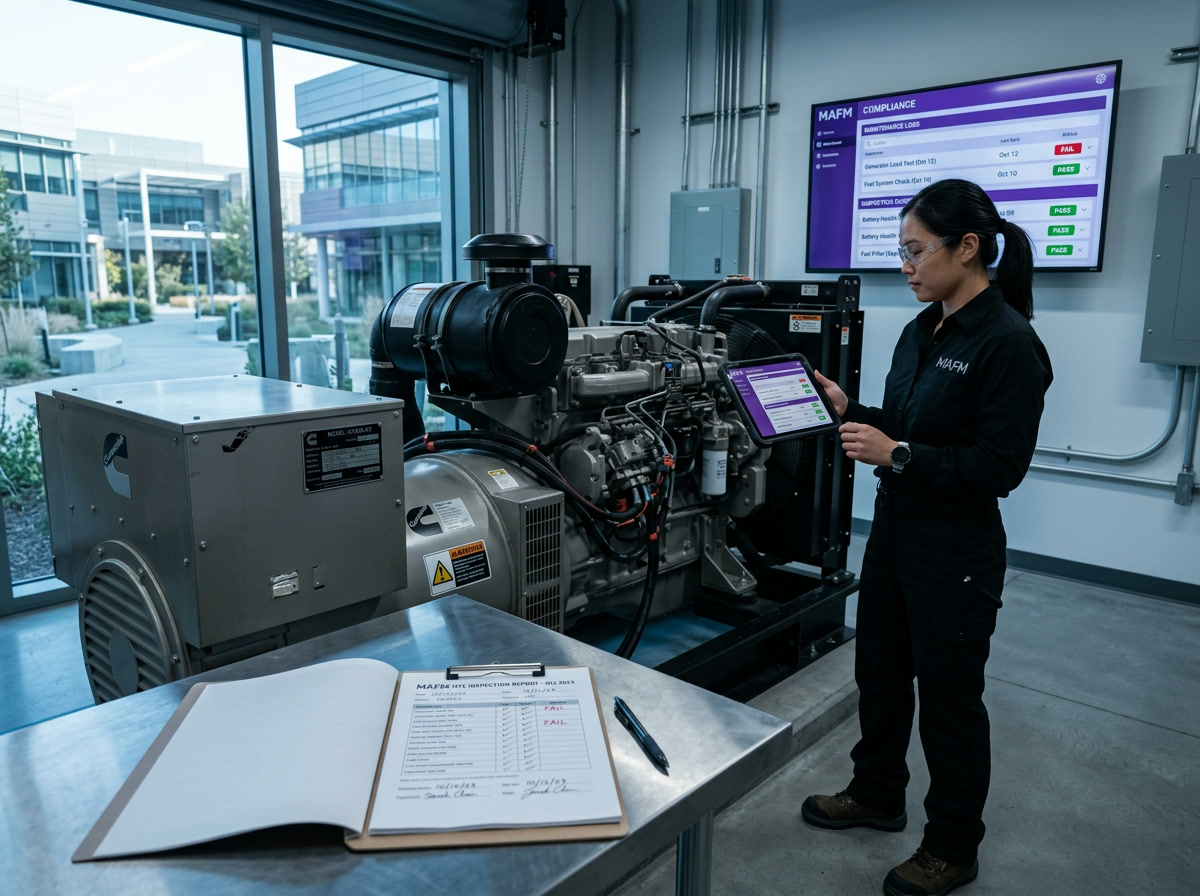
Earlier this week we covered the mechanics of pre-winter generator testing — load banking, fuel quality, and transfer switch verification. All of that work can be done perfectly and a facility can still get flagged during an annual fire inspection. The reason is almost always the same: the generator ran fine, but nobody can produce a clean, continuous record proving it ran fine on the schedule the code requires.
We see this constantly across San Jose, Santa Clara County, Sunnyvale, and Mountain View properties — particularly in multi-tenant buildings where generator responsibility gets split between ownership, a third-party vendor, and sometimes a tenant's own engineering staff. Each party assumes someone else is keeping the master log. When the fire marshal or an insurance loss-control engineer asks for twelve months of weekly inspection sheets and monthly load test reports, what shows up is three different spreadsheets, a stack of vendor invoices, and a six-week gap from when the previous facilities coordinator left the company.
This post is about the compliance record itself — what NFPA 110 actually requires you to document, who checks it, and how to build a system that doesn't fall apart the moment staff turns over. If testing is the engineering half of generator readiness, documentation is the legal half, and Silicon Valley properties are increasingly getting tested on both.
Why Documentation Matters As Much As The Test Itself
NFPA 110 is explicit that Emergency Power Supply Systems must be inspected weekly, exercised monthly under load, and load bank tested annually — but the standard spends nearly as much language on recordkeeping as it does on the mechanical requirements. Section 8.4 requires a written record of every inspection and test: date, duration, load level, oil pressure, coolant temperature, battery condition, and any deficiencies noted along with corrective action taken. That record has to be retained and available for review, typically for a minimum of three years depending on your AHJ's local amendments.
The logic is simple from a liability standpoint. If a generator fails during an actual outage — a PSPS event, a substation fault, a planned PG&E maintenance shutdown — and someone can show that a life-safety load (egress lighting, fire pump, smoke control, elevator recall) went dark, the first document anyone pulls is the testing log. For a hospital-adjacent medical office building in Palo Alto or a biotech facility in Sunnyvale running sample storage on backup power, that log is the difference between "equipment malfunction despite diligent maintenance" and "known deficiency, ignored for four months."
Insurance carriers treat it the same way. FM Global and other commercial property insurers writing policies on data centers and critical manufacturing space in the Valley now routinely request generator maintenance history as part of renewal underwriting, not just after a claim. A property with gaps in its record can see a loss-control recommendation turn into a premium surcharge, and in some cases a coverage exclusion tied specifically to business interruption from power failure.
Nfpa 110 Requirements: Level 1 Vs Level 2 and What Applies to You
The first documentation mistake we catch during facility audits is a building operating under the wrong EPSS classification, which cascades into wrong testing frequency and wrong recordkeeping. NFPA 110 Level 1 applies where failure of the system could result in loss of life — hospitals, high-rise life safety systems, some assembly occupancies. Level 2 applies where failure results in property damage or loss of business, not life safety — which covers the vast majority of commercial office, R&D, and light industrial buildings in Silicon Valley.
The distinction matters because Level 1 systems require more rigorous testing cycles and faster response windows for identified deficiencies, and inspectors will specifically check that your documented testing frequency matches your classification. We've walked into buildings where a generator serving a mixed-use property with a ground-floor urgent care clinic was being tested on a generic Level 2 schedule because that's what the original mechanical contractor specified a decade ago, with no one revisiting the classification after tenant mix changed. That's a code compliance gap that doesn't surface until the fire marshal's annual walkthrough, and by then it's a correction notice with a deadline, not a planning conversation.
Equally important: know which code cycle and local amendments your jurisdiction has adopted. Santa Clara County Fire, San Jose Fire Department, and the Sunnyvale Department of Public Safety don't all enforce identical editions of NFPA 110 or California Fire Code Chapter 6 generator provisions on the same timeline. A compliance program built around the 2016 edition requirements can be technically out of date if your AHJ has moved to a newer adopted code with tightened documentation language.
The Paper Trail: Building a Compliance Record That Survives An Audit
A defensible generator record has four components, and most facilities are missing at least one. First, the weekly visual inspection log — fuel level, battery charger status, room temperature, housekeeping around the unit, no-load visual check. This is the one most frequently skipped because it feels redundant between monthly load tests, but it's a distinct line item an inspector will ask for by date.
Second, the monthly load test record documenting at minimum 30% of nameplate kW for 30 minutes (or manufacturer-specified alternative), with actual load percentage, run duration, exhaust temperature, and any alarms triggered. Generic notes like "ran fine" don't satisfy the standard — the record needs measured values, not a checkbox. Third, the annual load bank test report, which should be a formal document from the testing vendor showing the unit carried a resistive/reactive load at or near 100% of nameplate rating, typically for one to two hours, with a clear pass/fail determination and any deficiencies corrected before sign-off.
Fourth — and this is the piece that actually gets flagged most often in Silicon Valley multi-tenant buildings — a deficiency correction log that closes the loop. If the monthly test noted a low coolant level or a battery showing reduced cranking amps, there needs to be a corresponding record showing the issue was addressed, with a date and the technician who performed the fix. An open deficiency with no documented resolution is worse, from an audit standpoint, than no test at all, because it shows a known problem was identified and left unresolved.
The practical fix we implement for clients is consolidating all four record types into a single digital log accessible to building ownership, the FM vendor, and designated tenant engineering contacts, with automated reminders tied to the testing calendar rather than relying on a vendor's internal scheduling. When a fire inspector or insurance engineer asks for the file, it should take minutes to produce twelve consecutive months of clean records, not days of reconstruction from email threads.
What Happens When You Fail: Deficiency Tags, Insurance Implications, and Tenant Notification
When an AHJ inspector finds a documentation gap or an actual equipment deficiency, the typical outcome is a correction notice with a defined cure period — often 30 to 60 days depending on severity and jurisdiction. Life-safety-related deficiencies on Level 1 systems can trigger much shorter windows, sometimes requiring an interim fire watch or temporary measures while repairs are made. For commercial Level 2 properties, the more common consequence is a documented violation that stays on file and gets re-checked at the next cycle — but a repeat violation signals a pattern of neglect that can affect both code standing and insurance renewal terms.
There's also a tenant communication dimension that's easy to underestimate. In multi-tenant R&D and office campuses, lease language frequently obligates landlords to maintain emergency power systems to code and to notify tenants of testing schedules and any known deficiencies affecting their space. A biotech tenant with freezer-dependent sample storage, or a data center tenant with SLA commitments to its own customers, will want visibility into generator compliance status as part of ongoing vendor risk management — and increasingly, sophisticated tenants are asking for copies of the testing log as part of annual lease audits, not just during initial due diligence.
The cost of getting caught short is rarely the correction itself — a battery replacement or coolant top-off is inexpensive. It's the cascading review that follows: insurance loss-control revisiting the whole account, a tenant escalating to their own facilities or legal team, or a second inspection finding additional gaps because the first one prompted closer scrutiny of the entire mechanical compliance file.
Conclusion
Generator testing and generator documentation are two different disciplines, and treating them as one is where most Silicon Valley properties get exposed. The engineering work — load testing, fuel management, transfer switch verification — protects the building during an actual outage. The documentation work protects the building, and the people responsible for it, when someone asks for proof after the fact. Going into the winter outage season, the properties in the strongest position aren't just the ones with generators that start — they're the ones that can hand an inspector a complete, dated, legible record without a scramble.
If your compliance file has gaps, overlapping vendor logs, or hasn't been reviewed against your current NFPA 110 classification, now — before the first PSPS event or winter storm outage of the season — is the time to close them, not after an AHJ finds them for you.
Cta
MAFM manages end-to-end generator compliance programs — testing, documentation, and AHJ-ready recordkeeping — for commercial properties across Silicon Valley. Contact us to audit your current generator compliance file before this season's fire inspections.
Internal Links
Reference earlier in this week's series the posts covering load bank testing procedures and fuel quality/transfer switch maintenance; link forward to Friday's roadmap post tying the full pre-winter generator protocol together.
External Links
NFPA 110 Standard for Emergency and Standby Power Systems (nfpa.org); Santa Clara County Fire Department fire code and inspection guidance pages.
Ready to Optimize Your Facilities?
MAFM offers comprehensive facility management solutions tailored to your business needs.
Get in Touch