The November Countdown: Why Your Maintenance Wishlist Needs to Be Funded by Thanksgiving
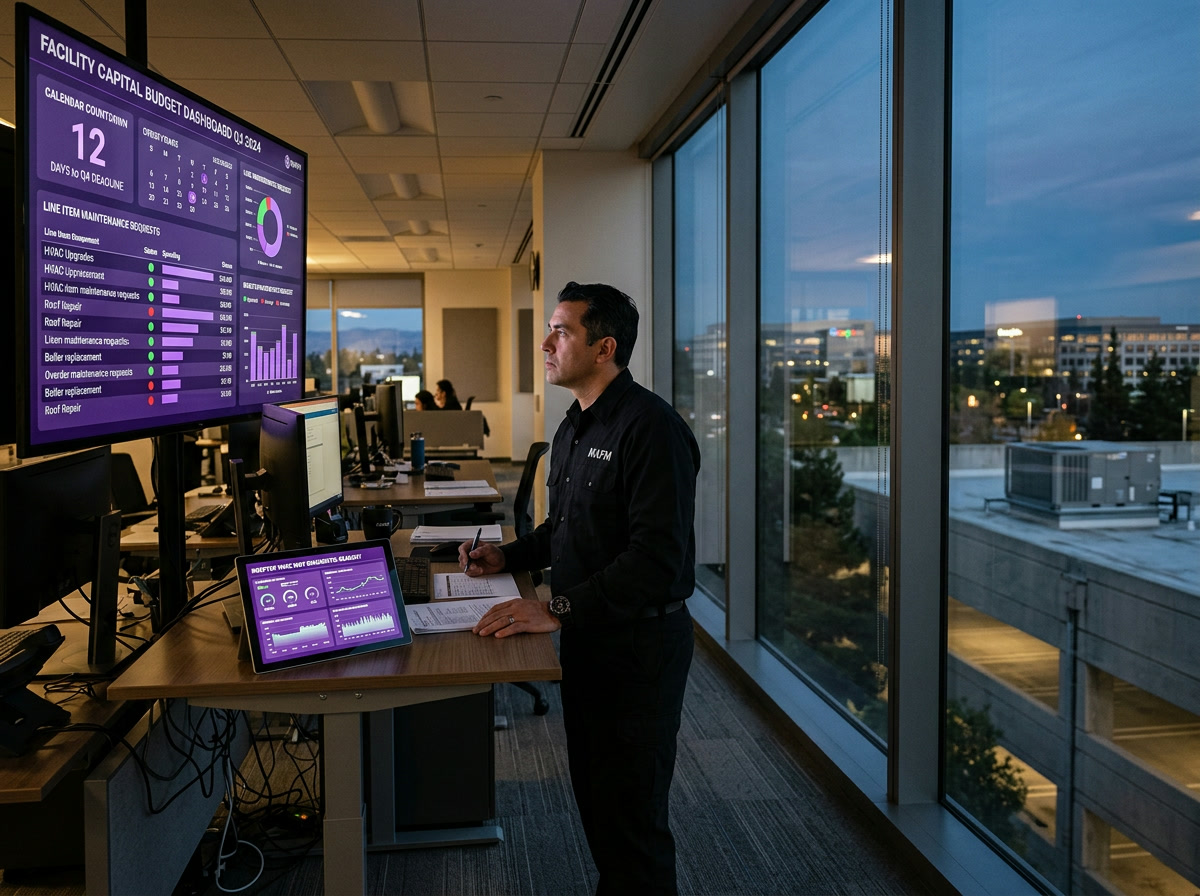
The November Countdown: Why Your Maintenance Wishlist Needs to Be Funded by Thanksgiving
If you manage a commercial property anywhere between San Jose and Redwood City, you already know the rhythm: finance locks next year's capital budget sometime between the second week of November and early December, and whatever line items aren't approved by then get pushed to a 2027 cycle that won't release funds until March or April at the earliest. That's a four-to-five month gap where a failing rooftop unit, a cracked parking structure expansion joint, or an aging fire pump controller becomes your problem to manage on reactive maintenance dollars instead of planned capital.
This week on the MAFM blog, we're running a five-part series on exactly what needs to happen before that freeze hits — starting today with the list itself. We'll cover HVAC and mechanical systems, life-safety and compliance items, exterior envelope and parking structures, and by Friday, how to actually build the business case that gets these items approved before the budget door closes. Think of this as your pre-flight checklist for the next eight weeks.
Here's the uncomfortable truth we see every year working with property management groups and in-house facility teams across the Valley: the items that get deferred in November aren't random. They're almost always the big-ticket mechanical and structural items that are expensive enough to require approval, but not yet broken enough to trigger an emergency purchase order. That gray zone is exactly where deferred maintenance becomes a six-figure problem by Q2.
Why November Is The Real Deadline, Not December 31
Most facility managers think of year-end as a calendar event — December 31 — but the budget reality is different. Finance and ownership groups typically finalize capital plans two to four weeks before year-end to allow time for board sign-off, loan covenant reviews, or REIT reporting requirements. For a lot of the commercial and mixed-use properties we service in Santa Clara and San Mateo counties, that means the real deadline is the second or third week of November, not the last day of December.
This matters because facility teams often submit their maintenance requests in late November or early December, assuming they have until year-end to get approval. By then, the capital committee has already met, the budget has already been allocated across other priorities — tenant improvements, leasing commissions, insurance premium increases — and your HVAC replacement request gets bumped to "Q1 2027 evaluation." In practice, that evaluation often doesn't happen until the system fails and you're issuing an emergency purchase order at 20-30% above planned pricing because you're buying equipment on short lead time instead of competitively bid lead time.
The fix isn't complicated, but it does require moving faster than most teams are used to. If your organization's fiscal year matches the calendar year, you want your prioritized maintenance list, with vendor quotes attached, in front of decision-makers no later than November 13. That gives ownership roughly two weeks to review, ask questions, and approve before Thanksgiving week effectively shuts down decision-making until December.
Building The List — What Actually Belongs On It
Not every maintenance item deserves a spot on the pre-freeze list. The items that belong here share three characteristics: they have a real failure risk within the next 12-18 months, they cost enough to require capital or special approval (typically anything over $5,000-$10,000 depending on your property's threshold), and the cost of waiting is measurably higher than the cost of acting now.
Rooftop HVAC units installed before 2012 are a classic example. A packaged rooftop unit has a typical service life of 15-20 years, and most Silicon Valley office and flex buildings built or retrofitted during the dot-com and early 2010s expansion are now sitting right at that edge. Replacing a unit proactively during a planned shutdown runs meaningfully less than an emergency swap during a July heat event, when every HVAC contractor in the region is backlogged and premium rates apply for rush installation and crane access.
Fire and life-safety equipment belongs on this list every single year, not because it fails often, but because the compliance exposure is disproportionate to the cost. Fire pump controllers, backflow preventers tied to fire suppression, and emergency generator transfer switches all have defined service lives and inspection-driven replacement triggers under NFPA standards. If your last annual fire pump test flagged a controller issue, that's not a "monitor and revisit" item — that's a capital request this month, because an AHJ citation or failed inspection can trigger tenant notification requirements that are far more expensive than the equipment itself.
Parking structure and exterior envelope items round out the list: expansion joint seals, structural waterproofing membranes approaching the end of their warranty period, and elevator modernization items tied to state inspection cycles. California's elevator inspection requirements under Title 8 mean that certain deficiencies found during annual inspection carry mandatory correction timelines — those aren't optional line items, they're compliance deadlines wearing a maintenance disguise.
The Cost Math Finance Teams Actually Respond to
Facility managers often present maintenance requests in terms of equipment condition — "the unit is 18 years old and showing corrosion." Finance teams respond better to risk-adjusted cost comparisons, and building that comparison is worth the extra hour it takes.
Take a rooftop unit replacement quoted at $45,000 for proactive, scheduled replacement during a shoulder-season weekend. Compare that to the realistic cost of letting it fail in service: emergency service call rates typically run 1.5-2x standard rates, rush equipment procurement can add 15-25% to unit cost, and if the failure happens during a leased space's occupied hours, you're also looking at potential rent credits or lease default exposure if your lease includes HVAC uptime guarantees — which an increasing number of Silicon Valley office and lab leases do, particularly for life sciences tenants with environmental control requirements written into their lease terms.
That comparison — $45,000 planned versus $65,000-$75,000 unplanned, plus tenant relationship damage that doesn't show up on an invoice — is the version of this argument that gets approved in a capital committee meeting. We've found that attaching even a simple two-column comparison (planned cost vs. realistic emergency cost, with a cited data point like equipment age against ASHRAE's typical service life tables) moves requests through approval meaningfully faster than condition narratives alone.
It's also worth quantifying what deferred maintenance costs in aggregate, not just item by item. Industry data consistently shows that every dollar deferred in planned maintenance generates roughly $3-$5 in reactive repair and replacement costs down the line. For a facility team managing a half-million-dollar annual maintenance budget, that ratio applied across even three or four deferred items is the difference between a controlled 2027 maintenance plan and a year spent chasing emergencies.
Sequencing Your Requests for Maximum Approval Odds
Not every item on your list needs to go in front of ownership as a single monolithic ask. Bundling everything into one large capital request can actually work against you — a $280,000 combined ask is an easier target to defer in full than four separate requests ranging from $15,000 to $95,000, each with its own clear risk justification.
We recommend sequencing requests into three tiers. Tier one covers compliance-driven items with regulatory deadlines — fire/life-safety deficiencies, elevator inspection findings, ADA-triggered repairs. These should be framed as non-discretionary and submitted first, because they're the hardest for any capital committee to reject outright. Tier two covers high-failure-risk mechanical items like aging rooftop units, boilers, and chillers nearing end of service life, framed with the cost-comparison math from Section 3. Tier three covers condition-based items — envelope sealing, parking lot resurfacing, interior finishes — that improve asset value and tenant experience but carry lower immediate failure risk; these are reasonable candidates to hold if budget is genuinely constrained.
This tiered approach also gives you a fallback position in negotiation. If ownership can't fund the full list, you want to walk into that conversation already knowing which items are truly non-negotiable versus which can realistically wait another quarter without meaningful risk increase. Facility managers who present a single undifferentiated list often end up with everything cut equally; those who come in with clear tiers tend to walk away with at least tiers one and two intact.
Timing your submissions across the first two weeks of November, rather than all at once, also gives decision-makers room to process smaller asks individually rather than facing one large number that triggers sticker shock and a blanket "let's revisit in Q1" response.
Conclusion
The next two weeks matter more than any other stretch in the facility management calendar. Every rooftop unit, fire pump controller, and parking structure joint that doesn't make it onto an approved list by mid-November becomes a line item you're managing reactively — on someone else's timeline, at someone else's price, likely during the worst possible moment operationally.
Over the rest of this week, we'll dig into the specific systems driving the most urgent November decisions: HVAC and mechanical equipment nearing end of life, fire and life-safety compliance items with hard regulatory deadlines, and the exterior envelope and parking structure work that's easy to defer but expensive to ignore. By Friday, we'll pull it all together into a practical roadmap for building the business case that actually gets approved.
Cta
Need a second set of eyes on your facility's risk-ranked maintenance list before you submit it to ownership? MAFM's facility assessment team can benchmark your equipment against service-life data and build the cost comparisons that move capital requests through approval — reach out this week while there's still runway before the freeze.
Internal Links
Link forward to this week's upcoming posts on HVAC/mechanical system prioritization, fire and life-safety compliance deadlines, exterior envelope and parking structure maintenance, and Friday's capital request roadmap post.
External Links
NFPA 25 (Standard for the Inspection, Testing, and Maintenance of Water-Based Fire Protection Systems) for fire pump and life-safety compliance cycles; ASHRAE equipment service life tables for HVAC replacement benchmarking.
Ready to Optimize Your Facilities?
MAFM offers comprehensive facility management solutions tailored to your business needs.
Get in Touch