The Night Shift That Keeps Silicon Valley Running: A Labor Day Series on the People Behind Clean Buildings
The Night Shift That Keeps Silicon Valley Running: A Labor Day Series on the People Behind Clean Buildings
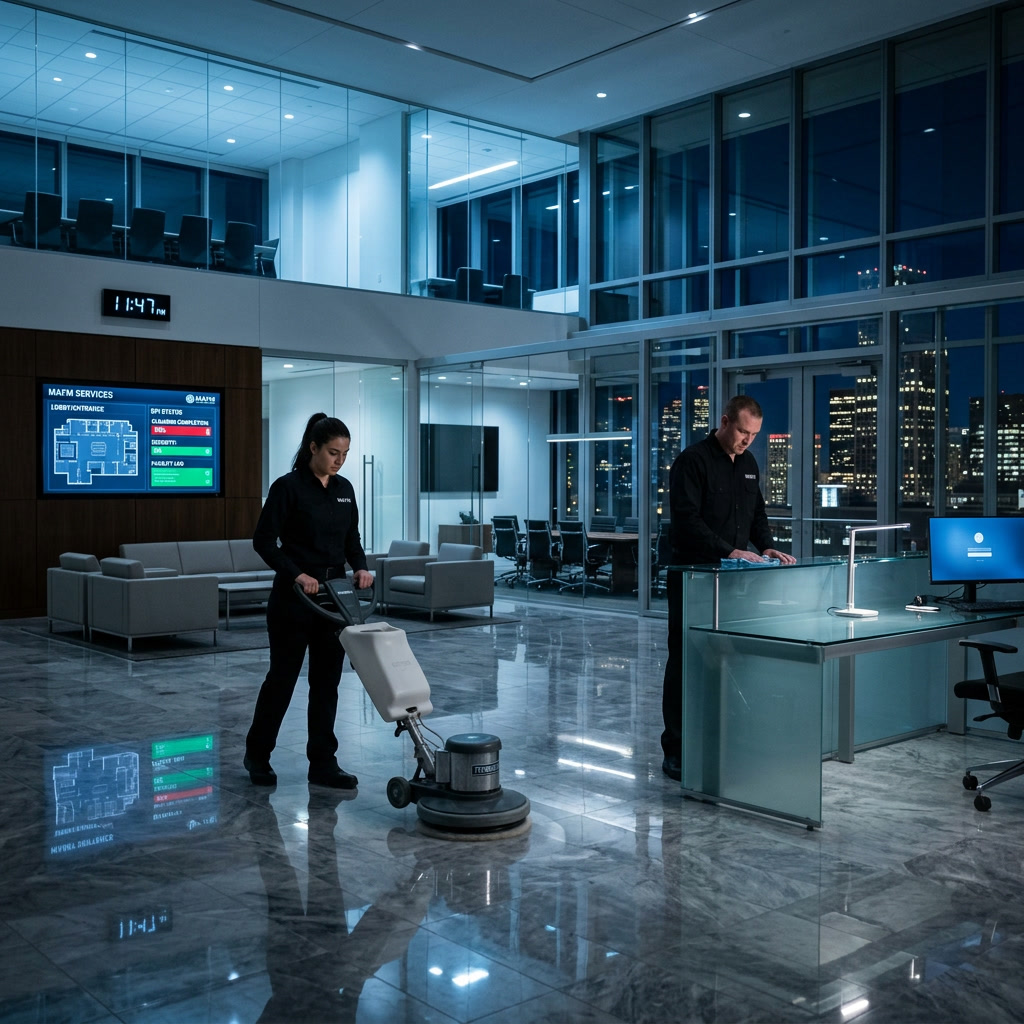
Every Monday morning, thousands of Silicon Valley employees walk into lobbies with gleaming floors, restrooms stocked and spotless, and conference rooms reset for back-to-back meetings. Almost none of them think about who made that happen. It's a crew that clocked in around 6 p.m. the night before, worked through the building after the last badge swipe, and clocked out before the first espresso machine fired up in the break room. That invisibility is by design — good janitorial and maintenance work is supposed to be unnoticeable. But invisible doesn't mean unskilled, and it certainly doesn't mean low-stakes.
This week, in honor of Labor Day, we're running a five-part series here on the MAFM blog dedicated to the workforce behind commercial facilities management in Silicon Valley. We'll cover the labor shortage reshaping janitorial staffing across the Peninsula, the training and certification pipeline that turns a new hire into a floor-care technician who can run a $9,000 auto-scrubber without damaging polished concrete, the safety realities of working overnight in occupied buildings, and the compensation and retention strategies that separate facility service providers who keep good people from those who churn through three crews a year.
Today, we're starting with the big picture: who these workers actually are, what their jobs really involve in 2026, and why the people managing Silicon Valley's buildings should be paying closer attention to workforce stability than they typically do.
Who Is Actually Cleaning Your Building
Ask most facility managers to describe their janitorial vendor's crew, and you'll get a vague answer: "the night team," maybe a headcount, rarely names. That gap matters more than it seems. A typical mid-size commercial building in Santa Clara or San Mateo County — say, 120,000 square feet of Class A office space — runs on a crew of four to seven people per shift: two to three general cleaners handling trash, restrooms, and common areas; one floor care specialist running burnishers and scrubbers; and a lead or supervisor doing quality walkthroughs and handling tenant requests that come in after hours.
These aren't entry-level positions in the way people assume. A floor care technician working on raised-access flooring in a semiconductor R&D facility needs to understand static-control matting, ESD-safe cleaning chemicals, and which equipment can and can't be used near sensitive lab equipment. A porter working a biotech campus in Redwood City needs OSHA bloodborne pathogen training if they're servicing labs that generate regulated waste. A crew member cleaning a 24/7 data center in Santa Clara needs badge-access protocols, an understanding of hot aisle/cold aisle containment, and the judgment to know that a wet mop near a raised floor tile is a very different risk than in a standard office hallway.
The demographic reality is also worth stating plainly: this workforce in Silicon Valley is disproportionately immigrant, disproportionately Spanish-speaking as a first language, and disproportionately commuting long distances because the buildings they clean sit in cities they can no longer afford to live in. A janitor cleaning offices in Mountain View or Palo Alto may be commuting from Gilroy, Tracy, or Stockton — a 90-minute drive that shapes everything from shift scheduling to turnover.
The Job Has Changed More Than Most People Realize
The stereotype of janitorial work as mop-and-bucket labor hasn't been accurate for at least a decade, and Silicon Valley's building stock has accelerated that shift. Facility managers overseeing LEED-certified towers now require crews trained in green-certified chemical systems — Green Seal or EcoLogo products, microfiber protocols that cut water use, and dilution-control systems that prevent the over-use of concentrate that used to be standard practice. Getting this wrong isn't just an environmental miss; it can jeopardize a building's LEED Existing Buildings Operations and Maintenance recertification, which increasingly matters to tenants negotiating lease renewals.
Equipment has changed too. Autonomous floor scrubbers are now common in large-footprint office and warehouse spaces across the Valley — machines like the Tennant T7AMR or similar robotic units that need a technician who can manage mapping software, not just push a machine down a hallway. Electrostatic sprayers, which became standard during the pandemic and never went away, require crews trained on proper distancing and dwell time to actually achieve disinfection rather than just wetting a surface. None of this is intuitive. It requires vendor-provided training hours that many facility contracts don't explicitly account for — and that many procurement teams don't ask about when comparing bids.
There's also a compliance layer that's grown heavier. Cal/OSHA's workplace violence prevention standard, which took full effect for most employers in 2024, requires documented training for night-shift workers who are often alone or in small groups in large, empty buildings. A janitorial crew working a Sunnyvale office park at 11 p.m. is, functionally, the security presence for that building until the next tenant badges in. Facility managers who haven't asked their janitorial vendor how they're handling workplace violence prevention plans, lone-worker check-in protocols, and emergency communication are carrying more liability exposure than they may realize.
The Staffing Shortage Facility Managers Are Feeling But Not Naming
Turnover in commercial cleaning has always run high — industry benchmarks have long put annual turnover in the 200% to 300% range for the sector nationally. But Silicon Valley's version of this problem has a specific local shape. Housing costs push workers to relocate farther from the buildings they service, which lengthens commutes and increases no-shows during commute-disrupting events — a BART delay, a Highway 101 accident, a wildfire smoke advisory that grounds carpools. When a two-person overnight crew loses one worker to a two-hour commute delay, the remaining person is now trying to clean a floor built for two in half the time, and quality slips in ways tenants notice by Tuesday.
Wage compression is part of the story too. San Jose, Sunnyvale, Mountain View, and several other Santa Clara County cities have local minimum wage ordinances that sit well above the state minimum — several in the $18 to $19 per hour range as of 2025 adjustments — which is good for workers but has compressed the gap between entry-level cleaners and skilled floor-care technicians. When a new hire with zero experience earns close to what a five-year veteran running the scrubber earns, retention of your most skilled people becomes a real problem, not a theoretical one.
We've watched facility service providers respond to this in two very different ways. Some treat it as a cost problem: cut hours, stretch crews thinner, accept quality degradation as the price of holding the line on the contract rate. Others treat it as a workforce problem: build wage ladders tied to certifications, guarantee minimum weekly hours so workers aren't stitching together two part-time janitorial jobs, and invest in referral bonuses that tap into the fact that reliable workers usually know other reliable workers. The second approach costs more per hour. It also produces buildings that actually stay clean, because the same trained crew is still there in year two instead of being replaced every four months by whoever answered a Craigslist ad that week.
What This Means for How You Manage Your Contract
If you manage facilities for a living, Labor Day is a reasonable moment to audit how much you actually know about the crew servicing your building — not the account manager who takes your calls, but the people physically in your space five or six nights a week. A few questions worth asking your current vendor, or any vendor you're evaluating: What is the average tenure of the crew assigned to my building? What does onboarding and equipment training actually look like in the first 30 days? Is there a documented workplace violence prevention plan specific to lone or small-crew night shifts? How is overtime handled when a crew member calls out?
The answers matter because crew stability is one of the most reliable predictors of service quality that most contracts never measure. A building serviced by the same core team for eighteen months develops institutional knowledge — which conference room's carpet stains easily, which tenant's suite has a strict no-fragrance policy for a chemically sensitive employee, which loading dock door sticks in the rain. That knowledge disappears every time turnover resets the crew, and no amount of a supervisor's clipboard checklist fully replaces it.
This also has a direct line to tenant experience and lease renewals, even though it rarely shows up in those conversations explicitly. Commercial tenants notice consistency more than they notice individual cleaning tasks. A building where the same face greets the property manager every few weeks, where issues get flagged before they become complaints, and where the crew clearly knows the space — that reads as competence to a tenant walking through during a renewal decision, even if they couldn't articulate why.
Conclusion
The people who clean Silicon Valley's offices, labs, and data centers overnight are running increasingly technical operations under real compliance and safety obligations, commuting further than they used to, and doing it in a labor market that rewards providers who invest in them and punishes those that don't. This week, we're going deeper into each piece of that picture — training pipelines, safety protocols, and the retention strategies that actually move the needle — because facility managers who understand this workforce make better vendor decisions than those who treat janitorial staffing as an interchangeable line item.
Later this week, we'll look at the specific training and certification pathways that turn new hires into skilled technicians, the night-shift safety protocols every facility manager should be asking about, and the compensation strategies that separate low-turnover crews from the revolving door.
Cta
If you're not sure how much crew turnover your current facility services vendor is absorbing — or hiding — talk to MAFM about a staffing transparency audit as part of your next contract review.
Internal Links
Reference forthcoming posts this week on janitorial training and certification pathways, night-shift safety and lone-worker protocols, and staffing retention strategies for facility service providers; link back to any prior MAFM posts on LEED operations compliance or vendor contract evaluation.
External Links
Cal/OSHA Workplace Violence Prevention in General Industry standard (dir.ca.gov); U.S. Bureau of Labor Statistics data on Building Cleaning Workers turnover and wage trends (bls.gov).
Ready to Optimize Your Facilities?
MAFM offers comprehensive facility management solutions tailored to your business needs.
Get in Touch