The Maintenance Log Audit: Closing Out Your 2026 Equipment Records Before the Insurance and Fire Marshal Calls Come In
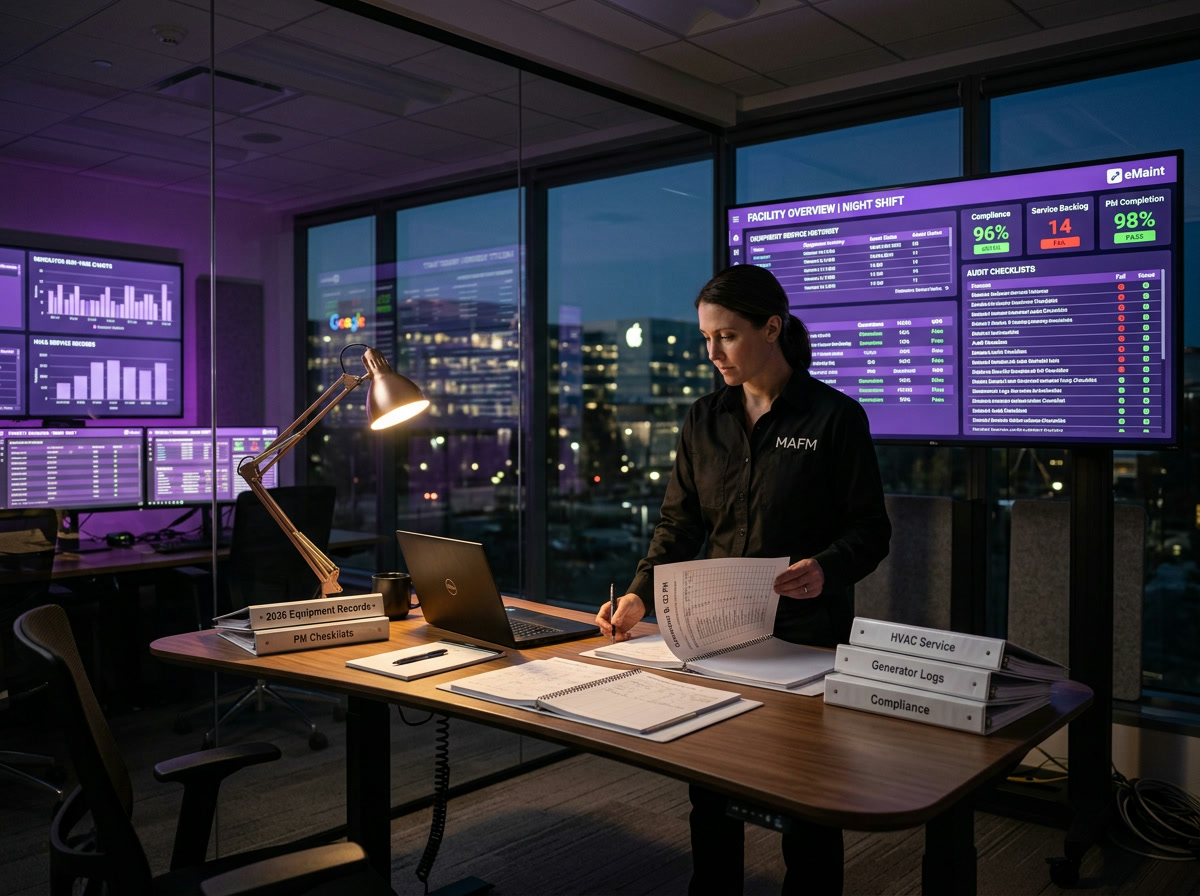
The Maintenance Log Audit: Closing Out Your 2026 Equipment Records Before the Insurance and Fire Marshal Calls Come In
Every January, the same scramble happens across Silicon Valley office parks and R&D campuses: an insurance underwriter requests twelve months of generator run logs, a fire marshal schedules a surprise inspection, or a tenant's lease renewal triggers a request for HVAC service history on the rooftop units serving their suite. If your maintenance records live in a mix of vendor PDFs, a technician's clipboard, and a CMMS that nobody finished populating, you spend the first two weeks of the new year reconstructing 2026 instead of planning 2027.
This is the third post in our series on year-end documentation for Silicon Valley facility managers, and it zeroes in on the records that get the most scrutiny and cause the most pain when they're incomplete: equipment maintenance logs. Unlike lease files or vendor contracts, these records aren't just administrative — they're the evidence base for life-safety compliance, warranty claims, insurance coverage, and the capital planning conversations you'll be having with ownership in Q1.
The good news is that a maintenance log audit is one of the more mechanical tasks on your year-end list. It doesn't require legal review or tenant coordination — it requires someone sitting down with your equipment list and checking it against twelve months of service tickets. The bad news is that most buildings skip it until a certificate renewal or an incident forces the issue.
Why Maintenance Logs Carry More Weight Than Most Facility Managers Realize
A maintenance log isn't just a scheduling tool — it's the document that determines whether a warranty claim gets paid, whether an insurance claim gets contested, and whether your building passes an AHJ inspection without a correction notice. When a chiller compressor fails in year four of a ten-year warranty, the manufacturer's first question is whether the unit received its required preventive maintenance on schedule, performed by a qualified technician, with documented refrigerant pressures and oil analysis. If that record doesn't exist or is incomplete, a $40,000 compressor replacement that should have been covered becomes an owner expense.
The same logic applies to insurance. Commercial property and liability underwriters increasingly request maintenance documentation as part of renewal underwriting, particularly for buildings with central plants, standby generators, or fire pumps. A gap in your NFPA 25 sprinkler inspection records or your NFPA 110 generator testing log doesn't just look bad — it can be cited as a basis for denying a claim tied to that system's failure.
For Silicon Valley specifically, where many buildings house data center space, cleanrooms, or 24/7 lab operations, the stakes are higher because the equipment is more specialized and the downtime cost is steeper. A property with backup generators supporting a tenant's server room needs documentation that goes beyond "ran fine" — it needs load bank test results, fuel polishing records, and transfer switch exercise logs that satisfy both the tenant's SLA requirements and your insurer's expectations.
The Equipment Categories That Need a Clean 2026 Paper Trail
Not every piece of equipment carries equal documentation risk, so prioritize your audit around systems that are inspected by outside authorities, covered by active warranties, or critical to tenant operations.
Life-safety systems come first: fire sprinkler systems (NFPA 25 quarterly and annual inspections), fire pumps (weekly churn tests and annual flow tests), fire alarm panels (annual testing per NFPA 72), and standby/emergency generators serving life-safety loads (NFPA 110 monthly load testing, often at 30% of nameplate capacity for 30 minutes minimum). These are the records most likely to be requested by the Santa Clara County or San Jose fire marshal during an annual inspection, and gaps here can result in correction notices that affect your certificate of occupancy status.
Mechanical equipment comes next: central plant chillers and boilers, cooling towers (with their own compliance layer around Legionella management plans under ASHRAE 188 and, in many California jurisdictions, local water system registration), rooftop units, and air handlers. For each, you want manufacturer-recommended service intervals matched against actual completed work orders, refrigerant tracking logs for EPA Section 608 compliance, and any water treatment records for cooling towers.
Vertical transportation is its own category — elevators and escalators require documented maintenance under California's Division of Occupational Safety and Health (Cal/OSHA, Division of Labor Standards Enforcement for conveyances), including annual safety inspections and categorized testing (Category 1 and Category 5 tests at longer intervals). Your elevator contractor should be providing these automatically, but facility managers are often surprised to find a unit due for Category 5 testing with no record that it happened.
Finally, backflow preventers, roof membranes under warranty, and building automation system (BMS) calibration records round out the list. None of these are glamorous, but each one has a specific party — an insurer, a manufacturer, a local water authority — who may ask for proof.
Reconciling Warranty and Service Contract Coverage Before January
Maintenance logs and service contracts should match up, but by year-end they often don't, because equipment ages out of warranty, vendors change, or service frequencies get adjusted mid-year without updating the governing documents. Before you close out 2026, pull your active equipment warranty list and check three things against your maintenance logs: whether the required service frequency was actually met, whether the technician performing the work was manufacturer-certified (many warranties require this explicitly), and whether any warranty is expiring in Q1 2027 that should trigger a service contract change or a capital replacement conversation.
This is also the moment to reconcile what you're paying for against what you're getting. It's common to find a mechanical service contract priced for quarterly preventive maintenance on a cooling tower where the actual field visits only happened twice. That's not necessarily a vendor problem — sometimes it's a scheduling gap on the facility management side — but either way, you want to catch it in December rather than discover it when the tower has a scaling issue in July and the vendor points to a service history that doesn't support an emergency response SLA.
For buildings with multiple service vendors covering different systems — a common setup across Silicon Valley campuses that split HVAC, fire/life safety, elevators, and generators among specialists — year-end is also when you should confirm certificate of insurance currency for each vendor. An expired COI sitting in your file from a vendor who serviced your fire pump in August is a liability exposure that's easy to miss and easy to fix if you catch it now.
Turning a Clean 2026 Record Into Your 2027 Capital Plan
The real payoff of this exercise isn't just risk avoidance — it's that a complete maintenance history is the single best input for your 2027 capital planning conversation. When you can show ownership that a rooftop unit has had three compressor repairs in eighteen months, rising refrigerant top-offs, and a widening gap between rated and actual efficiency, you have a data-backed case for replacement instead of a gut-feel request for budget. Facility managers who walk into capital planning meetings with maintenance-log-backed asset condition assessments get funded more often than those who ask for money based on equipment age alone.
This is also where a reasonably current CMMS pays for itself. If your 2026 records are scattered across vendor invoices and email threads, year-end is the forcing function to get them consolidated — even if that means a few weeks of data entry before you can trust the system going into 2027. The goal isn't a perfect digital twin of every asset; it's a reliable record that tells you, for every piece of critical equipment, what was serviced, when, by whom, and what it cost, so that the next audit, warranty claim, or capital request takes an hour instead of a week.
Conclusion
Maintenance logs rarely get the same year-end attention as leases or vendor contracts, but they carry outsized consequences when they're incomplete — denied warranty claims, insurance friction, fire marshal correction notices, and capital requests that don't hold up under ownership scrutiny. The audit itself is straightforward: match your equipment list against twelve months of service tickets, flag the gaps, and reconcile warranty and contract terms before they roll into a new year. Later this week, we'll look at how these equipment records connect to the broader compliance calendar facility managers need to manage across 2027.
Cta
If your 2026 maintenance records are scattered across vendors, inboxes, and spreadsheets, MAFM can run a full equipment documentation audit and get your CMMS ready for a clean 2027 — reach out to schedule a year-end records review.
Internal Links
Reference earlier posts in this week's series on year-end lease and compliance documentation (Monday and Tuesday) and tease the upcoming post on building the 2027 compliance calendar.
External Links
NFPA 25 (Standard for the Inspection, Testing, and Maintenance of Water-Based Fire Protection Systems) and Cal/OSHA's Division of Labor Standards Enforcement guidance on conveyance (elevator) inspection requirements.
Ready to Optimize Your Facilities?
MAFM offers comprehensive facility management solutions tailored to your business needs.
Get in Touch