The Five-Day Window: How Silicon Valley Facility Teams Should Spend the Week Before Thanksgiving
The Five-Day Window: How Silicon Valley Facility Teams Should Spend the Week Before Thanksgiving
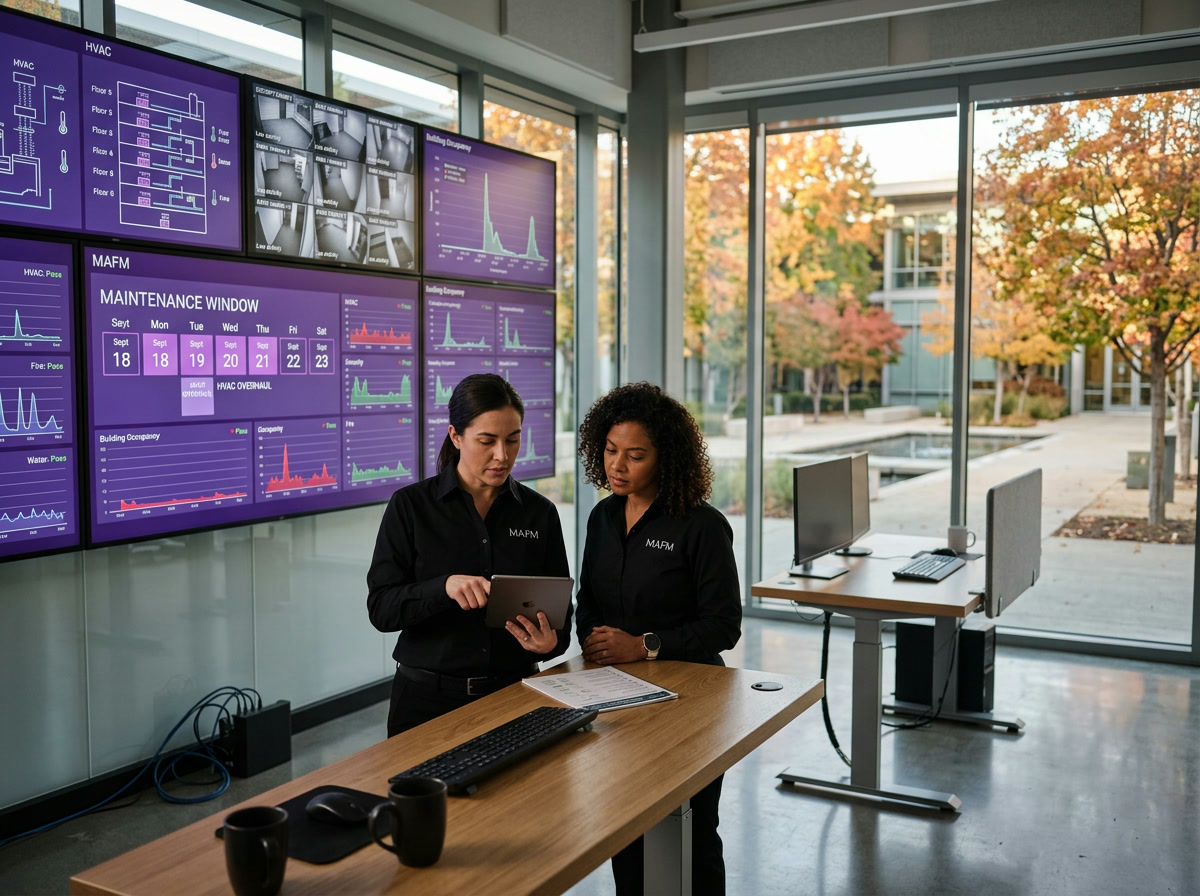
Thanksgiving week creates a strange operational gap in Silicon Valley commercial buildings. Occupancy drops to 15-30% of normal by Tuesday afternoon, many tenant companies close entirely Wednesday through Friday, and yet HVAC systems, security infrastructure, life safety equipment, and building envelopes don't get a holiday. For facility managers running multi-tenant office parks in Santa Clara, Sunnyvale, and Mountain View, or single-tenant corporate campuses in Palo Alto and Cupertino, this five-day stretch is one of the few predictable low-occupancy periods on the calendar — and it's either wasted or leveraged depending on how well the week before Thanksgiving is planned.
This week on the MAFM blog, we're running a five-part series on closing out November operations before the holiday period hits. Today's post lays out the overall framework: what actually needs to happen between now and Wednesday afternoon. Later this week we'll go deeper into specific facets — HVAC system adjustments for low-occupancy buildings, vendor and contractor scheduling around the holiday, security and access control protocols for partially vacant buildings, and a wrap-up that ties everything into a reusable year-end checklist.
We're writing this because we see the same pattern every year across our Silicon Valley portfolio: buildings that treat Thanksgiving week as "just a quiet week" end up paying for it in January with deferred maintenance tickets, emergency HVAC calls, and tenant complaints about a building that wasn't ready when everyone came back. Buildings that treat it as a planned operational window — four to five business days with minimal foot traffic — get ahead of deferred work, cut utility costs, and walk into December in better shape than they started November.
Why The Week Before Thanksgiving Is a Distinct Operational Phase
Most facility teams mentally file Thanksgiving under "holiday schedule" and treat the prep the same way they'd treat a three-day weekend. That's a mistake specific to this particular week. Unlike Memorial Day or Labor Day, Thanksgiving creates a multi-day occupancy cliff rather than a single closure day. In a typical 150,000-square-foot Class A office building in San Jose or Santa Clara, Monday and Tuesday still run at 70-85% occupancy, but Wednesday afternoon occupancy can fall to under 20% as tech companies release staff early, and it often stays there through the following Monday given how many tenants extend the holiday into a mini-break.
That extended trough matters because it's long enough to justify work that a single-day closure wouldn't — filter changes, economizer recalibration, elevator maintenance that requires taking a cab out of service for four hours, deep cleaning of spaces normally too occupied to access properly. But it's also short enough that if you don't plan it this week, you lose the window entirely. Vendors book up fast for the Tuesday-before slot specifically because every building in the area is trying to schedule the same work in the same 48-hour period.
The other reason this week deserves distinct treatment: it's the last full operational week before December, which brings its own compressed schedule of year-end deadlines, holiday decorating requests, and winter weather prep. Whatever doesn't get closed out by Wednesday afternoon this week tends to get pushed into a December calendar that's already crowded. We've watched facility teams carry open work orders from mid-November all the way into January simply because the natural "pause point" of Thanksgiving week passed without anyone using it.
The Four Categories of Work That Belong in This Window
Not everything belongs in a Thanksgiving-week push. We sort the work into four buckets to keep teams from either overloading the window or under-using it.
The first bucket is occupancy-dependent maintenance — work that's disruptive or impossible with people at their desks. This includes carpet extraction in high-traffic corridors, HVAC balancing and economizer testing, elevator modernization milestones, and any work requiring sustained noise or odor (floor refinishing, certain adhesives, duct cleaning). These should be scheduled for Wednesday through Friday specifically, when occupancy is lowest, not Monday or Tuesday when the building still feels mostly normal.
The second bucket is vendor-dependent work that requires booking weeks in advance — fire alarm testing, elevator inspections, generator load testing, and any compliance-driven service where the vendor's calendar, not your building's calendar, is the constraint. If this wasn't locked in two to three weeks ago, Monday of Thanksgiving week is your last reasonable chance to confirm it's still happening, because vendor crews themselves take Thursday and Friday off and their Wednesday slots fill first.
The third bucket is staffing and access logistics — figuring out who's actually in the building Wednesday through Friday, adjusting janitorial and security coverage accordingly, and confirming holiday pay and on-call rotations with your engineering staff before Tuesday, not Wednesday morning. The fourth bucket is the small physical prep items that get forgotten in the rush: confirming loading dock schedules for tenants doing deliveries ahead of the holiday, checking that irrigation and exterior lighting timers are adjusted for the shorter occupancy pattern, and making sure any pending capital project milestones don't accidentally require sign-off from someone who'll be unreachable by Wednesday afternoon.
The Monday-Tuesday Walkthrough That Catches Most Problems
Every property we manage gets a structured walkthrough on the Monday of Thanksgiving week, and we'd recommend any facility team build the same habit even without outside support. The goal isn't a general inspection — it's specifically to catch the things that will become expensive or embarrassing if they surface Wednesday afternoon when staffing is thin and vendors are unavailable.
Start with mechanical rooms and rooftop units. Check for any outstanding filter change or belt replacement that was deferred from October — Thanksgiving week is the easiest four-day stretch of the quarter to get a tech on the roof without complaints about noise or restricted access. Then move to life safety systems: confirm exit signage, emergency lighting, and fire extinguisher inspection tags are current, since a partially vacant building is exactly when insurers and AHJs (authorities having jurisdiction) tend to flag gaps if an incident does occur. A building with reduced staffing and a lapsed extinguisher inspection is a much worse story to tell than the same lapse in a fully staffed building.
Next, walk the exterior and loading areas. Landscaping crews often finish their last full-service visit before the holiday, so this is the moment to confirm leaf removal, irrigation shutdown adjustments, and any drainage issues are addressed before four or five days pass without anyone watching storm drains after the first real November rain. In Silicon Valley specifically, early rain events in late November are common enough that we build storm drain and downspout checks into every Thanksgiving-week walkthrough — a clogged drain that goes unnoticed over a five-day low-occupancy stretch can mean standing water against a foundation by the time anyone's back on Monday.
Finally, check tenant-facing systems: elevator call buttons, lobby directories, badge readers at reduced-traffic entrances that might get locked down for the holiday. If a building is shifting to a single-entrance protocol for the holiday period, Monday is the day to test that the designated entrance's badge reader, intercom, and lighting are all functioning — not Wednesday morning when the facility vendor who services access control is already gone for the week.
Communicating The Plan to Tenants and Ownership
A huge amount of the Thanksgiving-week friction we see isn't mechanical at all — it's a communication gap between the facility team and the people who occupy or own the building. Tenants need to know, by Monday at the latest, exactly what's changing: modified hours for building engineering staff, which entrances remain active, whether HVAC will run on a reduced schedule Wednesday through Friday, and who to call if something goes wrong while the building is thinly staffed.
That HVAC question deserves particular attention because it's the single most common source of post-holiday tenant complaints. If you're planning to run rooftop units on a reduced or setback schedule to cut utility costs during the low-occupancy stretch — a legitimate and often substantial savings opportunity we'll cover in more depth later this week — tenants with any skeleton crew working Wednesday or the following Monday need to know in advance, not discover a 68-degree office at 7 a.m. Even a short email on Monday referencing adjusted temperature setpoints prevents a frustrated call to the property management office on a day when fewer people are there to answer it.
Ownership and asset management also need a short status update this week, particularly on anything capital-related that's mid-project. If a reroofing job, parking lot resurfacing, or elevator modernization has a milestone landing during the holiday window, owners should hear about it proactively rather than finding out when they happen to drive by an empty parking lot with equipment staged in it. A two-paragraph email Monday morning — what's scheduled, what's deferred to December, and what the contingency plan is if a vendor cancels — does more to build trust with ownership than almost any other single communication all year, simply because it demonstrates the facility team is managing the calendar rather than reacting to it.
Conclusion
The week before Thanksgiving rewards facility teams that treat it as a distinct, plannable operational phase rather than an extension of a normal week or a simple holiday pause. The buildings that come out of this stretch in the best shape are the ones that used Monday and Tuesday to lock in vendor schedules, complete a targeted walkthrough, and get ahead of tenant and ownership communication — leaving Wednesday through Friday genuinely available for the occupancy-dependent work that's hard to schedule any other time of year.
Over the rest of this week, we'll go deeper into each piece of this framework: adjusting HVAC and energy management for the low-occupancy stretch, locking down vendor and contractor schedules before the holiday crunch, securing partially vacant buildings without over-restricting legitimate access, and building a reusable checklist that turns this into a repeatable annual process rather than a scramble every November.
Cta
If your team is still finalizing Thanksgiving-week vendor schedules or needs a facility partner to run the walkthrough and tenant communication for you, MAFM's Silicon Valley operations team can step in this week — contact us to get your building holiday-ready before Wednesday.
Internal Links
Reference this week's upcoming posts on HVAC scheduling for low-occupancy buildings, vendor and contractor coordination around the Thanksgiving holiday, security and access protocols for partially vacant properties, and Friday's year-end facility checklist roundup.
External Links
BOMA International's guidance on seasonal building operations and energy management, and NFPA's life safety inspection standards (NFPA 101) relevant to holiday-period staffing and emergency equipment checks.
Ready to Optimize Your Facilities?
MAFM offers comprehensive facility management solutions tailored to your business needs.
Get in Touch