The Cardboard Tsunami: Managing Black Friday-to-New Year Package Waste in Silicon Valley Office Parks
The Cardboard Tsunami: Managing Black Friday-to-New Year Package Waste in Silicon Valley Office Parks
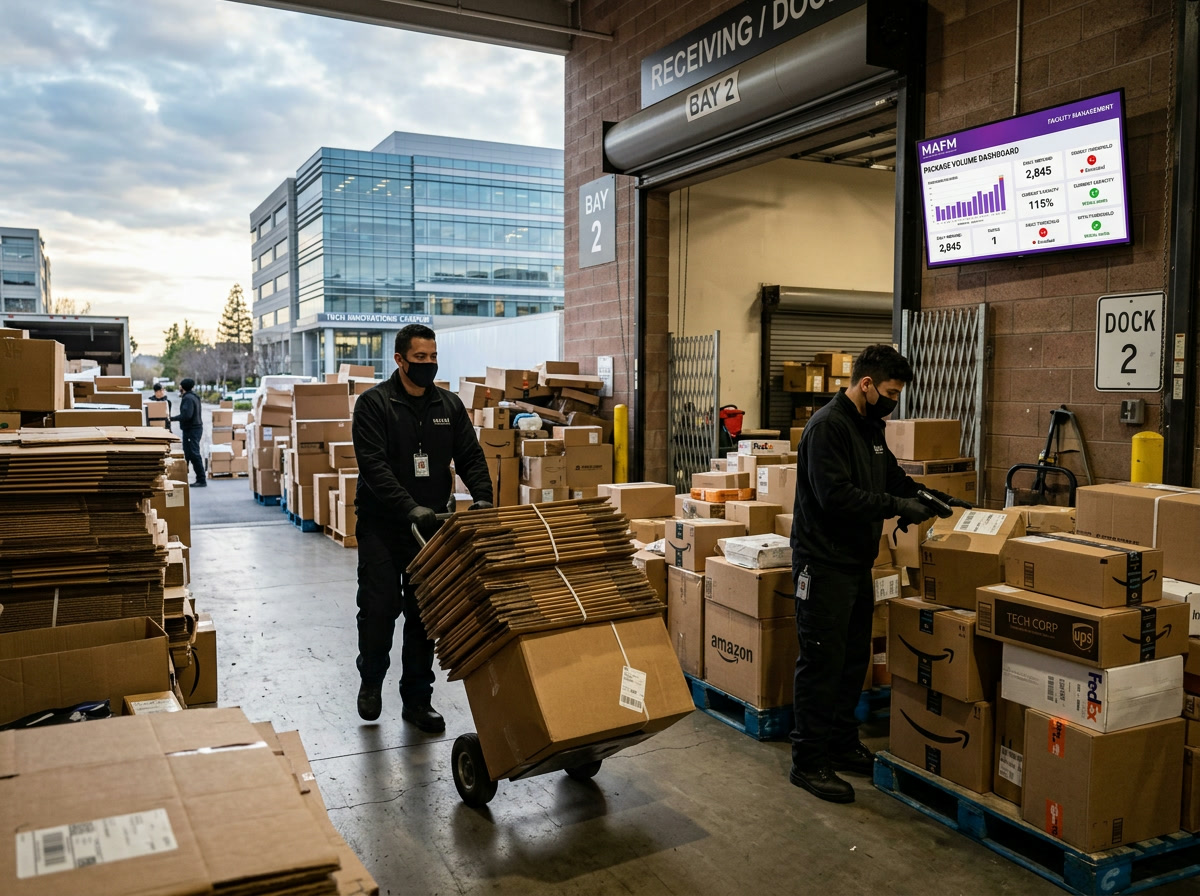
If you manage a multi-tenant office campus anywhere between Mountain View and San Jose, you already know what's coming this week. Cyber Monday isn't just a retail event — it's the single biggest stress test your package room and loading dock will face all year. Between now and the first week of January, the volume of cardboard moving through a typical 150,000-square-foot office building can jump three to five times its normal baseline, and it doesn't taper off until well after New Year's returns season winds down in mid-January.
Earlier this week we looked at the broader holiday waste surge facilities deal with in Q4. This post zooms in on one specific, high-friction piece of that puzzle: cardboard and packaging waste from the explosion of employee online shopping. In Silicon Valley specifically, this problem is amplified by two local factors — campuses with concierge-style package rooms handling hundreds of personal deliveries a day, and tenant populations with disposable income that makes this market a disproportionately heavy e-commerce zone compared to national averages.
Get the equipment sizing, hauler scheduling, and compliance pieces wrong during this six-week window, and you're looking at overflowing compactors, blocked loading docks, contamination fines, and tenant complaints that land directly on the property manager's desk. Get it right, and it's a non-event. Here's how experienced operations teams handle it.
Sizing The Problem Before It Sizes You
A standard office building compactor — say a 30-yard self-contained unit — is typically scheduled for pickup once or twice a week based on normal tenant generation rates. During Cyber Week and the weeks following, that same compactor can fill in half the time, because cardboard, unlike general office trash, is bulky and compacts inefficiently unless it's broken down properly before it goes in.
The math that catches facility teams off guard: a single mid-size campus with 2,000 employees, even at a conservative estimate of 15% of staff receiving one personal package per week during November and December, generates roughly 300 additional boxes weekly on top of normal tenant and janitorial cardboard. Multiply that across a 10-building portfolio and you're adding several tons of cardboard volume per week that didn't exist in October.
The practical issue isn't the cardboard itself — it's airspace. Un-flattened boxes trap air, and a compactor that should hold three weeks of flattened cardboard gets consumed in four days by boxes employees tossed in whole. This is why the first lever most Silicon Valley facility teams pull isn't more equipment, it's signage and behavior: laminated "break it down" placards at every package room and loading dock, reinforced by building engineering staff who physically flatten overflow during morning rounds.
Equipment Decisions — Compactors, Balers, and Extra Pulls
For campuses that generate enough cardboard volume to justify it, this is the window where a dedicated cardboard baler starts to pencil out versus relying solely on a general compactor. A vertical baler (roughly $8,000-$15,000 for a mid-capacity unit, or available through lease-to-own hauler programs) produces dense 500-800 pound bales that haulers will often pick up at a better rate per ton than loose or compacted mixed cardboard, because baled OCC (old corrugated cardboard) is a cleaner commodity stream.
If a baler isn't in the budget or the space, the next lever is temporary pull-frequency increases with your hauler — moving from a weekly to twice-weekly or even three-times-weekly cardboard pull for the six-week window. Most commercial haulers serving Santa Clara County (Recology, GreenWaste, Republic Services depending on your franchise zone) will accommodate seasonal frequency changes, but they need the request submitted with enough lead time — typically two to three weeks before Thanksgiving, not during it. Facility teams that wait until the dock is already overflowing in early December are stuck paying rush fees or going without service for days.
It's also worth confirming dock door scheduling with your hauler now. Cyber Week traffic plus increased pull frequency means more truck visits competing for the same loading dock windows that tenant move-ins, catering deliveries, and the building's regular trash and recycling pulls already use. A quick coordination call to stagger hauler windows avoids the scenario where a cardboard truck and a tenant's furniture delivery are both trying to use a single dock door at 10 a.m. on a Tuesday.
Staying Compliant While Volume Spikes
California's commercial recycling mandate (AB 341) requires businesses generating four or more cubic yards of waste per week to arrange recycling service, and cardboard is one of the most heavily scrutinized streams for contamination. The risk during the holiday surge isn't whether cardboard gets recycled — most buildings already have that stream set up — it's contamination creeping in as volume increases and less-trained temporary staff or rushed building engineers toss things into the cardboard stream that don't belong there.
The biggest contamination offender this time of year is padded mailers and bubble-lined envelopes, which look like cardboard but contain plastic film that haulers will reject or downgrade an entire load for. The second is styrofoam packaging inserts from electronics returns, which spike in January as holiday gifts get exchanged. A contaminated load doesn't just get sent to landfill instead of recycled — depending on your hauler contract, it can trigger a contamination fee charged back to the building, sometimes $75-$150 per rejected load.
The fix is low-cost but requires discipline: clear signage at package rooms distinguishing cardboard-only bins from general waste, and a quick training refresh for janitorial and engineering staff before Thanksgiving, not after a rejected load shows up on the hauler invoice in January. Some campuses also add a small "packaging materials" bin near package pickup areas specifically for bubble wrap, air pillows, and padded mailers, routed to general waste or a specialty film-recycling program rather than contaminating the OCC stream.
Staffing and Communicating With Tenants
Package rooms in multi-tenant Silicon Valley buildings are often staffed by a single concierge or managed through a locker system like Amazon Hub or Luxer One, and neither is built to absorb a 300-400% volume increase without adjustment. Buildings running manual sign-in package rooms typically need temporary part-time staffing coverage for the six-week window — even four extra hours a day dedicated to breaking down boxes and restocking locker space pays for itself in avoided overflow and tenant frustration.
Tenant communication matters just as much as equipment and staffing. A short email to building tenants in the week before Thanksgiving — noting expected package room congestion, a reminder to collect packages promptly, and a note that cardboard should be flattened and placed in designated bins rather than left beside them — reduces friction significantly. Buildings that skip this step tend to see package rooms become de facto storage areas by mid-December, with boxes stacked against walls creating both a fire code concern and a trip hazard that falls squarely on the facility team's liability.
It's also the right window to flag lithium battery disposal awareness, since gift returns and device upgrades spike in late December and January. Loose batteries from returned electronics ending up in general trash or cardboard bins are a genuine fire risk in compactors and baler chambers — several documented compactor fires nationally each December trace back to lithium batteries compressed with cardboard. A simple battery drop-box near the package room, clearly separate from recycling, solves this cheaply.
Conclusion
Cardboard volume during Cyber Week and the weeks following isn't a surprise — it's a predictable, measurable seasonal spike that rewards facility teams who plan equipment capacity, hauler frequency, and tenant communication two to three weeks ahead rather than reacting once docks are overflowing. The buildings that handle this smoothly aren't necessarily spending more money; they're spending it earlier, on signage, staffing hours, and a phone call to the hauler, rather than later on rush fees and contamination charges.
As we continue this week's look at holiday waste management, the next piece will turn to the compliance side of Q4 waste surges — specifically how California's organic waste diversion law intersects with the catered events and office parties that pile onto an already full waste stream.
Cta
If your campus hasn't locked in seasonal hauler pull-frequency changes or package room staffing for the next six weeks, MAFM can audit your current waste infrastructure and get adjustments scheduled before the Cyber Week surge hits your dock.
Internal Links
Link back to Monday's series introduction on Q4 waste volume trends in Silicon Valley facilities, and forward-reference Thursday/Friday posts in the series covering organics diversion compliance and a week-end roadmap for holiday waste planning.
External Links
CalRecycle's Mandatory Commercial Recycling (AB 341) program page; Solid Waste Association of North America (SWANA) guidance on seasonal cardboard and OCC market pricing fluctuations.
Ready to Optimize Your Facilities?
MAFM offers comprehensive facility management solutions tailored to your business needs.
Get in Touch