The Backbone of Silicon Valley's Buildings: Why Hispanic Heritage Month Matters to Facility Management
The Backbone of Silicon Valley's Buildings: Why Hispanic Heritage Month Matters to Facility Management
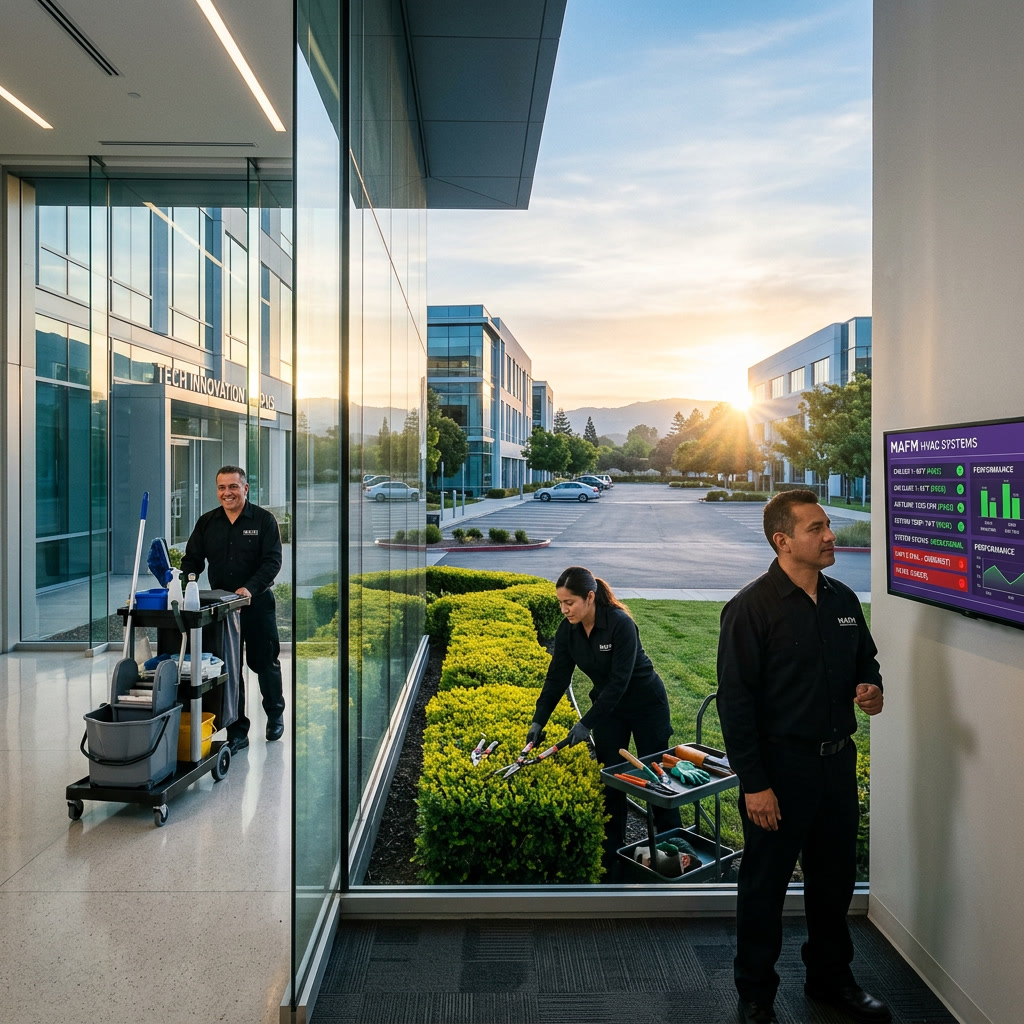
Walk through any Class A office campus in Sunnyvale, Santa Clara, or Mountain View before 6 a.m. and you'll meet the workforce that makes the rest of the day possible. Custodial crews finishing overnight cleaning cycles. Landscaping teams staging equipment before the parking lots fill. Engineers checking chiller logs and HVAC readouts before tenants arrive. In Silicon Valley, a disproportionate share of that workforce is Hispanic and Latino — and that fact shapes everything from how facility teams are trained to how buildings actually perform.
This week, MAFM is running a five-part series for Hispanic Heritage Month (which runs September 15 through October 15) examining the workforce realities behind commercial facility management in the Bay Area. We're not doing this as a symbolic gesture tacked onto a corporate calendar. We're doing it because the data is impossible to ignore if you manage buildings here: according to Bureau of Labor Statistics occupational data, Hispanic workers make up roughly 40-45% of building cleaning and maintenance occupations nationally, and in California that share runs higher still, particularly in janitorial, landscaping, and general maintenance trades. If you operate a facility in Santa Clara County, chances are a significant portion of the people keeping your building running are part of this workforce.
Over the next four posts, we'll dig into specific facets of this reality: how staffing agencies and FM providers recruit and retain in a labor market where turnover routinely hits 200-300% annually for janitorial roles, what bilingual training programs actually look like on the ground, how immigration status and work authorization complicate compliance for property owners, and how frontline crew leadership pipelines get built (or don't) in this industry. Today's post sets the frame: why the composition of this workforce isn't a footnote to facility management strategy — it's central to it.
The Workforce Numbers Behind Every Building You Manage
Facility managers tend to think about labor in terms of headcount and coverage hours — how many janitors per square foot, how many HVAC technicians on call, how many landscaping crews rotating through a portfolio. Fewer think about labor composition, but it matters operationally. In Santa Clara County, Hispanic and Latino workers represent close to a third of the overall labor force, and within building services occupations specifically — janitorial, groundskeeping, general maintenance — that concentration is markedly higher, often exceeding 50% in field crews even when office-level FM staff skews differently.
This isn't unique to the Valley, but the Valley's tight labor market makes it more consequential. When a 500,000-square-foot campus in San Jose needs to staff three shifts of janitorial coverage plus a dedicated engineering team, the recruiting pool for those roles draws heavily from Hispanic and Latino workers already embedded in Bay Area service industries — many of whom move between hospitality, food service, and facility management roles depending on wages and schedule flexibility. A property manager who doesn't understand this labor market is competing for the same limited pool as every hotel, restaurant, and warehouse operator in the region, often without realizing it.
The practical consequence: staffing plans that ignore workforce composition tend to underperform. We've seen facility contracts where turnover ran 40% higher than portfolio average simply because scheduling, communication, and safety training weren't built around the actual crew makeup — night-shift schedules that ignored childcare realities, safety data sheets only available in English at facilities where crew leads spoke Spanish as a first language, incident reporting forms nobody could complete accurately. None of that is a diversity talking point. It's an operations problem that shows up in your KPI dashboard as higher incident rates, slower response times, and elevated replacement costs.
What Culturally Competent Staffing Actually Looks Like
"Culturally competent" gets thrown around as a soft HR phrase, but in facility management it has hard operational meaning. It means safety training delivered in the language crews actually speak, not just posted in English because OSHA technically allows it. It means chemical handling certifications for janitorial staff that are verified for comprehension, not just signed off as completed. It means supervisors who can communicate directly with crews during an emergency — a burst pipe, a chemical spill, an active HVAC failure — without a translation delay that costs minutes you don't have during a life-safety event.
At MAFM, this shows up in concrete staffing decisions: bilingual crew leads on every account with more than six field staff, safety training materials produced in Spanish and English side by side (not translated after the fact), and onboarding documentation that covers wage theft protections and workers' comp rights clearly, because facility service workers are disproportionately vulnerable to both. This isn't charity — it's risk management. A crew that fully understands lockout/tagout procedures or bloodborne pathogen protocols because the training was delivered in their primary language is a crew less likely to generate an OSHA citation or a workers' comp claim that lands on your building's insurance experience modification rate.
There's a retention dividend too. Facility service workers who feel communicated with — genuinely, not performatively — stay longer. Given that replacing a trained janitorial technician costs an estimated $3,000-$5,000 once you account for recruiting, background checks, training, and lost productivity during ramp-up, a facility manager who treats language and cultural competence as core staffing infrastructure rather than an HR footnote is protecting margin, not just morale.
The Supervisor Pipeline Problem
Here's where most FM providers in Silicon Valley fall short: they staff frontline Hispanic and Latino workers effectively but fail to build promotion pipelines into supervisory and management roles. Walk into most facility management back offices and the composition flips dramatically from the field — English-dominant, often lacking representation that mirrors the crews being managed. That gap isn't just an equity issue; it's an operational one.
Crew leads who came up through the field understand things a credentialed but externally-hired supervisor often doesn't: which loading dock door sticks in cold weather, which tenant complains reflexively versus which complaint signals a real problem, how long a strip-and-wax job actually takes on 1980s-era VCT flooring versus modern LVT. That institutional knowledge is a retention and quality asset, and it evaporates when promotion pathways don't exist. We've found that facilities with visible, achievable paths from janitorial technician to crew lead to shift supervisor — with wage steps and training requirements clearly mapped out — see measurably lower attrition among senior field staff, because there's somewhere to go besides a competitor.
Building that pipeline requires deliberate investment: supervisory training offered bilingually, tuition assistance for facilities management certifications like BOMA's or IFMA's credentialing tracks, and performance review processes that don't quietly penalize accented English or non-native fluency in ways that block advancement. Facility owners evaluating an FM vendor's proposal should be asking not just "what's your janitorial staffing ratio" but "what does your promotion pipeline look like, and how many of your current supervisors came up through the field."
Why This Matters to Your Building'S Bottom Line
It's tempting to file workforce diversity under corporate social responsibility and move on to HVAC maintenance schedules and janitorial contract renewals. But in a facility management context, workforce strategy and building performance are the same conversation. Tenant satisfaction scores correlate directly with consistency of service — and consistency depends on retention. A janitorial or engineering team with 250% annual turnover produces inconsistent results no matter how good the contract specifications look on paper, because institutional knowledge about a specific building's quirks walks out the door every few months.
Silicon Valley's tenant base also increasingly cares about this directly. Tech tenants with their own DEI commitments are asking property managers pointed questions about vendor labor practices during lease negotiations and renewals — how service contractors are staffed, whether wage theft protections exist, whether workforce development is happening. A facility manager who can speak specifically to workforce composition, training investment, and promotion pathways is answering those questions from a position of strength rather than scrambling for talking points during a tenant sustainability audit.
There's also a straightforward labor market argument: Silicon Valley's unemployment rate for service occupations has stayed persistently low, and competition for reliable facility staff isn't easing. FM providers and property owners who build genuine relationships with the Hispanic and Latino workforce that dominates this labor pool — through fair wages, real advancement paths, and cultural competence baked into operations rather than bolted on — are the ones who'll have staffed buildings in 2027 while competitors are still running recruiting ads.
Conclusion
The workforce keeping Silicon Valley's buildings clean, safe, and operational is overwhelmingly Hispanic and Latino, and that fact deserves more attention from property owners and facility directors than it typically gets. This week, we're using Hispanic Heritage Month as an occasion to look closely at what that means operationally — not as a once-a-year observance, but as a lens on staffing strategy, training investment, and retention that matters every day of the year.
Later this week we'll dig into the specifics: retention strategies that actually move the needle in a high-turnover labor market, what compliant and effective bilingual safety training looks like in practice, and how to evaluate whether your current FM vendor is building real advancement pipelines or just checking a diversity box.
Cta
If you're evaluating whether your current facility management staffing strategy reflects the realities of the Silicon Valley labor market, MAFM offers a complimentary workforce and vendor assessment — contact us to schedule a walkthrough of your portfolio's staffing structure.
Internal Links
Reference to this week's upcoming posts on janitorial retention strategy (Tuesday), bilingual safety training and compliance (Wednesday), supervisor pipeline development (Thursday), and the Friday synthesis/roadmap post tying the series together.
External Links
U.S. Bureau of Labor Statistics, Labor Force Characteristics by Race and Ethnicity report (bls.gov); Building Owners and Managers Association (BOMA) International workforce development resources.
Ready to Optimize Your Facilities?
MAFM offers comprehensive facility management solutions tailored to your business needs.
Get in Touch