Security and Facility Management Integration for Silicon Valley Commercial Properties
Security and Facility Management Integration for Silicon Valley Commercial Properties
Most Silicon Valley commercial buildings treat security and facility management as separate functions: different vendors, different budgets, different communication channels. Security guards monitor cameras and control access. Facility staff maintains buildings and responds to service requests. The two groups coordinate minimally, until an incident reveals the gaps.
A water leak detected on security cameras goes unreported to facility management for 4 hours because no protocol exists. An HVAC contractor accesses the building after hours but security has no notification of approved vendor access. A janitorial crew discovers unlocked doors and broken windows during night cleaning but has no direct line to security dispatch.
These coordination failures create security vulnerabilities, operational inefficiencies, and liability exposure. Properties integrating security and facility operations achieve 30-45% faster incident response, eliminate duplicate coverage costs, and create comprehensive building protection greater than either function provides independently.
Here's how leading Silicon Valley commercial properties integrate security and facility management into unified building operations.
Understanding the Integration Gaps
Common Failure Patterns
Incident detection without response authority:
Security observes facility issue (water leak, HVAC failure, broken equipment)
No authority or training to respond
No protocol for facility notification
Issue worsens while security watches, uncertain how to escalate
Facility access without security coordination:
Contractors and vendors access building for maintenance
Security unaware of who should have access and when
Cannot distinguish authorized access from security breach
Contractors often bypass access controls ("let us in, we're here to fix the HVAC")
Duplicate overnight building coverage:
Security guard patrols building overnight
Janitorial crew works throughout building overnight
Each operates independently despite physical presence in same space
Opportunity for coordination and cross-training missed
Emergency response confusion:
Building emergency occurs (fire alarm, medical emergency, suspicious person)
Unclear whether security or facility management leads response
Delayed decision-making while determining responsibility
Critical time lost during confusion
The Cost of Separation
A Palo Alto office building tracked incidents over 12 months with separated security/facility operations:
Total incidents requiring both security and facility response: 47
Average time from detection to facility notification: 3.2 hours
Average time from detection to resolution: 8.7 hours
Estimated cost of delayed response: $38,000 (water damage, tenant disruption, emergency service premiums)
After implementing integrated program:
Same incident rate: 44 incidents
Average detection to notification: 12 minutes
Average detection to resolution: 2.4 hours
Estimated cost prevention: $31,000 annually
Integration program cost: $8,500 annually
Net benefit: $22,500
Building the Integrated Security-Facility Program
Component 1: Unified Communication Protocols
Shared communication platform:
Security and facility staff on same radio channel or communication app
Real-time coordination during incidents
Immediate notification of issues requiring other team's response
Escalation matrix:
Clear responsibility assignment for every incident type
Primary responder and backup clearly defined
Decision authority documented
Sample responsibility matrix:
Fire alarm activation: Security leads (coordinate evacuation), Facility supports (building systems, vendor coordination)
Water leak: Facility leads (source control, damage mitigation), Security supports (access control, area protection)
Medical emergency: Security leads (coordinate first responders), Facility supports (access facilitation, utilities)
Power outage: Facility leads (assessment, restoration), Security supports (building security during outage, access control)
Suspicious person: Security leads (assessment, law enforcement coordination), Facility supports (building lockdown, access control)
After-hours contractor access: Facility approves in advance, Security verifies and monitors
Component 2: Cross-Training Programs
Security and facility staff trained in basics of each other's function.
Security staff trained in:
Basic facility systems (location of main shutoffs: water, gas, electrical)
How to recognize facility failures (HVAC sounds, water pressure issues, unusual equipment sounds)
When to notify facility management vs. handle directly
Basic emergency response (fire extinguisher use, first aid, AED)
Facility staff trained in:
Access control systems and procedures
How to recognize security issues (suspicious behavior, unauthorized access, safety hazards)
When to notify security vs. handle directly
Basic emergency response protocols
Cross-training delivery:
Quarterly joint training sessions (4 hours)
Annual emergency drill involving both teams
Monthly coordination meetings reviewing recent incidents
Benefits:
Security staff becomes "eyes and ears" for facility issues during patrols
Facility staff recognizes and reports security concerns during building rounds
Faster response when either team member encounters cross-functional issue
Stronger team cohesion and communication
Component 3: Integrated Technology Systems
Access control and facility management system integration:
Access control logs who enters building and when
Facility management system shows approved vendor/contractor schedules
Security system cross-references access against scheduled maintenance
Alerts generated for access without scheduled work order
Video surveillance for facility verification:
Cameras monitor high-value equipment rooms (electrical, mechanical, IT)
Facility managers access feeds to verify equipment status remotely
Time-stamped video provides documentation for contractor work verification
Remote monitoring reduces need for physical rounds
Building automation system (BAS) alerts to security:
HVAC failures, temperature excursions, water detection events automatically alert security
Security becomes first responder while facility manager is notified
Critical issues addressed immediately, not discovered hours later
Mobile app integration:
Single mobile platform showing:
- Security incidents and alerts
- Facility work orders and status
- Building system status
- Unified communication
Both teams work from same information in real-time
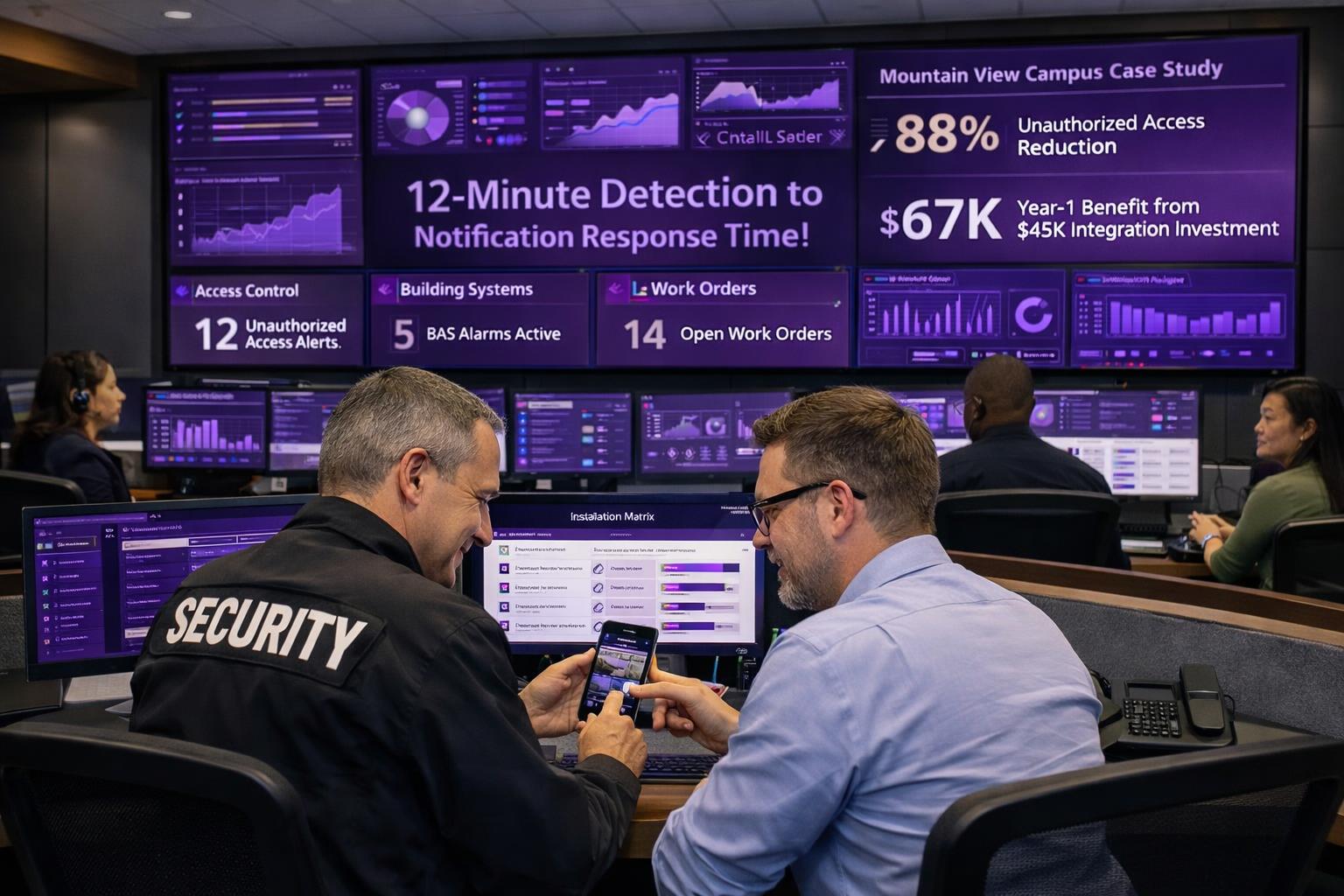
A Mountain View tech campus integrated security and facility systems:
Investment: $45,000 (access control integration, mobile app deployment, camera expansion)
Results first year:
- Facility issues detected average 4.2 hours faster (security patrol discovery)
- Unauthorized after-hours access reduced 88% (cross-reference against scheduled work)
- Equipment room security incidents: Zero (vs. 3 previous year)
- Facility-security coordination time: Reduced from 15 minutes to 2 minutes average
ROI: $67,000 in prevented damage and operational efficiency
Component 4: Vendor Coordination Protocol
After-hours and emergency vendor access requires security-facility coordination.
Pre-approved vendor access system:
Facility management maintains database of approved vendors
Each vendor has authorized personnel list
Scheduled work creates access authorization in security system
Security verifies vendor against database before granting access
Emergency vendor access:
Facility manager authorizes via phone/text
Security verifies authorization before access
Security monitors vendor during work
Facility manager notified upon vendor departure
Vendor escort policy:
High-security areas: Security or facility escort required
General building areas: Unescorted access permitted for approved vendors during normal hours
After-hours: All vendors escorted regardless of area
Work completion verification:
Security confirms vendor departure and secures areas accessed
Facility manager receives notification of work completion
Video review available if questions arise
Integrated Overnight Operations
Day Porter and Security Coordination
Buildings with day porter (daytime janitorial service) and security can coordinate effectively.
Porter as facility eyes during security gaps:
Security often single-person coverage unable to patrol entire building continuously
Porter moving throughout building becomes additional monitoring presence
Porter trained to report security concerns immediately
Security as facility backup:
Porter encounters issue requiring immediate facility response
Security assists or coordinates response during porter's normal duties
Communication:
Porter and security on same radio channel
Mutual awareness of location and activities
Immediate coordination when needed
Night Cleaning and Security Collaboration
Night janitorial crews and security guards both present in building overnight, opportunity for coordination.
Joint building security:
Cleaning crew reports unlocked doors, windows, or security concerns to security
Security monitors cleaning crew ensuring access limited to appropriate areas
Mutual accountability improves both security and cleaning quality
Cleaning verification:
Security patrols verify cleaning completion in different areas
Provides objective verification of janitorial service delivery
Identifies areas needing management follow-up
Incident documentation:
Either team discovering damage, spills, or unusual conditions documents and reports
Shared documentation system captures information from all sources
Better incident tracking and trend analysis
A San Jose office building integrated night security and janitorial operations:
Security guard conducts cleaning verification during patrols (15 minutes added to patrol route)
Cleaning crew reports 12 security issues over 6-month period (open doors, windows, suspected unauthorized access)
Issues that would have gone undetected until morning: 9 of 12
Cost to implement: $0 (training and communication protocol only)
Value: Multiple prevented security incidents, improved cleaning accountability
Emergency Response Integration
Unified Emergency Command
During building emergencies, clear command structure essential.
Emergency types and incident command:
Fire/life safety: Security leads (trained in evacuation, first responder coordination)
Building systems failure: Facility leads (technical expertise required)
Natural disaster (earthquake): Security leads initial response, Facility assesses building safety
Security incident (active threat): Security leads, Facility supports lockdown
Emergency operations center (EOC):
Designated location with communication systems
Security and facility leadership together during major incidents
Access to building systems, camera feeds, communication tools
Pre-staged emergency supplies and documentation
Joint emergency training:
Annual tabletop exercises with scenarios requiring coordination
Semi-annual full-scale drills
After-action review identifying improvement opportunities
Tenant Emergency Communication
Security and facility must coordinate tenant notification.
Emergency notification systems:
Mass notification platform (email, text, building PA)
Security and facility both authorized to trigger based on incident type
Pre-scripted messages for common scenarios
Real-time updates during evolving situations
Notification protocols:
Who triggers notification depends on incident type
Dual authorization for building evacuation (both security and facility confirm)
Documentation of all emergency notifications
Post-incident review of communication effectiveness
Measuring Integration Success
Key Performance Indicators
Incident response time:
Time from detection to first response
Target: <10 minutes for all incidents
Benchmark: 50% reduction from pre-integration baseline
Cross-functional incidents:
Number requiring both security and facility response
Coordination quality rating (smooth/acceptable/problematic)
Target: 95%+ rated smooth or acceptable
Unauthorized access events:
After-hours access without proper authorization
Target: <2 per quarter
Communication effectiveness:
Average time for security-facility coordination
Target: <5 minutes from initial contact to coordinated response
Training compliance:
Percentage of staff completing cross-training
Target: 100% of both teams annually
A Sunnyvale office park tracked integration KPIs:
Year 1 (baseline - separated operations):
Incident response time: 2.4 hours average
Cross-functional incidents: 42 annually, 62% rated "problematic"
Unauthorized after-hours access: 8 incidents
Year 2 (integrated operations):
Incident response time: 22 minutes average (85% improvement)
Cross-functional incidents: 38 annually, 95% rated "smooth/acceptable"
Unauthorized after-hours access: 1 incident (88% reduction)
Security-facility cost combined: Reduced 12% through efficiency gains
Tenant security satisfaction: Increased 34 percentage points
Integrate Security and Facility Operations
MAFM provides integrated security and facility management programs for Silicon Valley commercial properties, including unified communication protocols, cross-training, technology integration, and vendor coordination that creates comprehensive building protection while improving operational efficiency.
Schedule your consultation: Contact MAFM.PRO
Ready to Optimize Your Facilities?
MAFM offers comprehensive facility management solutions tailored to your business needs.
Get in Touch