Nighttime Operations Management: How Silicon Valley Facility Managers Control Quality When Nobody Is Watching
Nighttime Operations Management: How Silicon Valley Facility Managers Control Quality When Nobody Is Watching
The majority of facility management work happens when the building is dark. Nightly cleaning, floor care, restocking, and maintenance work occur between 6 PM and 6 AM, the hours when facility managers, property managers, and tenants are not present to observe the work being performed. This creates the most fundamental quality control challenge in commercial facility management: ensuring consistent execution of work that nobody is watching.
The gap between daytime management attention and nighttime operational reality is where most facility quality problems originate. Corners get cut not because cleaning staff are inherently negligent, but because the absence of observation, feedback, and accountability creates an environment where effort naturally gravitates toward efficiency rather than thoroughness.
Here is the nighttime operations framework that closes the gap between what you expect and what actually happens after the lights go down.
The Supervision Structure
Effective nighttime operations require a supervision model specifically designed for after-hours conditions. The management structure that works during the day (where facility managers circulate through the building, interact with staff, and observe work quality directly) does not exist at night.
On-site lead supervision is the minimum viable oversight model. Every night shift should have a designated lead who is responsible for staff attendance, work assignment, quality verification, and issue escalation. The lead is not a full-time supervisor in most mid-size buildings, they are a working team member with additional accountability for the shift's overall performance.
Select leads based on demonstrated quality standards, communication ability, and willingness to hold peers accountable. Technical cleaning skill alone is insufficient, the lead must be comfortable directing others and addressing performance issues in real time. Compensate leads with a meaningful wage differential that acknowledges their additional responsibility. A 10-15% premium over the standard cleaning rate is common and justified.
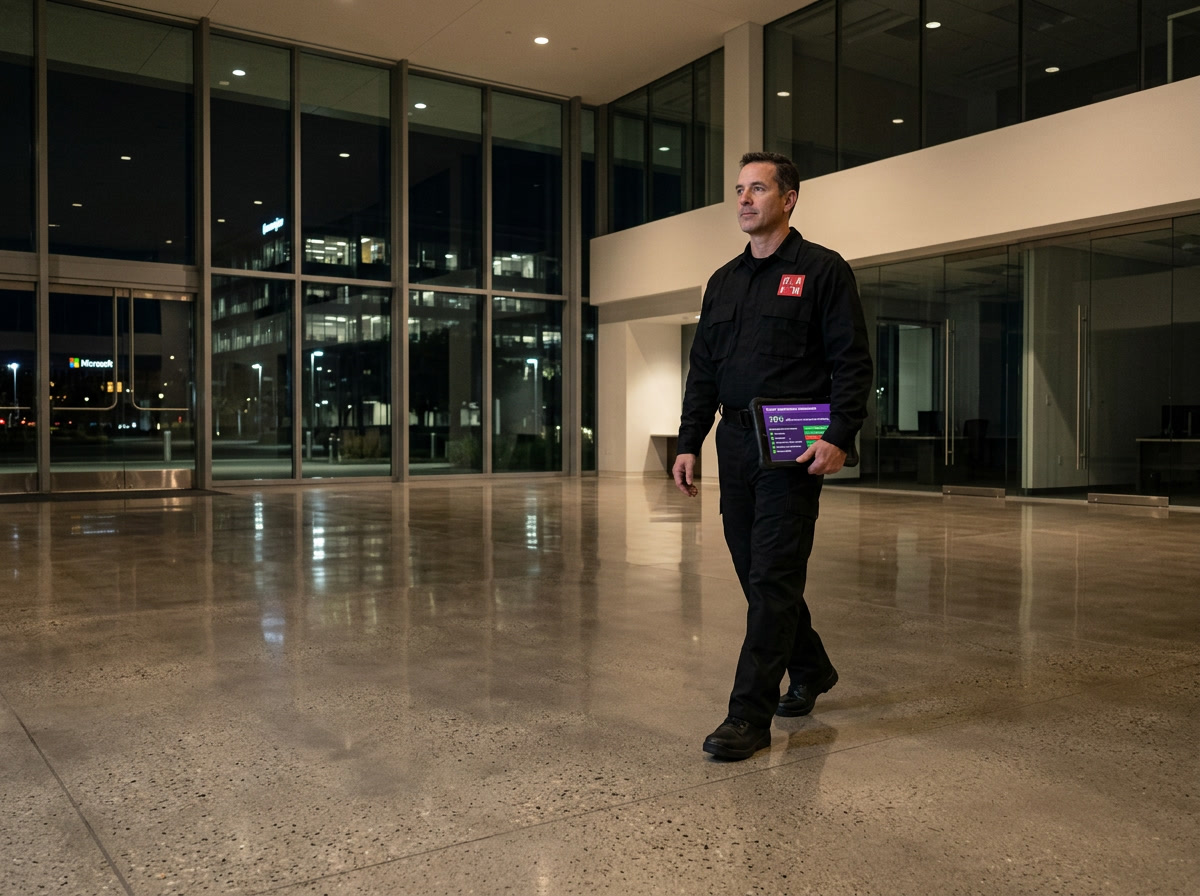
Roving supervision by a manager who visits the building during the night shift provides the external accountability that on-site leads alone cannot fully replicate. Even a 45-minute visit at an unpredictable time during the shift (walking the building, inspecting completed work, talking with staff) creates an awareness that quality is being monitored that persists long after the manager leaves.
For portfolio operators managing multiple buildings, schedule roving supervision visits across properties on a rotating basis. Each building should receive at least one unannounced supervisory visit per week. The unpredictability matters more than the frequency, staff who know they might be visited at any time maintain higher standards than staff who know exactly when the supervisor arrives.
Technology-Enabled Accountability
Technology fills the supervision gaps that physical management presence cannot cover every night.
GPS-enabled time and attendance systems verify that cleaning staff are present at the building during their scheduled hours. Mobile clock-in systems with geofencing confirm that staff are physically at the correct location when they record their start and end times. This eliminates time theft, the practice of clocking in remotely or leaving early while recording a full shift, which industry data suggests affects 10-15% of nighttime cleaning hours.
Task verification through mobile inspection apps requires cleaning staff to document completed work with time-stamped photographs. The lead or individual team members photograph specific areas after cleaning (restrooms, break rooms, lobby, executive areas) creating a visual record that supervisors review the following morning. This documentation serves both accountability and quality verification purposes.
Building access logs record every entry and exit through secured doors, providing an independent record of who was in the building, when they arrived, and when they departed. Cross-reference access logs against time records to verify consistency.
Real-time communication platforms connect nighttime staff with on-call management for issue escalation. A cleaning lead who discovers a water leak, security concern, or equipment failure at midnight needs a reliable communication path to reach someone who can authorize response. Define your after-hours escalation protocol explicitly, who to contact, in what order, for which types of issues.
Quality Control Protocols
Nighttime quality control requires structured protocols that compensate for the absence of continuous management observation.
Shift-start walkthroughs by the cleaning lead before the team begins work establish the baseline condition of the building. This walkthrough identifies pre-existing issues (spills, damage, maintenance conditions) that should be documented before the cleaning team begins work. Without this baseline, any issue discovered the following morning cannot be accurately attributed.
Shift-end inspections by the cleaning lead after work is complete verify that every assigned area meets the quality standard before the team departs. The lead walks each floor and common area, checking work quality against the scope checklist. Areas that do not meet standard get corrected before the team leaves.
Random area audits by the lead during the shift catch quality issues in real time rather than discovering them after the team has moved on. Select two to three areas each night for detailed mid-shift inspection. This unpredictable spot-checking maintains quality awareness throughout the shift.
Morning walk inspections by the daytime facility manager or building engineer provide next-day quality verification and feedback. Walk the building before tenants arrive, noting any quality deficiencies, missed areas, or outstanding issues. Communicate findings to the night team lead before the next shift so corrections are made immediately.
The feedback loop between morning inspections and nighttime corrections is the mechanism that drives continuous improvement. Quality issues identified in the morning must reach the night team before their next shift, and the night team must understand that identified issues will be verified the following morning. This closed-loop accountability is what separates buildings with consistent nighttime quality from those with chronic performance gaps.
Security Management During Nighttime Operations
Nighttime cleaning staff are often the only people in the building during the hours when security vulnerability is highest. This dual reality, cleaning staff as both workers and de facto security presence, requires explicit security protocols.
Key control and access management ensure that cleaning staff can access all areas required for their work without compromising building security. Issue access credentials that provide the minimum necessary access for each team member's assignment. Revoke credentials immediately when staff terminate or transfer.
Visitor and contractor protocol during nighttime hours requires that cleaning staff know how to handle unexpected encounters with non-staff individuals in the building. The protocol should be clear: do not confront or engage with unauthorized individuals. Withdraw to a safe location and contact security or law enforcement immediately.
Tenant space security protocols prevent the exposure of sensitive tenant materials and equipment. Cleaning staff should be trained to close and lock office doors after cleaning, avoid reading or handling documents on desks, never use tenant computers or equipment, and report any observed security anomalies.
Incident documentation and reporting for any security-related observation during the night shift should follow a defined process. Whether the observation is an unlocked exterior door, a suspicious vehicle in the parking lot, or an unfamiliar person in the building, documentation creates a record that supports investigation and prevention.
Supply and Equipment Management
Nighttime operations depend on supply availability and equipment readiness that must be verified before each shift begins.
Pre-shift supply verification confirms that all chemicals, paper products, liners, and cleaning supplies are stocked to levels sufficient for the entire shift. Running out of supplies mid-shift creates incomplete work and requires staff to improvise, neither of which produces acceptable quality outcomes.
Equipment pre-shift checks verify that vacuums, floor machines, and cleaning equipment are functional before the shift begins. A vacuum with a full bag or a floor machine with a burned-out motor discovered at 10 PM cannot be replaced until the following business day, leaving assigned tasks incomplete.
Supply room organization and chemical management at night must follow the same standards enforced during the day. Chemicals stored improperly, equipment left dirty after use, and supply rooms left in disarray during nighttime shifts indicate a supervision gap that needs correction.
Restocking completion at shift end ensures that the building is fully prepared for tenant arrival the following morning. Every restroom, break room, and common area should be stocked to full par levels when the night team departs. Morning supply shortages indicate either inadequate par levels or incomplete nighttime restocking, both are correctable with proper management attention.
Conclusion
Nighttime operations represent the largest block of facility management labor hours and the greatest quality control challenge. The buildings that deliver consistent results around the clock are the ones that invest in supervision structures, technology-enabled accountability, systematic quality protocols, and closed-loop feedback systems that keep nighttime performance aligned with daytime standards.
Evaluate your current nighttime operations against this framework. Spend one night this month on an unannounced visit to observe your building's after-hours reality firsthand. What you see will either confirm your program's effectiveness or reveal the gaps that need immediate attention.
MAFM PRO maintains rigorous nighttime operations management with technology-verified quality at every property we serve. Contact us to discuss how our after-hours accountability delivers consistent results.
Schedule your consultation: Contact MAFM.PRO
Ready to Optimize Your Facilities?
MAFM offers comprehensive facility management solutions tailored to your business needs.
Get in Touch