Why the Next Generation of Silicon Valley Facility Management Demands a Different Kind of Partner
Why the Next Generation of Silicon Valley Facility Management Demands a Different Kind of Partner
Over the past fourteen weeks, we have published seventy articles exploring every dimension of commercial facility management in Silicon Valley. We have covered budgets and vendor scorecards, HVAC optimization and restroom excellence, emergency preparedness and tenant retention, smart building technology and California compliance, staffing models and career development. The collection represents the most comprehensive facility management knowledge base published for the Silicon Valley market.
But knowledge without execution is just information. The gap between understanding best practices and consistently delivering them across real buildings with real tenants and real budget constraints is where most facility management programs fall short. Closing that gap, transforming knowledge into daily operational reality, is the challenge that defines our industry and the mission that drives everything we do.
This final post is not a sales pitch. It is an honest reflection on what the Silicon Valley facility management market needs, where the industry falls short, and what it takes to build a facility management practice worthy of the most demanding commercial real estate market in the world.
The Problem with Traditional Facility Management
The traditional facility management model was designed for a different era. It was built around scheduled tasks performed by interchangeable labor, managed through periodic inspections, and evaluated primarily on cost. This model worked well enough when building systems were simple, tenant expectations were modest, and competitive differentiation came from lease rates and location rather than workplace experience.
That era is over. Today's Silicon Valley commercial buildings are technology-dense environments with sophisticated climate systems, complex fire and life safety infrastructure, sensitive air quality requirements, and occupants who expect campus-quality facility services regardless of building size. Managing these buildings with the tools and approaches of the previous generation produces results that fall measurably short of market expectations.
The most common failure mode is not catastrophic, it is gradual. Buildings managed under traditional models do not suddenly collapse in quality. They slowly drift downward. Cleaning standards erode as turnover replaces experienced staff with untrained newcomers. Preventive maintenance schedules slip as reactive demands consume available labor hours. Vendor accountability weakens as quarterly reviews become annual formalities. Common areas age without strategic refresh investment. And tenant satisfaction declines in increments too small to trigger alarm until the renewal conversation reveals that the tenant has been quietly touring competitors for months.
What Data-Driven Facility Management Actually Means
The term data-driven has been used so liberally in facility management marketing that it has nearly lost its meaning. Every FM company claims to be data-driven. Very few actually are.
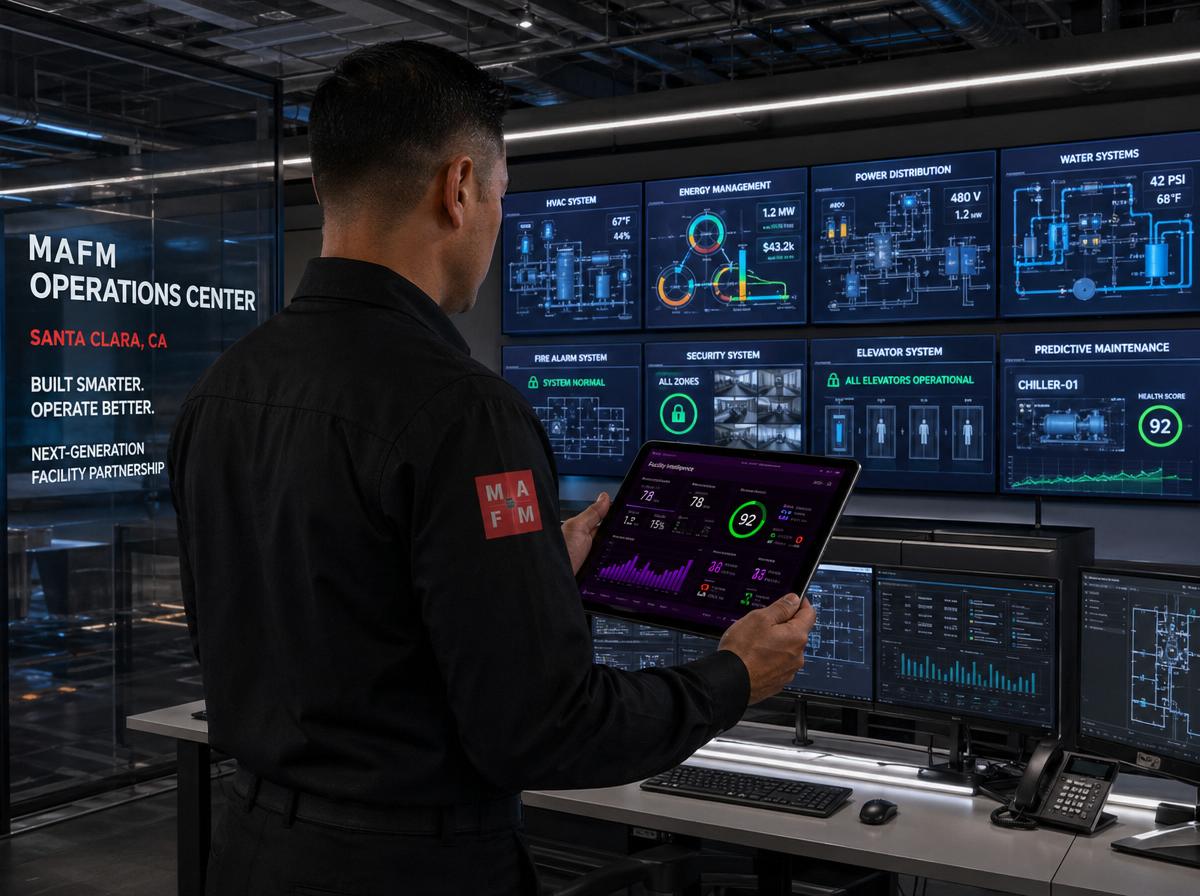
Genuine data-driven facility management means that every operational decision is informed by measured outcomes rather than assumptions or habits. It means tracking the ten KPIs that predict building performance, inspection pass rates, work order completion times, planned-versus-reactive maintenance ratios, cost per square foot, energy use intensity, tenant satisfaction scores, and using those metrics to drive specific operational adjustments on defined timelines.
It means that when a building's inspection scores decline from 92% to 87% over two months, the response is not vague direction to try harder but a root cause analysis that identifies the specific areas, shifts, or tasks driving the decline and implements targeted corrections that are verified through subsequent measurement.
It means that staffing models are built from workload calculations, adjusted for building-specific conditions, and validated against productivity metrics, not inherited from the previous contract or estimated from industry averages that may not reflect your building's actual requirements.
It means that vendor performance is evaluated against objective scorecards with documented quarterly reviews, and that contract decisions are supported by longitudinal performance data rather than the most recent anecdote or the lowest bid.
Data-driven facility management is not a technology platform. It is a management discipline that uses data as the foundation for every decision, every improvement, and every accountability conversation.
The Integration Imperative
The most sophisticated building systems in the world deliver mediocre results when managed in silos. HVAC optimization, cleaning operations, tenant communication, preventive maintenance, and life safety compliance all interact in ways that siloed management misses.
A building's air quality depends on HVAC filtration, cleaning chemical selection, ventilation management, and occupancy patterns, four domains that typically fall under different management responsibilities. Optimizing any one in isolation produces limited results. Integrating all four into a coordinated air quality program produces outcomes that exceed what any single domain can deliver independently.
Tenant satisfaction depends on cleaning quality, maintenance responsiveness, common area appearance, climate comfort, and communication professionalism, five dimensions that traditional management evaluates separately. An integrated approach recognizes that deficiency in any single dimension undermines the others and manages all five as components of a unified tenant experience strategy.
The facility management partner that delivers integrated operations, where every function reinforces every other function, produces building performance that exceeds the sum of its parts. The provider that manages cleaning, maintenance, vendor coordination, compliance, and tenant experience as separate workstreams delivers competent execution of individual tasks without the synergy that distinguishes good buildings from great ones.
The People Equation
No technology platform, management system, or operational framework produces results without the people who execute it. The facility management industry's persistent challenge (attracting, developing, and retaining the workforce that delivers daily operational quality) is not solved by better software. It is solved by better leadership.
The facility management companies that consistently outperform their competitors share a common approach to their workforce: they invest in training before they need to, they compensate above market rates because quality staff deliver above-market results, they build career pathways that give every team member a visible trajectory, and they treat every position, from night cleaning technician to portfolio director, with genuine professional respect.
This approach costs more upfront than the commodity labor model that many FM companies rely on. It is also dramatically less expensive over time because it produces lower turnover, higher productivity, fewer quality failures, and stronger tenant satisfaction. The math consistently favors investment in people.
Bilingual operations capability is not a nice-to-have in the Bay Area, it is an operational requirement. A facility management team that communicates effectively in both English and Spanish delivers training with full comprehension, safety instruction without language barriers, and management oversight without information gaps. This capability should be standard, not exceptional.
What the Next Five Years Demand
The facility management industry between 2026 and 2030 will undergo more change than the previous twenty years combined. The forces driving this transformation, building electrification, AI integration, sustainability mandates, wellness-focused operations, and the continued evolution of workplace expectations, create both challenge and opportunity for every property in Silicon Valley.
The buildings that thrive through this transformation will be managed by partners who understand these forces not as distant trends but as current operational realities that require preparation today. Electrification transition planning cannot wait until mandates take effect. AI-powered optimization cannot be implemented during the quarter you need its results. Sustainability compliance cannot be achieved through last-minute scrambling.
The facility management partner you choose today determines whether your building leads this transformation or chases it. The choice is not between different levels of cleaning quality, it is between management philosophies that either embrace complexity as an opportunity or retreat from it as an inconvenience.
The Standard We Set
Every article in this seventy-post series represents a standard we hold ourselves to. The vendor scorecard framework we published is the scorecard we invite our clients to use on us. The KPIs we recommended are the KPIs we report monthly. The training program we described is the program we deliver to every team member. The inspection methodology we outlined is the methodology we execute weekly.
Publishing our operational philosophy in this level of detail is deliberate. We believe that the facility management industry benefits from transparency about what excellent operations look like, and we believe that companies confident in their own execution welcome scrutiny rather than avoiding it.
The knowledge we have shared across fourteen weeks is freely available to every facility manager, property owner, and FM company in Silicon Valley. We publish it because raising the standard of facility management across the market benefits everyone, tenants, property owners, facility professionals, and the industry as a whole.
Conclusion
The Silicon Valley commercial real estate market deserves facility management that matches the sophistication of the companies that occupy its buildings, the investment that ownership has made in its properties, and the expectations of the people who spend their working lives within its walls.
That standard is achievable. It requires a management partner that combines data-driven operations, integrated service delivery, workforce investment, and genuine commitment to continuous improvement. It requires a partner built for the complexity of this market and this moment.
Seventy articles. Ninety-five thousand words. Fourteen weeks of operational knowledge shared openly with the market we serve. This is who we are. This is how we operate. And this is the standard we bring to every building that carries the MAFM name.
MAFM PRO delivers the operational standard described across this entire content series. Contact us to discuss how our approach transforms your building's performance, protects your investment, and earns the confidence of every tenant you serve.
Schedule your consultation: Contact MAFM.PRO
Ready to Optimize Your Facilities?
MAFM offers comprehensive facility management solutions tailored to your business needs.
Get in Touch