Building a Janitorial Training Program That Reduces Turnover by 40% and Transforms Cleaning Quality
Building a Janitorial Training Program That Reduces Turnover by 40% and Transforms Cleaning Quality
The janitorial industry's annual turnover rate in the Bay Area hovers between 200% and 300%. Read that number again. In a typical year, every position on your cleaning team turns over two to three times. Each turnover event costs $1,500-$3,000 in recruiting, onboarding, training, and lost productivity. For a ten-person cleaning crew, that is $30,000-$90,000 annually in turnover costs alone, money that produces zero value for the building or its tenants.
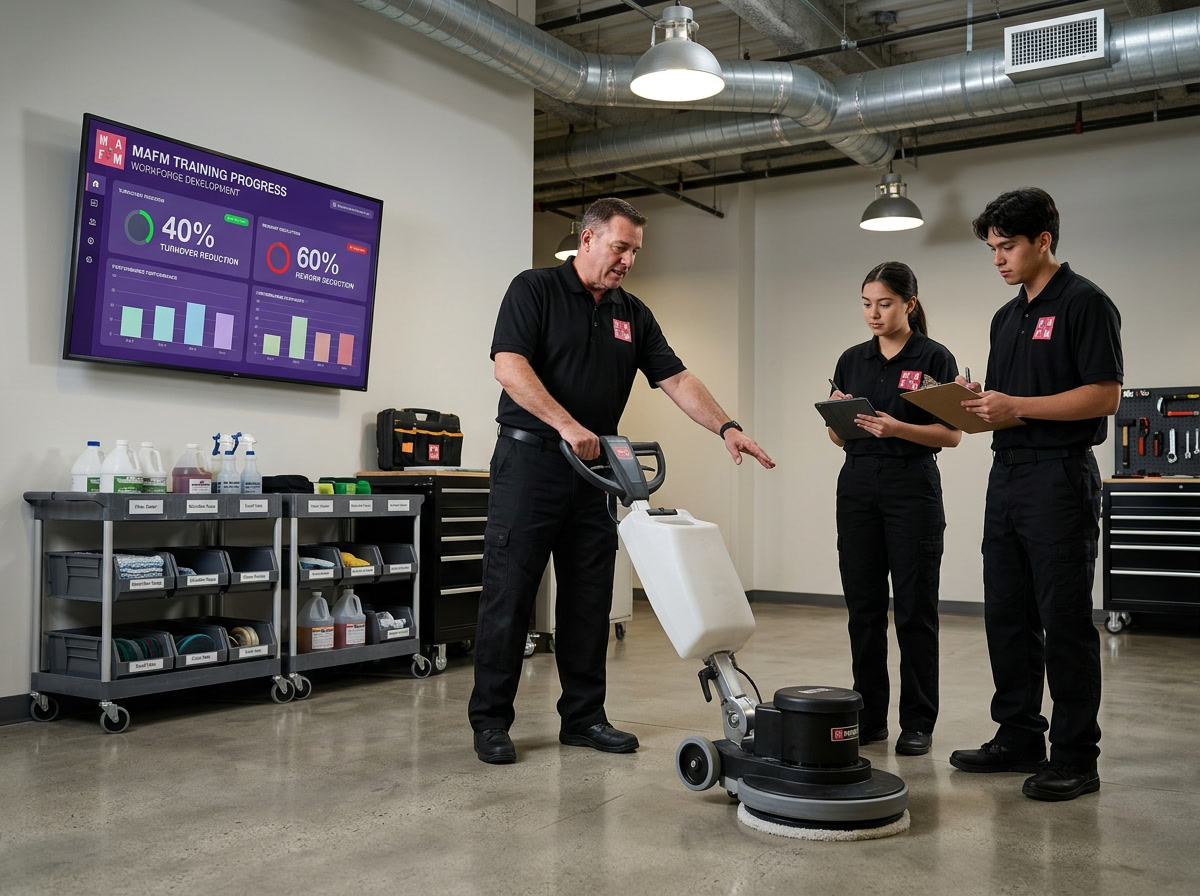
The single most effective intervention for reducing turnover is also the intervention most commonly underinvested: structured, ongoing training. Cleaning staff who receive proper training perform better, feel more competent and valued, and stay longer. The data is consistent across the industry. Organizations with formal training programs report 35-45% lower turnover compared to those that rely on shadow training and on-the-job learning.
Here is how to build a training program that transforms both retention and cleaning quality.
Why Traditional Janitorial Training Fails
Most janitorial training follows the same pattern: a new hire shadows an experienced employee for one to three shifts, receives a keyring, and is expected to perform independently. This approach fails for reasons that are predictable and avoidable.
Shadow training transfers both good habits and bad habits from the trainer to the trainee. If the experienced employee takes shortcuts, skipping under-desk vacuuming, using the same cloth for restrooms and break rooms, over-diluting cleaning chemicals, the new hire learns those shortcuts as standard practice. Without a documented standard to train against, institutional knowledge degrades with every generation of employees.
Sink-or-swim onboarding accelerates early turnover. New employees who feel inadequately prepared for their responsibilities experience stress and frustration that drives departure within the first 30-60 days. The irony is that the turnover rate during the onboarding period is the highest of any employment phase, and it is the phase where the employer has the most control over the employee's experience.
Language barriers compound the training challenge. A significant percentage of janitorial staff in Silicon Valley speak Spanish as their primary language. Training delivered exclusively in English fails to reach these team members effectively, creating knowledge gaps that manifest as inconsistent performance and safety compliance issues.
One-time training ignores the reality that skills, products, equipment, and standards evolve continuously. A cleaning technician trained in 2023 and never retrained is operating on outdated knowledge by 2026. Products change, equipment upgrades require new procedures, and regulatory requirements shift.
The Structured Training Framework
Effective janitorial training operates on three levels: initial onboarding, building-specific orientation, and ongoing professional development. Each level serves a distinct purpose and requires dedicated time investment.
Initial onboarding covers universal skills and knowledge that apply regardless of building assignment. This training should be completed before the new employee works their first independent shift and covers fundamental cleaning techniques for each surface type, chemical safety and proper dilution procedures including GHS label reading and SDS interpretation, equipment operation for every piece of equipment they will use, personal protective equipment selection and proper use, bloodborne pathogen awareness and exposure response, and basic customer service skills for tenant interaction.
Initial onboarding requires a minimum of eight hours of dedicated training time. Attempts to compress this into a two-hour overview inevitably produce undertrained staff who make mistakes, work inefficiently, and leave quickly.
Building-specific orientation follows initial onboarding and focuses on the particular property where the employee will work. This training covers the building's cleaning scope and schedule, specific room-by-room cleaning requirements, security procedures and key control protocols, tenant-specific requirements and sensitivities, equipment storage locations and supply management, emergency procedures specific to the building, and communication protocols with management and tenants.
Building-specific orientation requires an additional four to six hours of guided walkthrough and supervised practice. The new employee should clean each area of their assignment under observation before working independently, with feedback provided during the supervised session rather than after independent work has been evaluated.
Ongoing professional development maintains and expands skills throughout employment. Schedule quarterly training sessions covering new products and techniques, seasonal procedure changes, refresher training on high-impact topics like chemical safety and infection prevention, and advanced skills development for employees interested in career advancement.
Bilingual Training Delivery
Silicon Valley's janitorial workforce is predominantly bilingual, with many team members more comfortable receiving information in Spanish than English. Training programs that ignore this reality deliver partial effectiveness at best.
Develop all training materials in both English and Spanish. Written procedures, safety documents, chemical labels, and building-specific instructions should be available in both languages. The incremental cost of bilingual documentation is minimal, and the improvement in comprehension and compliance is substantial.
Deliver training sessions in the primary language of the participants. A training session delivered in English to a team that thinks in Spanish produces surface-level compliance without deep understanding. When possible, use bilingual trainers who can switch between languages to ensure every participant fully comprehends each concept.
Safety training specifically must be delivered in the employee's primary language. California law requires this, and the practical importance is self-evident. A chemical safety instruction that an employee does not fully understand because of language barriers creates genuine health risk.
Visual training aids (photographs, diagrams, video demonstrations) transcend language barriers and reinforce verbal instruction. Create a visual library showing correct techniques, proper chemical use, equipment operation, and quality standards. These resources serve as reference materials long after the training session concludes.
Training as a Retention Tool
Training investment communicates organizational value to employees. When a company invests time and resources in developing an employee's skills, that employee receives a clear message: you matter here, and we want you to succeed.
This message is particularly powerful in the janitorial industry, where many workers have experienced employers who treat them as interchangeable and disposable. A structured training program that treats cleaning staff as professionals worthy of development creates loyalty and engagement that directly reduces turnover.
Career pathway training amplifies the retention effect. When employees see that training leads to advancement (from cleaning technician to lead, from lead to supervisor, from supervisor to account manager) they commit to the organization rather than viewing the position as temporary.
Create visible advancement criteria tied to training completion. Define what skills and certifications an employee must acquire to qualify for promotion. Make the pathway transparent so every team member can see their potential trajectory and understand what is required to advance.
Recognition for training achievement reinforces the value of professional development. Whether through certificates, wage increases tied to skill milestones, or public acknowledgment, recognizing employees who complete training programs creates positive reinforcement that encourages continued participation.
Measuring Training Effectiveness
Training programs require the same performance measurement discipline as any other operational investment. Track metrics that confirm whether your training investment is producing the intended outcomes.
Track 90-day retention rates as the primary indicator of onboarding effectiveness. If new hires are leaving within their first 90 days at rates exceeding 30%, your onboarding program is not adequately preparing them for success. Investigate the specific reasons for early departures through exit interviews and adjust training content accordingly.
Compare inspection scores between trained and untrained staff. If your training program is effective, recently trained employees should achieve inspection pass rates comparable to experienced staff within 60-90 days. Persistent quality gaps between new and experienced employees indicate training content or delivery deficiencies.
Track rework rates, the frequency of tasks that must be repeated because initial performance did not meet standards. Untrained staff rework rates typically run 15-25% of assigned tasks. Properly trained staff should achieve rework rates below 5% within 90 days. The cost savings from reduced rework alone often justify the training program investment.
Monitor safety incident rates by training cohort. Employees who complete comprehensive safety training should experience significantly fewer injuries, chemical exposures, and near-miss incidents than employees who received abbreviated or no safety training.
Building Your Training Infrastructure
You do not need a corporate training department to implement effective janitorial training. What you need is documented standards, consistent delivery, and accountability for completion.
Create a training manual that serves as both curriculum guide and reference document. Organize it by topic area with clear procedures, visual aids, and assessment checkpoints. Make physical copies available in every janitorial closet and supply room.
Designate lead trainers from your experienced staff. Select individuals who demonstrate both technical competence and the ability to teach effectively. Invest in their development as trainers, not every excellent technician is an excellent teacher, and basic train-the-trainer skills make a measurable difference in training effectiveness.
Document every training session with attendance records, topics covered, and assessment results. This documentation satisfies regulatory requirements, supports quality improvement analysis, and provides evidence of your organization's commitment to professional development.
Invest in Your Team, Transform Your Operation
Training is the most underleveraged investment in janitorial operations. Every dollar spent on structured, bilingual, ongoing training returns multiples through reduced turnover, improved cleaning quality, fewer safety incidents, and a more engaged workforce.
Build your training program this quarter. Document your standards, develop bilingual materials, designate your trainers, and schedule your first comprehensive onboarding session for your next new hire. The results will be visible in your retention data, your inspection scores, and the professionalism of the team that represents your building every day.
MAFM PRO invests in comprehensive, bilingual training for every team member across every property we serve. Contact us to learn how our training-first approach delivers superior facility outcomes.
Schedule your consultation: Contact MAFM.PRO
Ready to Optimize Your Facilities?
MAFM offers comprehensive facility management solutions tailored to your business needs.
Get in Touch