From Decorations to Evacuation Routes: Your Halloween Weekend Facility Safety Roadmap
From Decorations to Evacuation Routes: Your Halloween Weekend Facility Safety Roadmap
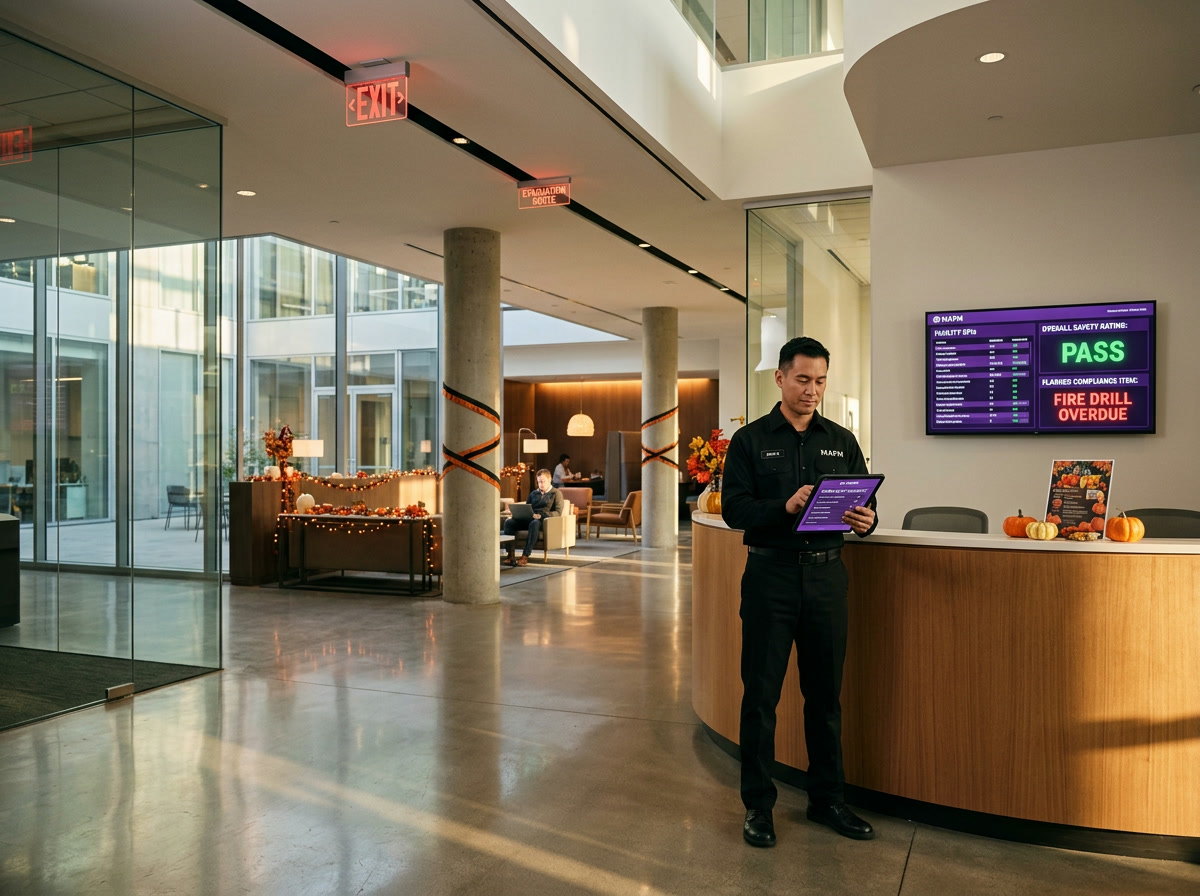
If you've followed along this week, you've seen us dig into the specific mechanics of getting a commercial building ready for Halloween-level foot traffic — fire code compliance for decorations, crowd flow in lobbies and parking structures, staffing models for after-hours events, and the janitorial surge planning that keeps a building presentable through Monday morning. Today, as the actual holiday lands on a Saturday this year (meaning most tenant events will happen Friday afternoon and into the weekend), we're pulling those threads together into a single operational checklist you can hand to your building engineer, security lead, and property manager before they clock out tonight.
Halloween is a useful stress test because it compresses a lot of what makes facility management hard into 48 hours: combustible decorations, people who don't normally occupy the building (kids, visiting family, costumed guests who can't be easily identified by badge photo), elevated noise and alcohol at tenant parties, and a maintenance team that still needs to execute a normal Friday-to-Monday turnover. The buildings that handle it well aren't the ones with the most elaborate decorations — they're the ones where someone walked the property with a checklist 24 hours out and closed every gap before it became an incident report.
This post is designed to be the thing you print, not the thing you read once. We'll walk through the four areas that matter most going into tonight and this weekend, with the understanding that most Silicon Valley campuses are dealing with a mix of multi-tenant office buildings, mixed-use retail podiums, and corporate campuses hosting their own employee events — each with slightly different exposure.
The 24-Hour Walkthrough, Consolidated
Earlier this week we covered decoration fire code compliance in detail — the short version is that any fog machine, open flame (yes, battery LED "candles" count as the safe alternative, real wax does not), or extension cord daisy-chain needs to be gone or corrected before 5 p.m. today. If your property has already done that walkthrough, do a second pass focused specifically on egress: Halloween decorations have a habit of migrating toward exit signage and stairwell doors as tenants add more streamers and cobweb netting throughout the week. A corridor that was compliant Monday can be non-compliant by Friday simply through accumulation, not malicious intent.
The second half of the walkthrough is about sightlines and access control, which we detailed in Tuesday's post on crowd flow. Confirm that any temporary tables, candy stations, or photo backdrops tenants have set up in common areas don't block fire extinguisher cabinets, AED locations, or the path to at least one of your two required means of egress from any assembly space. For buildings with ground-floor retail or a lobby event, this is also the moment to verify your parking structure signage and any temporary barricades are reflective and lit — sunset is around 6:04 p.m. in the Bay Area this time of year, and a surprising number of incident reports from Halloween events trace back to poor visibility in structured parking between 6 and 8 p.m.
Staffing The Gap Between "Normal Building" and "Event Venue"
Wednesday's post went deep on staffing models, but the synthesis point for property managers juggling multiple buildings is this: your standard janitorial and security staffing ratios were built around steady-state occupancy, not a four-hour spike. If your building normally runs one security officer per shift for a 200,000-square-foot office property, that ratio does not hold when a tenant hosts a 150-person costume party with outside guests who aren't in your access control system. We've found the trigger point is roughly 75 non-badged visitors in a building during business hours — above that, you need a second officer stationed at the primary entrance specifically for visitor management, separate from whoever is doing routine patrol.
The same logic applies to janitorial staff, but in reverse timing. Instead of adding bodies during the event, the smarter move — which several of our clients implemented this week — is shifting the janitorial shift later. A crew that normally starts at 6 p.m. for an office building should start at 9 or 10 p.m. tonight, after the bulk of trick-or-treat traffic in mixed-use buildings or after-hours parties in corporate campuses has cleared out, rather than trying to clean around an active event and re-cleaning the same spill twice.
If your property doesn't have the internal headcount to flex up for one night, this is exactly the kind of temporary coverage a facilities management partner should be arranging on your behalf with licensed, insured staff — not a scramble of whoever's available from a general labor pool.
The Monday Morning You'Re Actually Planning for
It's worth saying plainly: Halloween itself is the easy part. The harder problem, and the one that actually shows up in tenant satisfaction scores, is the Monday morning after — when employees arrive to find candy wrappers ground into carpet, pumpkin residue in the loading dock, cobweb spray residue on glass partitions, and decorations that nobody took down. Thursday's post on janitorial surge planning covered the specific equipment and chemical considerations (carpet extraction for sugar residue, glass cleaner that won't streak over spray-on cobweb film, extra waste hauling capacity for pumpkin and candy wrapper volume), so we won't repeat the details here.
What matters for this roadmap is sequencing. Build your weekend janitorial schedule backward from Monday 7 a.m., not forward from Friday night. That typically means: a walkthrough and partial reset Friday night after the event winds down, a deeper clean Saturday or Sunday when the building is empty and crews have room to work without navigating foot traffic, and a final inspection Monday at 6 a.m. — before the first tenant badges in — to catch anything the weekend crew missed. Buildings that only schedule the Friday-night clean consistently end up with Monday complaint tickets about sticky floors and lingering decoration debris, because one pass can't fully address what accumulated over a multi-day event window.
Decoration removal deserves its own line item on that schedule, with a named owner. "Someone will take it down" is how buildings end up with a skeleton still zip-tied to a lobby column on November 15th. Assign it to a specific crew member with a specific time window, and photograph the common areas once decorations are down so you have a record for any tenant who claims property was damaged during removal.
What to Carry Forward Into November and December
The reason we built this week around Halloween specifically is that it's a low-stakes rehearsal for a much bigger season. Within three weeks, many of these same buildings will be managing Thanksgiving week shutdowns and reduced staffing, and within six weeks they'll be hosting holiday parties, managing vendor gift deliveries at loading docks, and dealing with the same high-traffic, non-standard-visitor dynamics at a larger scale and with higher stakes — colder weather, earlier darkness, and often alcohol-related liability exposure that's more significant than a Halloween office party.
Treat this week's checklist as a template, not a one-time document. The 24-hour walkthrough process from Section 1, the staffing trigger-point logic from Section 2, and the backward-scheduled cleaning plan from Section 3 all transfer directly to a December holiday party or a Q4 all-hands event with visiting executives and families. The buildings we work with that handle December smoothly are, almost without exception, the same ones that ran a disciplined process this week. Save tonight's walkthrough notes, the visitor count that triggered your staffing adjustment, and your janitorial sequencing — you'll reuse all three almost unchanged in about five weeks.
One more thing worth flagging before you leave for the weekend: confirm your after-hours emergency contact list is current and posted at both the security desk and with whoever's managing the building remotely. Halloween weekend is also the first cold-weather test for HVAC systems in many buildings as nighttime temperatures drop into the 40s — a heating system issue discovered Saturday morning with no one able to reach a technician until Monday is its own kind of incident report.
Conclusion
Halloween weekend won't make or break your facility's year, but how your team handles it tells you a lot about whether you're ready for the denser, higher-liability events coming in November and December. The properties that come through this weekend clean — literally and in terms of incident reports — are the ones where someone treated it as a real operational event requiring a real plan, not an afterthought layered on top of business as usual.
If this week's series highlighted gaps in your own readiness — whether that's decoration compliance, visitor staffing ratios, or a janitorial schedule that can't flex for event weekends — now is the time to close them, while the lessons are fresh and before the holiday season arrives in earnest.
Cta
MAFM provides on-demand staffing surges, event-specific safety walkthroughs, and flexible janitorial scheduling for Silicon Valley properties managing holiday-season foot traffic — contact us to build your November-December readiness plan before the next event lands on your calendar.
Internal Links
Reference this week's earlier posts on decoration fire code compliance (Monday), lobby and parking structure crowd flow for high-traffic events (Tuesday), flexible staffing models for after-hours tenant events (Wednesday), and janitorial surge planning for holiday weekends (Thursday).
External Links
National Fire Protection Association (NFPA) guidelines on temporary decorations and means of egress in commercial occupancies; OSHA guidance on crowd management and emergency evacuation planning for workplaces hosting events.
Ready to Optimize Your Facilities?
MAFM offers comprehensive facility management solutions tailored to your business needs.
Get in Touch