Decorations, Deadlines, and the Fire Marshal: A Facility Manager's Halloween Playbook
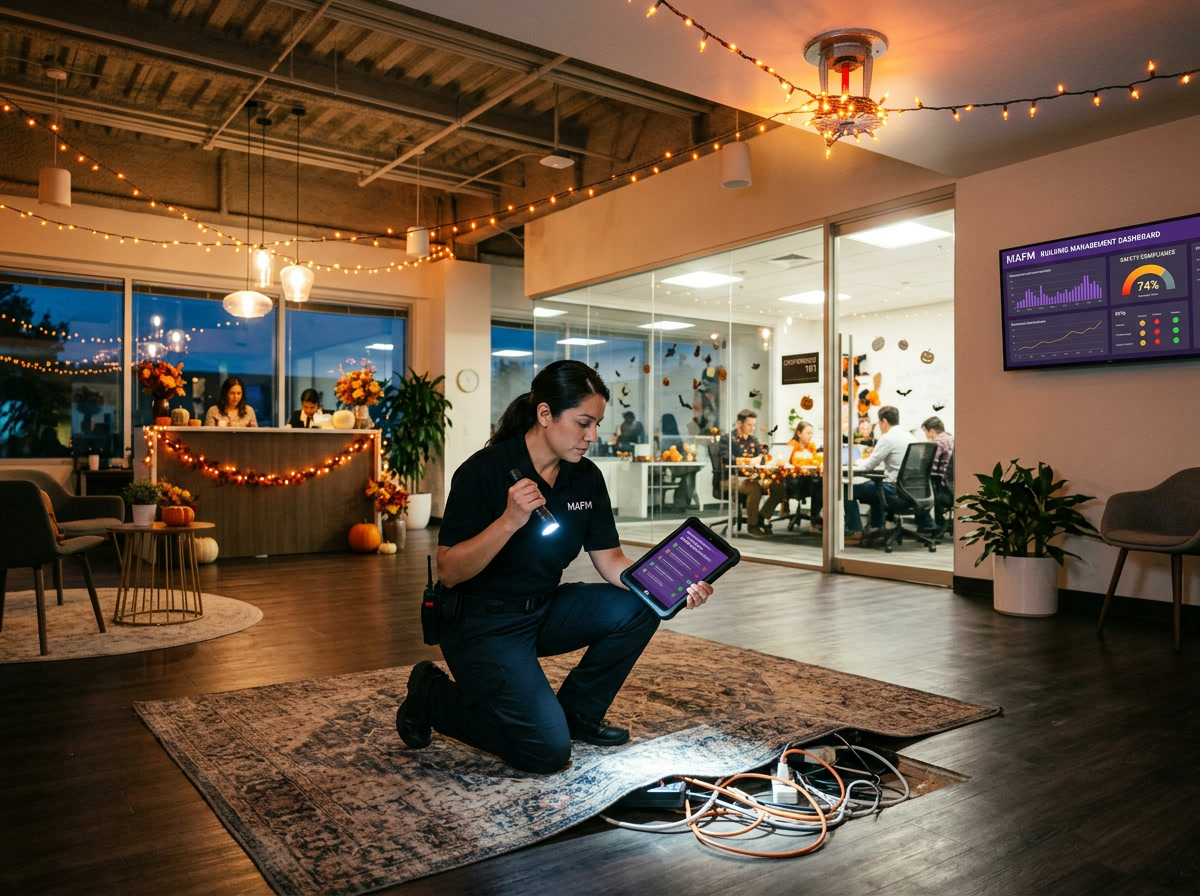
Decorations, Deadlines, and the Fire Marshal: A Facility Manager's Halloween Playbook
Every October, the same scenario plays out across Silicon Valley office parks: a well-meaning tenant admin orders a fog machine, strings of battery-operated lights, and a few bags of "flameless" candles from an online retailer, sets up a haunted conference room, and never thinks to check the lease rider, the fire code, or the building's insurance certificate requirements. By the time facilities gets involved, decorations are already stapled to sprinkler heads and extension cords are daisy-chained under a breakroom rug. Multiply that scenario by a dozen tenant suites in a single building and you have the week facility managers dread most between September and the holiday rush in December.
This is the first post in our five-part series on Halloween and fall event facility management, where we're breaking down the operational, safety, and compliance protocols that separate a smooth tenant celebration from an incident report. Today we're focused on the foundational layer: what actually needs to happen at the building level before a single pumpkin or string light goes up, including fire code specifics, decoration policies, and the walkthrough cadence that catches problems before the fire marshal does.
For Class A and Class B commercial properties in San Jose, Mountain View, Sunnyvale, and across the Peninsula, this isn't about being a buzzkill. It's about running a building where tenant engagement and legal liability aren't in conflict, and where facility teams aren't scrambling on October 30th to undo three weeks of unsupervised tenant creativity.
Why Fall Decorating Season Is a Distinct Risk Window
Halloween decorating sits at an unusual intersection of risk factors that most other tenant events don't combine. You've got open flame substitutes (candles, string lights, sometimes actual candles despite policy) concentrated in spaces with higher-than-normal combustible loading from paper decorations, fabric, dried corn stalks, and hay bales. You've got temporary electrical loads from fog machines, strobe lights, and inflatable decorations plugged into circuits that weren't sized for seasonal add-ons. And you've got all of this happening in buildings where egress paths, already tight in many pre-2015 Silicon Valley office stock, get further narrowed by decorative displays in hallways and lobbies.
California Fire Code Chapter 8, specifically the provisions adopted through NFPA 701 for flame-resistant decorative materials, applies to commercial occupancies regardless of whether the activity is tenant-organized or building-organized. That means a facility manager who allows an untreated hay bale display in a shared lobby is exposed to the same code violation as if the building itself had installed it. Local fire marshals in Santa Clara County have historically increased building walkthroughs in the two weeks surrounding Halloween specifically because call volume for decoration-related incidents (small fires, false alarms from fog machines triggering smoke detectors, egress blockages) spikes measurably compared to the rest of the year.
The fog machine issue deserves its own callout because it's the single most common incident we see. Particulate-based fog and haze machines, even the "safe for offices" consumer models, will trigger photoelectric smoke detectors at close range. A single tenant party fog machine run near a corridor-mounted detector can pull a full building evacuation, a fire department response, and in many jurisdictions a false alarm fine that lands on the property owner, not the tenant who brought the machine in. This is a cost and disruption problem entirely preventable with a decoration policy issued three weeks ahead of the event, not three days.
Building-Wide Decoration Policy, Written and Distributed
The single highest-leverage action a facility management team can take this week is issuing a written, building-specific decoration policy to every tenant, not a generic email reminder but a document with specific prohibited items, specific required materials, and a specific point of contact for exceptions. We recommend this come from building management under the property's letterhead, referencing the lease's rules and regulations exhibit, so tenants understand it's enforceable, not a suggestion.
The policy should explicitly prohibit: open flame of any kind including taper and pillar candles (battery LED candles only), untreated natural materials like hay, straw, or dried cornstalks unless certified flame-retardant with documentation on file, decorations mounted to or obstructing any fire suppression equipment including sprinkler heads, pull stations, and extinguisher cabinets, any decoration that reduces egress corridor width below the code-required clear path (typically 44 inches in commercial corridors), and fog, haze, or smoke-effect machines in any space with ceiling-mounted smoke detection unless pre-cleared with building engineering to verify detector type and placement.
On the permitted side, specify that all fabric, paper, and plastic decorative materials in common areas must carry NFPA 701 flame-resistance certification or a vendor tag confirming treatment, that extension cords must be 14-gauge minimum, UL-listed, and not run under carpets or through doorways, and that any tenant-installed lighting beyond standard power strips requires a facilities walkthrough before the event date. We've found that giving tenants a simple one-page checklist alongside the formal policy dramatically increases compliance, because most office admins organizing a Halloween party aren't trying to violate fire code, they simply don't know fire code exists in this context.
Timing matters here. This policy needs to go out by the first week of October to give tenants time to source compliant materials, not swap them out after a failed pre-event walkthrough. Buildings that wait until the week of Halloween to distribute guidelines end up either forcing last-minute teardowns that frustrate tenants or looking the other way on violations because there's no time to fix them, which is the worse outcome.
The Pre-Event Walkthrough and Sign-Off Process
A written policy without enforcement is a liability document, not a safety program. We recommend every tenant hosting a decorated space or an after-hours party complete a facilities walkthrough 48 to 72 hours before the event, conducted by building engineering or a contracted life-safety inspector, not left to the tenant's own judgment.
The walkthrough checklist should cover egress clearance measured at the narrowest point of every decorated corridor or doorway, visual confirmation that no decoration touches or is within 18 inches of a sprinkler head, verification of flame-retardant tags on fabric and paper materials, an electrical load check on any circuit carrying party equipment (coffee makers, speakers, lighting, and a fog machine on the same strip is a common overload scenario we catch every year), and confirmation that exit signage remains unobstructed and illuminated. For buildings with a monitored fire alarm panel, we also recommend notifying your central station and, where required by local ordinance, the fire department non-emergency line that a tenant event involving fog or haze effects is scheduled, which prevents an automatic dispatch on a confirmed false alarm and avoids the fine.
Document the walkthrough with timestamped photos and a signed checklist from both the facilities representative and the tenant contact. This isn't bureaucratic overkill, it's the record that protects the property owner if an incident occurs despite precautions, and it's also the record that lets you say yes to tenant creativity with confidence instead of blanket prohibition. Buildings that skip documentation tend to drift toward either rubber-stamping everything or banning decorations outright, and neither serves the tenant relationship or the risk profile well.
Staffing this correctly matters too. If your property has six or eight tenants all hosting Friday afternoon parties on October 30th, your engineering team needs a walkthrough schedule built into the week, not an assumption that it'll happen organically between work orders. We typically recommend blocking two to three hours of dedicated facilities staff time per tenant event for inspection, minor remediation requests, and follow-up re-checks.
Coordinating With Property Insurance and Vendor Certificates
The piece most facility teams underestimate is insurance coordination, particularly when tenants bring in outside vendors for Halloween events: catering companies, costume character performers, photo booth operators, or inflatable decoration rental companies. Each of these vendors should be providing a certificate of insurance naming the property owner and management company as additional insured, with general liability coverage at the limits specified in your property's standard vendor requirements, typically $1 million per occurrence and $2 million aggregate for Silicon Valley commercial properties.
This matters more for Halloween events than most tenant activities because the added elements, an open flame-adjacent fog machine, a costumed performer with a prop weapon, a bounce house or inflatable in a parking area, each introduce a distinct liability category your building's base policy may not anticipate. We recommend facility managers request vendor certificates no later than five business days before the event, giving enough lead time to flag a gap and either require a substitute vendor or add a rider before the party happens, not after.
It's also worth a direct conversation with your property's insurance broker in early October, before any individual tenant event is scheduled, to confirm how your current policy treats temporary tenant gatherings and whether there's a notification threshold (number of attendees, use of outdoor space, alcohol service) that triggers a special event rider requirement. Some Silicon Valley landlords have found out the hard way, after a slip-and-fall at a tenant Halloween party, that their general liability policy had a carve-out for events exceeding a certain headcount that nobody had flagged to the tenant planning a 150-person rooftop gathering.
Conclusion
Halloween in a commercial building doesn't have to be a liability event waiting to happen, but it does require facility teams to front-load the work: a written decoration policy distributed early, a documented pre-event walkthrough process, and insurance coordination that catches gaps before they become incidents. The buildings that handle this well aren't the ones with the strictest rules, they're the ones with the clearest process, because tenants will work within guidelines they understand and that get communicated with enough lead time to actually comply.
Later this week, we'll go deeper into specific protocols for tenant party staffing and after-hours access, HVAC and odor control for catered events, and how to handle the cleanup and damage assessment that follows a well-attended Halloween gathering. Each builds on the foundation this post lays out, so if your building hasn't issued a decoration policy yet, this is the week to get it done.
Cta
MAFM's facility teams handle seasonal event walkthroughs, decoration policy drafting, and vendor insurance verification for Silicon Valley commercial properties year-round. Contact us before October 31 to get your building's Halloween protocol in place with time to spare.
Internal Links
Reference the upcoming posts in this week's Halloween and fall events series, including tenant party staffing and after-hours access protocols, HVAC and odor management for catered events, and post-event cleanup and damage assessment procedures.
External Links
California Fire Code Chapter 8 (decorative materials and flame resistance requirements) via the California State Fire Marshal's office; NFPA 701 standard for flame-resistant textiles and films.
Ready to Optimize Your Facilities?
MAFM offers comprehensive facility management solutions tailored to your business needs.
Get in Touch