Commercial Carpet Maintenance: The Program Silicon Valley Properties Use to Triple Carpet Life
Commercial Carpet Maintenance: The Program Silicon Valley Properties Use to Triple Carpet Life
Carpet represents one of the largest capital investments in Silicon Valley commercial buildings, typically $8-$15 per square foot installed for quality commercial carpet tile. A 50,000 square foot office building has $400,000-$750,000 invested in flooring. Yet most properties treat this asset with minimal systematic maintenance: vacuum occasionally, extract when visibly soiled, replace when it looks terrible.
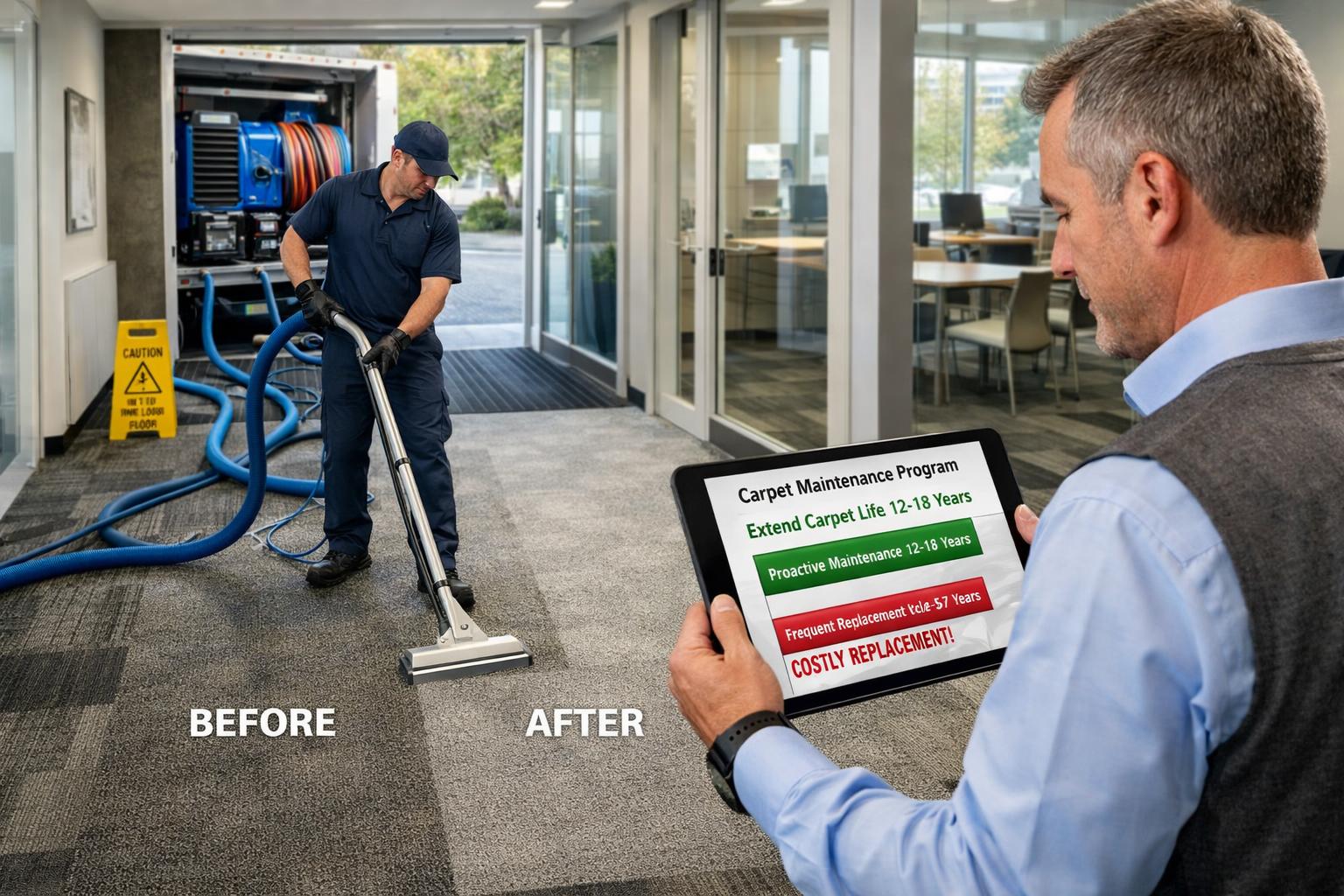
This reactive approach forces premature replacement. Poorly maintained carpet deteriorates in 5-7 years. Professional carpet maintenance programs extend useful life to 12-18 years, more than doubling the return on flooring investment while maintaining appearance, indoor air quality, and tenant satisfaction throughout the carpet's lifecycle.
The difference isn't expensive, comprehensive carpet maintenance adds $0.15-$0.30 per square foot annually but protects an asset worth 30-50x that cost. Here's the framework Silicon Valley properties use to maximize carpet performance and lifespan.
Understanding Carpet Deterioration
The Three Degradation Mechanisms
Carpet doesn't wear out randomly, it fails through predictable mechanisms that proper maintenance prevents or delays.
Mechanism 1: Soil Accumulation and Abrasion
Soil particles tracked onto carpet act as abrasives when walked on, cutting carpet fibers like sandpaper. A single grain of sand walked on 50 times cuts through nylon fibers.
Traffic patterns show visible wear not because people's feet damage carpet but because accumulated soil particles create abrasive cutting action.
Prevention: Aggressive soil removal before abrasion occurs (entrance matting, frequent vacuuming)
Mechanism 2: Oily Soil Attraction
Petroleum-based soils (from parking lots, roadways, mechanical equipment) coat carpet fibers. Once oily film exists, additional dry soil sticks to it. The cycle accelerates: oily soil attracts dry soil which provides more surface area for additional oily soil.
Without removal, this builds into the dark "traffic lanes" visible in poorly maintained carpet.
Prevention: Periodic extraction removing oily soils before buildup occurs
Mechanism 3: Biological and Chemical Degradation
Spills, humidity, and environmental factors cause:
Mold and mildew growth (degrades backing and fibers)
Staining (permanent discoloration)
Odor accumulation (absorbed into backing)
Fiber breakdown from harsh chemicals or sunlight
Prevention: Rapid spot cleaning, humidity control, appropriate cleaning chemistry
Typical Carpet Lifespan by Maintenance Level
No systematic maintenance (vacuum irregularly, extract when very dirty):
High-traffic areas: 3-5 years
Moderate traffic: 5-7 years
Low traffic: 7-10 years
Basic maintenance (vacuum 2-3x weekly, extract annually):
High-traffic areas: 5-7 years
Moderate traffic: 7-10 years
Low traffic: 10-12 years
Professional maintenance program (daily vacuum high-traffic, scheduled extraction, spot treatment):
High-traffic areas: 8-12 years
Moderate traffic: 12-15 years
Low traffic: 15-18 years
A Palo Alto office building tracked carpet replacement costs:
No program (reactive maintenance):
Average carpet life: 6 years
Replacement cost every 6 years: $480,000
Amortized annual: $80,000
Professional maintenance program:
Program cost: $12,000 annually
Average carpet life: 14 years
Replacement cost every 14 years: $520,000 (inflation-adjusted)
Amortized annual: $37,143 + $12,000 program = $49,143
Net annual savings: $30,857 (39% reduction)
Building the Comprehensive Carpet Maintenance Program
Component 1: Entrance Matting System
80-90% of soil enters buildings through entrances. Proper matting removes soil before it reaches primary carpet.
The 15-foot rule:
Minimum 15 feet of matting in entrance path removes 85-90% of tracked-in soil
12 feet removes 70-75%
6 feet removes only 40-50%
Matting types:
Exterior scraper mats: Remove heavy debris and moisture (6 feet minimum)
Interior absorption mats: Capture remaining moisture and fine particles (9 feet minimum)
Combined 15-foot system prevents soil migration to building carpet
Matting maintenance:
Vacuum daily during dry weather
Vacuum 2-3x daily during wet weather
Professional cleaning weekly
Replace when effectiveness declines (typically 2-3 years)
Investment:
Quality commercial matting: $3-$8 per square foot
15-foot entrance (6 feet wide): $270-$720 per entrance
Annual maintenance: $400-$800 per entrance
ROI: Every dollar spent on entrance matting saves $8-$12 in building carpet maintenance
Component 2: Vacuuming Program
Vacuuming removes dry soil before it embeds in carpet pile or causes abrasive damage.
Frequency by traffic level:
Heavy traffic (lobbies, corridors, elevators): Daily minimum, 2x daily optimal
Moderate traffic (open office areas, conference rooms): 3-5x weekly
Light traffic (private offices, storage): 2-3x weekly
Equipment requirements:
Commercial upright with beater bar (agitates pile, removes embedded soil)
HEPA filtration (prevents soil redistribution into air)
Regular bag/filter replacement (vacuum loses 50% effectiveness with full bag)
Annual vacuum maintenance (belts, brushes, motors)
Technique matters:
Slow passes (1 foot per second allows beater bar to work)
Overlapping strokes (ensures complete coverage)
Multiple passes in traffic lanes (1-2 passes insufficient for embedded soil)
Common failures:
Using residential vacuums in commercial applications (inadequate suction and durability)
Infrequent bag changes (reduced effectiveness)
Fast, cursory vacuuming (appearance of cleaning without soil removal)
Skipping under furniture and edges (soil accumulation zones)
Component 3: Interim Maintenance (Bonnet Cleaning)
Between deep extractions, interim cleaning maintains appearance in high-traffic areas.
What bonnet cleaning does:
Absorbent pad (bonnet) attached to rotary machine
Cleaning solution applied to carpet
Bonnet agitates and absorbs surface soil
When to use:
High-traffic areas between extraction cycles
"Refreshing" carpet before events or tours
Spot treatment of traffic lanes
Frequency:
High-traffic areas: Monthly
Moderate traffic: Quarterly
Combine with regular extraction schedule
Limitations:
Surface cleaning only (doesn't remove deep soil)
Not a substitute for extraction
Overuse can cause residue buildup
Costs:
Equipment: $400-$1,200 (rotary floor machine with bonnet attachment)
Bonnets: $15-$30 each (washable and reusable)
Cleaning solution: $20-$40 per gallon
Labor: 600-800 sq ft per hour
Component 4: Hot Water Extraction (Deep Cleaning)
Hot water extraction (often called "steam cleaning") removes embedded soil that vacuuming and bonnet cleaning cannot.
How extraction works:
Hot water mixed with cleaning solution injected into carpet under pressure
Powerful vacuum immediately extracts water, solution, and dissolved soil
Process removes deep soil, oily residues, and allergens
Frequency schedule:
Heavy traffic areas: Every 6 months
Moderate traffic: Annually
Light traffic: Every 18-24 months
Entire building rotation: Extract 1/2 or 1/3 of building every 6 months
Scheduling considerations:
Perform during low-occupancy periods (evenings, weekends)
Allow 6-12 hours dry time before occupancy
Use air movers to accelerate drying
Avoid extraction during humid weather (extended dry times)
Critical specifications:
Truck-mounted systems preferred (more powerful than portable)
Water temperature 160-200°F (optimal cleaning and faster drying)
pH-neutral cleaning solution (harsh alkaline or acidic products damage fibers)
Proper rinse extraction (residue attracts soil)
Costs:
Professional extraction: $0.12-$0.25 per square foot
50,000 sq ft building (full extraction): $6,000-$12,500
Phased approach (1/2 building every 6 months): $3,000-$6,250 per service
Component 5: Spot and Spill Management
Spills left untreated become permanent stains. Rapid response prevents damage.
The 24-hour rule:
Treat spills within 24 hours: 90% probability of complete removal
Treat after 24-48 hours: 60% probability
Treat after 48 hours: 30% probability (likely permanent stain)
Spot cleaning protocol:
Blot liquid immediately (never rub, spreads stain)
Apply appropriate spot cleaner based on stain type
Blot from outside edge toward center (prevents spreading)
Rinse with clean water
Blot dry
Repeat if necessary
Spot cleaning supplies (on-site storage):
General purpose carpet spot cleaner
Protein stain remover (blood, food, bodily fluids)
Oil/grease remover (mechanical oils, cooking oils)
Clean white towels (colored towels may transfer dye)
Spray bottles
Staff training:
Janitorial staff trained in spot cleaning techniques
Supplies accessible for immediate response
Documentation of spill response times and outcomes
A Mountain View building implemented spot cleaning protocol:
Before: Average 18-hour response to reported spills (overnight crew schedule)
After: Average 2-hour response (day porter with spot cleaning kit)
Permanent staining incidents: Reduced 78%
Carpet replacement sections: Reduced from 6 annually to 1
Annual savings: $8,200 in prevented carpet replacement
Carpet Protection Treatments
Fiber Protection Technology
Modern carpet protection (Scotchgard, Teflon, etc.) creates barrier preventing soil bonding to fibers.
Benefits:
Soil resists penetrating fiber (easier vacuuming removal)
Spills bead on surface allowing faster cleanup
Extended time before deep cleaning needed
Application:
Factory-applied during manufacturing (included in quality commercial carpet)
Re-application after extraction (protection degrades with cleaning)
Professional application during extraction service
Costs:
Protection re-application: $0.05-$0.12 per square foot
Frequency: After every extraction (annually for most areas)
ROI: Extends time between extractions 30-40%
Walk-Off Mats at Interior Transitions
Beyond entrance matting, transition mats between hard flooring and carpet prevent soil tracking.
Strategic locations:
Elevator lobbies (transition from tile to carpet)
Break room exits (prevent food spills tracking to carpet)
Restroom exits (moisture control)
High-traffic corridors entering carpeted office areas
Specifications:
3-6 feet of matting at each transition
Low-profile (prevents trip hazard)
Regular vacuuming and cleaning
Carpet Tile vs. Broadloom Maintenance
Carpet Tile Advantages
Carpet tile (modular squares typically 18"x18" or 24"x24") offers maintenance benefits over broadloom (rolled carpet).
Selective replacement:
Damaged or stained tiles replaced individually
High-traffic areas (elevator entries, doorways) replaced without full carpet replacement
Typical commercial office: Replace 2-5% of tiles annually vs. replace entire carpet every 7-10 years
Access to under-floor infrastructure:
Tiles lift for cable access without cutting carpet
No patching required after electrical or data work
Spill containment:
Spills often confined to 1-4 tiles
Replace affected tiles rather than attempting stain removal
A San Jose tech company compared maintenance costs:
Prior building (broadloom carpet):
Full replacement every 7 years: $420,000
Amortized annual: $60,000
Current building (carpet tile):
Annual tile replacement (3% of carpet): $18,900
Extraction and maintenance: $8,200
Total annual: $27,100
Net savings: $32,900 annually (55% reduction)
Common Carpet Maintenance Mistakes
Mistake 1: Over-Wetting During Extraction
Applying too much water or inadequate extraction leaves carpet wet too long.
Problems:
Mold and mildew growth in backing
Delamination (backing separates from carpet)
Extended dry times (24+ hours) creating slip hazards and odors
Prevention:
Professional equipment with strong vacuum systems
Multiple extraction passes
Air movers for drying assistance
Humidity monitoring during drying
Mistake 2: Wrong Cleaning Chemistry
Harsh cleaners or improper pH damages carpet fibers and leaves residue.
Problems:
High-alkaline cleaners (pH >10) damage nylon and wool fibers
Acidic cleaners damage backing adhesives
Residue attracts soil (causes rapid re-soiling)
Prevention:
pH-neutral cleaners (6.5-7.5) for routine maintenance
Proper rinse extraction removing all cleaning residue
Test cleaning solutions on inconspicuous area first
Mistake 3: Irregular Maintenance Schedule
Cleaning "when it looks dirty" waits until damage already occurred.
Why appearance-based cleaning fails:
By time carpet looks dirty, abrasive soil damage already extensive
Traffic lanes showing wear have permanent fiber damage
Scheduled maintenance prevents damage rather than responding to it
Best practice: Calendar-based schedule regardless of appearance
Protect Your Flooring Investment
MAFM provides comprehensive carpet maintenance programs for Silicon Valley commercial properties, including scheduled extraction, daily vacuuming protocols, spot cleaning response, and documentation systems that extend carpet life while maintaining appearance and indoor air quality.
Schedule your consultation: Contact MAFM.PRO
Ready to Optimize Your Facilities?
MAFM offers comprehensive facility management solutions tailored to your business needs.
Get in Touch