Business Continuity Planning as a Facility Management Service: How Silicon Valley Properties Win Tenant Loyalty During Disruptions
Business Continuity Planning as a Facility Management Service: How Silicon Valley Properties Win Tenant Loyalty During Disruptions
Business continuity planning is typically framed as a tenant responsibility, the operations, HR, and IT teams inside each company developing plans for how the organization functions when normal conditions fail. Facility managers, in this traditional framing, maintain the building and let tenants figure out the rest.
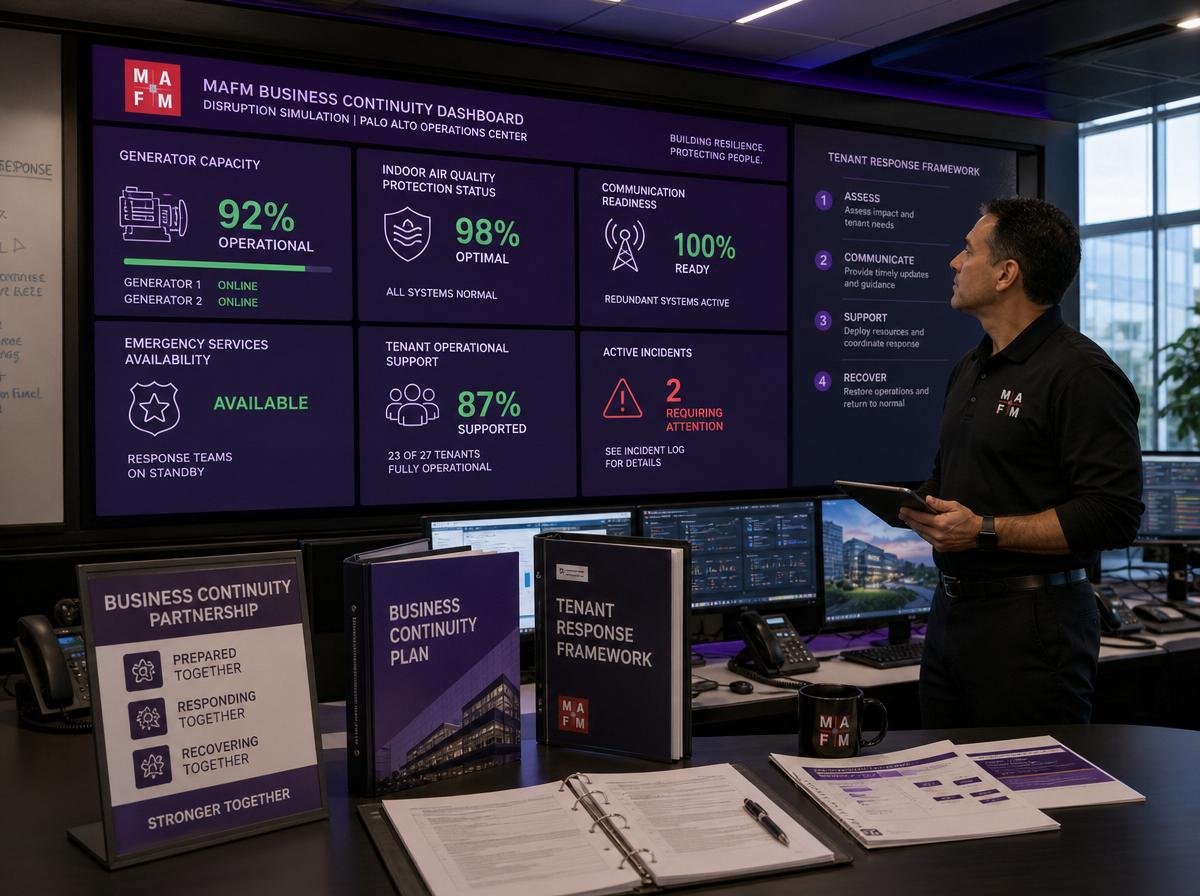
Silicon Valley's most competitive commercial properties have reframed this relationship. They recognize that tenants' ability to maintain operations during building disruptions depends directly on what the building provides, power availability, air quality protection, communication infrastructure, emergency services, and management responsiveness. Buildings that actively support tenant business continuity during disruptions create loyalty that no lease concession or amenity offering can replicate.
The tenant who successfully maintained operations through a 72-hour PSPS event because the building provided generator power, clear communication, and operational support is not shopping for alternatives at renewal time. The tenant who experienced those same 72 hours with no communication from management, no emergency power, and no operational guidance has spent that time researching competing buildings.
Here is how to position your building as an active business continuity partner, a designation that commands both tenant loyalty and market differentiation.
The Building as Business Continuity Infrastructure
Commercial buildings provide the physical infrastructure that tenant operations depend on, which makes building management decisions part of every tenant's business continuity equation whether it is explicitly acknowledged or not.
Power availability during PSPS events is the most immediate business continuity factor. Tech companies in Silicon Valley depend on continuous power for servers, communications, and employee workstations. A building that provides emergency generator power for critical tenant systems, even just 20–30% of normal building load, enables tenant operations that would otherwise be impossible. The facility manager who understands this relationship and communicates generator capacity and load management transparently becomes a business continuity partner; the one who simply reports that the building is on emergency power without specifying what that means for tenant operations is a communication gap at a critical moment.
Connectivity infrastructure has become as fundamental to business operations as power. Understanding your building's internet service redundancy, whether you have single-carrier or multi-carrier connectivity, whether your ISP infrastructure is vulnerable to the same PSPS events that affect the building, and whether tenants can access their cloud infrastructure during disruptions, allows you to communicate accurately and support tenants in making appropriate backup connectivity arrangements.
Physical security during disruptions represents another business continuity dimension. After-hours building access, security monitoring continuity when access control systems shift to battery backup, and the ability to secure tenant spaces when the building is operating on limited systems all affect tenant confidence in their ability to maintain physical security during disruptions.
Air quality protection is an increasingly central business continuity concern for Silicon Valley's knowledge workforce. A building that cannot maintain acceptable indoor air quality during smoke events forces tenants to implement remote work at a moment when the coordination costs are highest and the operational disruption is most acute.
The Business Continuity Communication Framework
The single highest-impact contribution a facility manager makes to tenant business continuity is communication, accurate, timely, specific information that allows tenants to make confident operational decisions during disruptions.
Tiered notification protocols match communication urgency and detail to event severity. Routine maintenance affecting building systems: 48–72 hours advance notice with specific impact details. Planned utility interruptions: one-week advance notice with duration estimate and affected systems. PSPS notification: immediate notification upon PG&E alert, with building status updates every four hours through the event. Emergency events: immediate notification upon discovery, with updates as facts are established.
Status dashboard communication through a building management platform, email list, or even a simple shared status page gives tenants a self-service source of current building information that reduces the volume of individual inquiries that facility managers must handle during events. The dashboard should show current building operational status, any systems affected, expected restoration timing, and the specific actions the building team is taking.
Specific versus vague communication is the most important quality dimension. "The building is experiencing some HVAC issues that we are addressing" tells tenants nothing they can act on. "HVAC Zone 3 on floors 4–6 is currently operating at reduced capacity due to a failed compressor. A technician is on-site and parts are being expedited. We expect restoration by 4 PM today." The second version allows tenants to make decisions, set expectations for their employees, and trust that management is competent.
Tenant Continuity Support Resources
Beyond communication, buildings can provide physical resources and operational support during disruptions that directly enable tenant business continuity.
Temporary workspace within the building provides operational continuity options when specific floors or areas are affected by localized conditions (water damage, HVAC failure, fire suppression activation) while the rest of the building remains functional. Maintaining a relationship with the tenant mix that allows temporary workspace sharing during localized disruptions enables tenants to maintain operations during events that would otherwise require full remote work.
External connectivity backup through a secondary ISP connection, even a cellular backup connection for the building's core networking infrastructure, provides an internet continuity option during events that affect primary fiber service. The incremental cost of a secondary cellular connection for a commercial building is modest relative to the connectivity resilience it provides for tenants whose operations depend on cloud infrastructure access.
Document recovery services contact facilitation (providing tenants with references to professional document scanning, recovery, and reconstruction services) supports tenants who experience localized document damage from water events, fire suppression activation, or similar localized incidents. This facilitation costs the facility manager nothing beyond the pre-season relationship development investment.
Tenant emergency contact network coordination, maintaining a current contact list that allows direct communication between affected tenants during disruptions, enables mutual support between companies sharing a building. A software company on floor 3 that has a surplus of emergency supplies can support the legal firm on floor 2 during an extended disruption when facility management creates the connection.
Pre-Disruption Tenant Engagement
The most productive investment in tenant business continuity support is the pre-disruption engagement that happens during calm conditions, before any event creates urgency.
Annual business continuity briefings with tenant operations or facilities contacts provide an opportunity to share your building's emergency capabilities, review the communication protocols tenants should expect, and understand the specific operational vulnerabilities that individual tenants have identified. These briefings position you as a partner in tenant resilience rather than simply a landlord.
Building system information sharing, providing tenants with documentation of the building's emergency power capabilities, air quality protection systems, water backup procedures, and communication infrastructure, allows tenants to incorporate building capabilities into their own business continuity plans accurately. Tenants who know their building has 72-hour generator fuel capacity plan their continuity options differently than tenants who assume the building has no emergency power.
Exercise participation is the highest level of business continuity partnership a building can offer. Inviting tenant operations and IT teams to observe building emergency exercises (PSPS simulations, smoke event response drills, seismic response tabletops) provides tenants with firsthand understanding of the building's emergency management capability and builds the personal relationships between tenant and building teams that function best during actual events.
Differentiating Your Building in the Market
Business continuity capability has become a leasing factor in the Silicon Valley commercial market, particularly for tenants whose operations have experienced the cost of building disruptions during prior events.
Market your business continuity infrastructure explicitly. Prospective tenants touring your building during fire season awareness are specifically evaluating whether the building provides protection against the disruptions they have experienced elsewhere. Your documented PSPS preparedness, air quality management protocols, emergency power specifications, and communication framework are relevant leasing information, not just operational details.
Reference existing tenant experiences during disruptions when appropriate, with tenant permission, as evidence of your building's real-world business continuity performance. A tech company CFO who can speak to the fact that their team maintained full operations during a prior PSPS event because the building's management team provided emergency power access and real-time communication is more convincing than any marketing document.
Business continuity audit reports, documenting your building's emergency capabilities across every relevant dimension, provide a structured framework for presenting this capability to prospective tenants and their real estate advisors.
Conclusion
Business continuity is where facility management becomes a strategic differentiator rather than a commodity service. The buildings that help their tenants maintain operations when conditions are most challenging earn a loyalty that no normal period performance can replicate, because the test of a building's management quality is not whether it runs well when nothing goes wrong, but how it performs when everything is most difficult.
Build your business continuity communication framework this fire season. Engage your tenants before the next disruption. Document your emergency capabilities explicitly. Position your building as a business continuity partner from the first communication of the year. The tenant retention and leasing differentiation that results will be measurable and lasting.
MAFM partners with Silicon Valley tenants on business continuity through documented emergency protocols, proactive communication, and operational support during every disruption. Contact us to discuss how our management approach protects tenant operations.
Schedule your consultation: Contact MAFM.PRO
Ready to Optimize Your Facilities?
MAFM offers comprehensive facility management solutions tailored to your business needs.
Get in Touch